
Skip to content
The Encyclopedia of Horology

Tool · German inclining dial

Inclining dial by Alexius Schniep

Partially verified

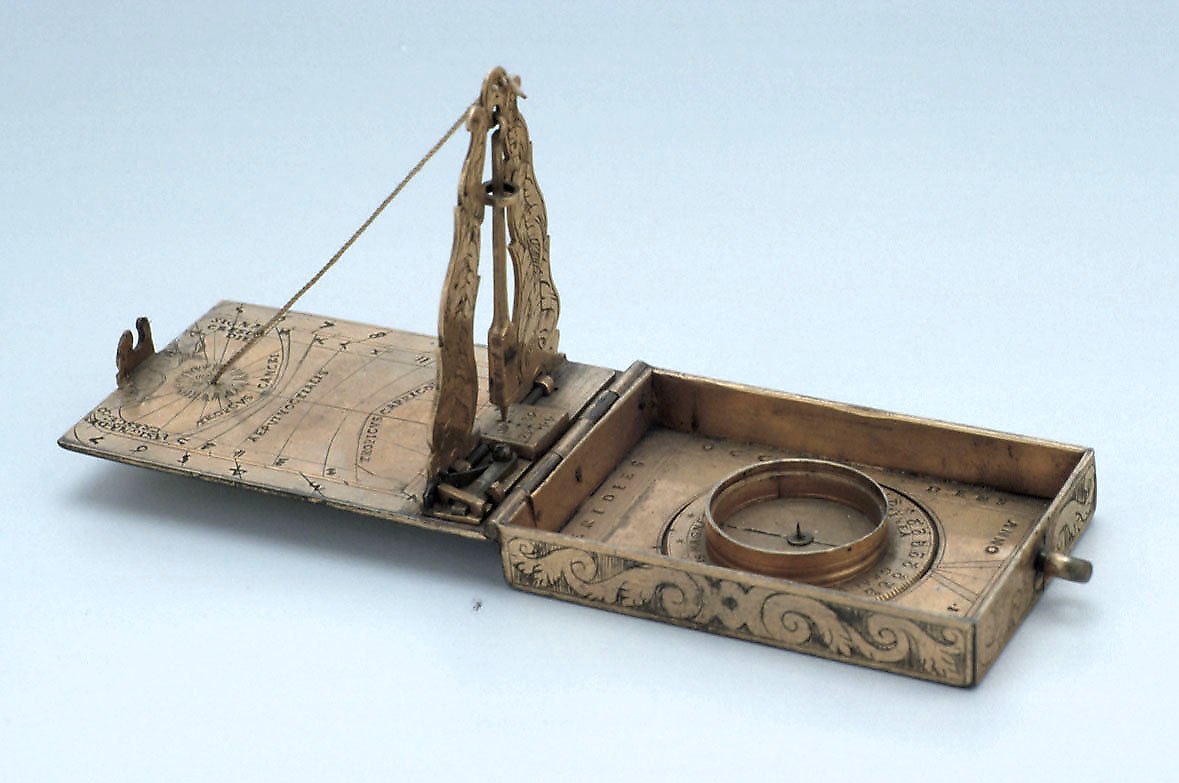
This inclining string gnomon sundial was created in 1578 by Alexius Schniep in Munich. The instrument measures 67 x 44 x 11 mm and is constructed from gilt brass. It consists of a hollow base containing a magnetic compass and a hinged lid that serves as the sundial. The dial features an hour scale, zodiac signs, and a string gnomon supported by a folding structure decorated with fish motifs. The base holds a rotatable compass for determining magnetic variation, complete with a degree scale. The exterior of the instrument includes a latitude table for 32 locations, while the underside is engraved with a figure of a woman, identified as a possible representation of Urania, set within an architectural archway. The maker's signature is positioned beneath the folding gnomon support, remaining visible only when the support is in its folded position.

The sundial shown with the lid opened, revealing the internal string gnomon, compass, and dial markings.
The sundial shown with the lid opened, revealing the internal string gnomon, compass, and dial markings. — Museum of the History of Science, Oxford. Rights pending — permission not yet requested. Original source

Catalogue identity

Source
www.mhs.ox.ac.uk
Category
Tool · German inclining dial
Maker / attribution
Alexius Schniep
Reference
Not recorded
Catalogue / lot identifier
52396
Source-reported date
1578
Source-reported place
Munich

Source-reported attribution and specifications are not independent authentication. A listing does not establish present ownership, current display, availability or permission to reproduce.

Object description

Construction and Design

The instrument is a compact, gilt brass device measuring 67 x 44 x 11 mm. It features a hinged lid-and-box arrangement, with a suspension ring that also serves as a locking mechanism. The interior of the lid is designed as an inclining string-gnomon dial.

The dial includes a folding gnomon support held by a sprung catch; the structure is decorated with engravings of fish. The string itself emerges from an engraved sun, featuring a knot used to indicate the sun's declination against labeled zodiac lines on the dial plate.

Evidence for this section
  • “The instrument consists of a hinged lid and a hollow box with a suspension ring which also serves as a lock for retaining the lid.”
  • “There is a folding gnomon support which is held perpendicular to the dial plate by a sprung catch and whose two parts are decorated as fish.”

Functional Components

The base of the device contains a central compass, measuring 23 mm in diameter, which can be rotated to account for magnetic variation. This sits upon a circular disc etched with a degree scale from 0 to 90.

The exterior face of the lid is inscribed with a latitude table titled 'TAB: LATITVDINIS REGIONVM', providing latitudinal coordinates for 32 geographic locations. The instrument also includes a plummet for setting the dial according to specific latitudes.

Evidence for this section
  • “In the centre is the compass, whose bowl is 23 mm in diameter and marked for variation.”
  • “The outer face of the lid carries a table titled 'TAB: LATITVDINIS REGIONVM' giving the latitudes of 32 places in roughly alphabetical order.”

Signature and Decoration

The maker's signature, 'HOC OPVS FECIT ALEXIVS SCHNIEP DE MONACO', is inscribed beneath the base of the gnomon support, hidden during active use. The date '1578' is engraved at the northern end of the main base.

The underside of the instrument features an engraved architectural scene containing a female figure.

Evidence for this section
  • “Under the base of the gnomon support, and visible only when the support is folded, is the signature 'HOC OPVS FECIT ALEXIVS SCHNIEP DE MONACO'.”
  • “The underside of the instrument carries an engraved image of a female figure in an archway.”

Open research questions

  • What is the specific geographic origin of the 32 locations listed in the latitude table?
  • How does the accuracy of the magnetic variation scale on this 16th-century instrument compare to modern measurements for that period?

Source evidence

Recorded claims and source quotations for Inclining dial by Alexius Schniep
FieldSource-reported valueSource quotation
MakerAlexius Schniep“Signed by Alexius Schniep”
Date1578“Dated 1578”
Place of manufactureMunich“Munich”
MaterialsGilt brass“Gilt brass”
Dimensions67 x 44 x 11 mm“67 x 44 x 11 mm”
Inventory number52396“Inventory number: 52396”
Signature locationBeneath the gnomon support“Under the base of the gnomon support, and visible only when the support is folded, is the signature 'HOC OPVS FECIT ALEXIVS SCHNIEP DE MONACO'”

Visible details

  • Hinged gilt brass box construction
  • Folding gnomon support featuring fish motifs
  • Integral compass with degree scale for magnetic variation
  • Engraved female figure on the base underside

Research qualifications

  • The female figure on the base is presumed to be the goddess Urania.
  • The signature is only visible when the gnomon support is folded.

Photograph identity and source facts were screened before import; rights clearance remains pending.

Consulted source

Inclining Dial

Reviewed 2026-10-26 · Record 9090a8833f

Terms in this record

Glossary explanations for terms named in this object’s record.