
Skip to content
The Encyclopedia of Horology

Tool · German inclining dial

Inclining Dial by Ulrich Schniep

Partially verified

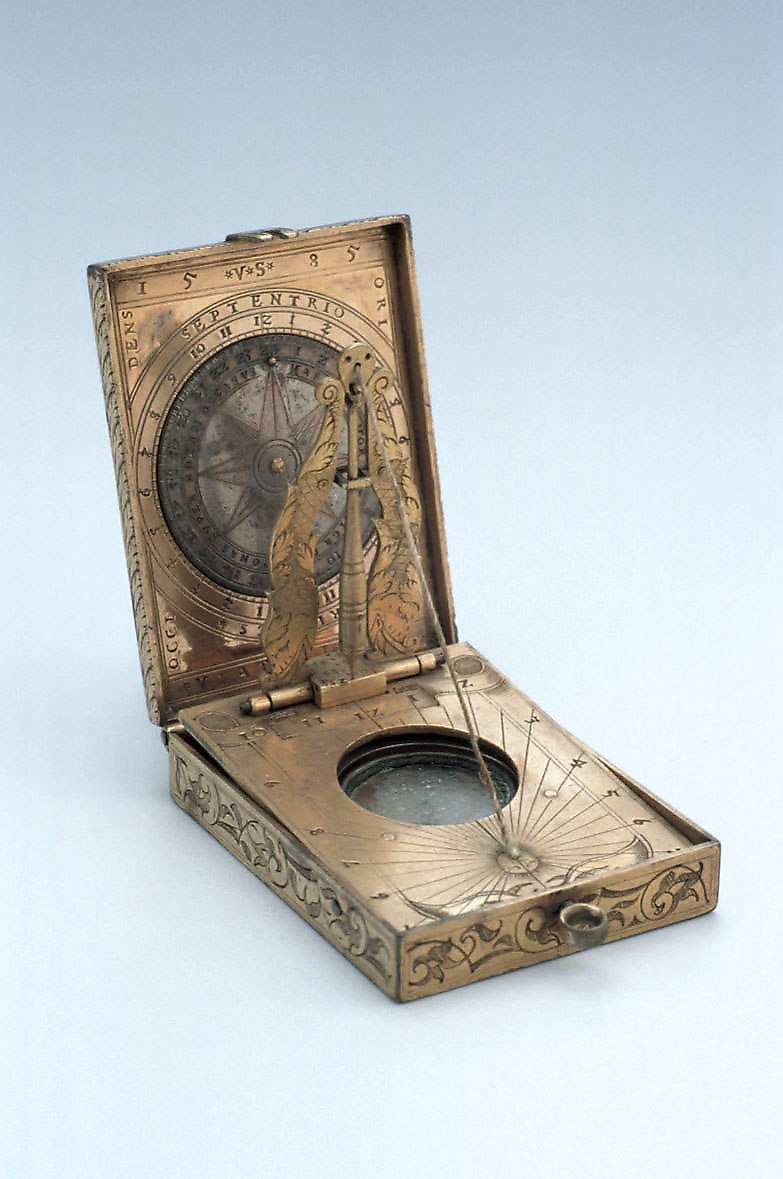
This 1585 inclining dial is made of gilt and silvered brass, measuring 66 x 48 x 15 mm. Signed by the Munich-based maker Ulrich Schniep, it is categorized as a viatorium. The instrument features a hinged lid and a base with a suspension ring that also functions as a lid lock. The interior of the cover contains a volvelle for converting equal to Italian hours. The main box holds an inclining string-gnomon sundial, which is adjustable for latitudes between 42 and 52 degrees using an integrated plummet and scale. The device incorporates a 21 mm diameter compass with a cross of direction and a scale for magnetic variation. The exterior is decorated with oak leaf and foliage engravings. The base features an engraving of Judith with the head of Holophernes. The lid's exterior bears a latitude table for 38 locations.

The inclining dial showing the string gnomon, fish-shaped support, compass, and internal volvelle.
The inclining dial showing the string gnomon, fish-shaped support, compass, and internal volvelle. — Museum of the History of Science, Oxford. Rights pending — permission not yet requested. Original source

Catalogue identity

Source
www.mhs.ox.ac.uk
Category
Tool · German inclining dial
Maker / attribution
Ulrich Schniep
Reference
Not recorded
Catalogue / lot identifier
40748
Source-reported date
1585
Source-reported place
Germany

Source-reported attribution and specifications are not independent authentication. A listing does not establish present ownership, current display, availability or permission to reproduce.

Object description

Construction and Dialing

The inclining dial is constructed from gilt and silvered brass and functions as a portable timekeeping instrument. The main box contains an inclining string-gnomon dial where the gnomon is supported by a folding structure shaped like two fish. The dial plate, which is adjustable for latitudes between 42 and 52 degrees, is fitted with an integral plummet to assist in setting the correct inclination.

An inset compass, measuring 21 mm in diameter, is located within the base. It features a silvered bowl and a scale of degrees specifically marked for magnetic variation. The dial plate itself contains a scale of equal hours, and the assembly pivots near the southern end to allow access to the compass beneath.

Evidence for this section
  • “The main box carries an inclining string-gnomon dial.”
  • “The inset compass is 21 mm in diameter and its silvered bowl has a cross of direction.”
  • “The integral plummet is positioned above a latitude scale from 42 to 52?”

Integrated Functions and Lid Decoration

The hinged lid of the instrument serves as an additional informational surface. Its outer face is engraved with a 'Tabula latitudinis Regionum', providing latitude information for 38 different locations. The inner face of the lid incorporates a volvelle used for converting between equal hours and Italian hours based on the time of sunset.

Decorative elements are present throughout the object, including oak leaf engraving on the lid sides and foliage engraving on the box sides. The base of the dial features a depiction of the biblical figure Judith holding the head of Holophernes, a design choice also observed on other instruments by the maker.

Evidence for this section
  • “The outer face of the lid carries a 'Tabula latitudinis Regionum' giving the latitudes of 38 places”
  • “The inside face of the cover has a volvelle for converting equal and Italian hours”
  • “The base is titled 'IVDITHA' and carries a portrait of a sword-bearing Judith with the head of Holophernes.”

Signatures and Provenance

The instrument is signed by Ulrich Schniep, with the mark '15 [star]V[star]S[star] 85' appearing at the northern end of the disc. The term 'VIATORIVM' is also inscribed, identifying the instrument by its historical nomenclature for this type of portable sundial.

The object is part of the Museum of the History of Science collection in Oxford, having previously been documented within the Lewis Evans Collection as item G. 386.

Evidence for this section
  • “Signed by Ulrich Schniep”
  • “At the northern end of the plate is the signature '15 [star]V[star]S[star] 85' and at the southern end the title 'VIATORIVM'”
  • “Provenance: Lewis Evans Collection G. 386.”

Open research questions

  • What specific geographic regions were included in the 'Tabula latitudinis Regionum' on the lid?
  • How did the variation scale 'GRADVS DECLINACIO MAGNETIS' correlate to 16th-century magnetic compass readings?

Source evidence

Recorded claims and source quotations for Inclining Dial by Ulrich Schniep
FieldSource-reported valueSource quotation
MakerUlrich Schniep“Signed by Ulrich Schniep”
Date1585“Dated 1585”
LocationMunich“Munich”
Dimensions66 x 48 x 15 mm“66 x 48 x 15 mm”
MaterialsGilt and silvered brass“Gilt and silvered brass”
Inventory Number40748“Inventory number: 40748”
Latitude Range42 to 52 degrees“latitude scale from 42 to 52?”

Visible details

  • The gnomon support is comprised of two parts decorated as fish.
  • The dial plate features an engraved sun with the string gnomon emerging from its mouth.
  • The base includes an engraving of Judith wielding a sword with the head of Holophernes.
  • The compass bowl is silvered and includes a cross of direction.

Research qualifications

  • The source attributes the instrument to the Munich-based maker Ulrich Schniep, though no further documentary evidence for this attribution is provided beyond the signature.
  • The exact nature of the magnetic variation scale's use beyond the marked degrees remains subject to historical interpretation.

Photograph identity and source facts were screened before import; rights clearance remains pending.

Consulted source

Inclining Dial

Reviewed 2026-10-26 · Record fc62c0b047

Terms in this record

Glossary explanations for terms named in this object’s record.