
Skip to content
The Encyclopedia of Horology

Tool · Italian horizontal dial

Horizontal Pin Gnomon Dial by Carlo Plato

Partially verified

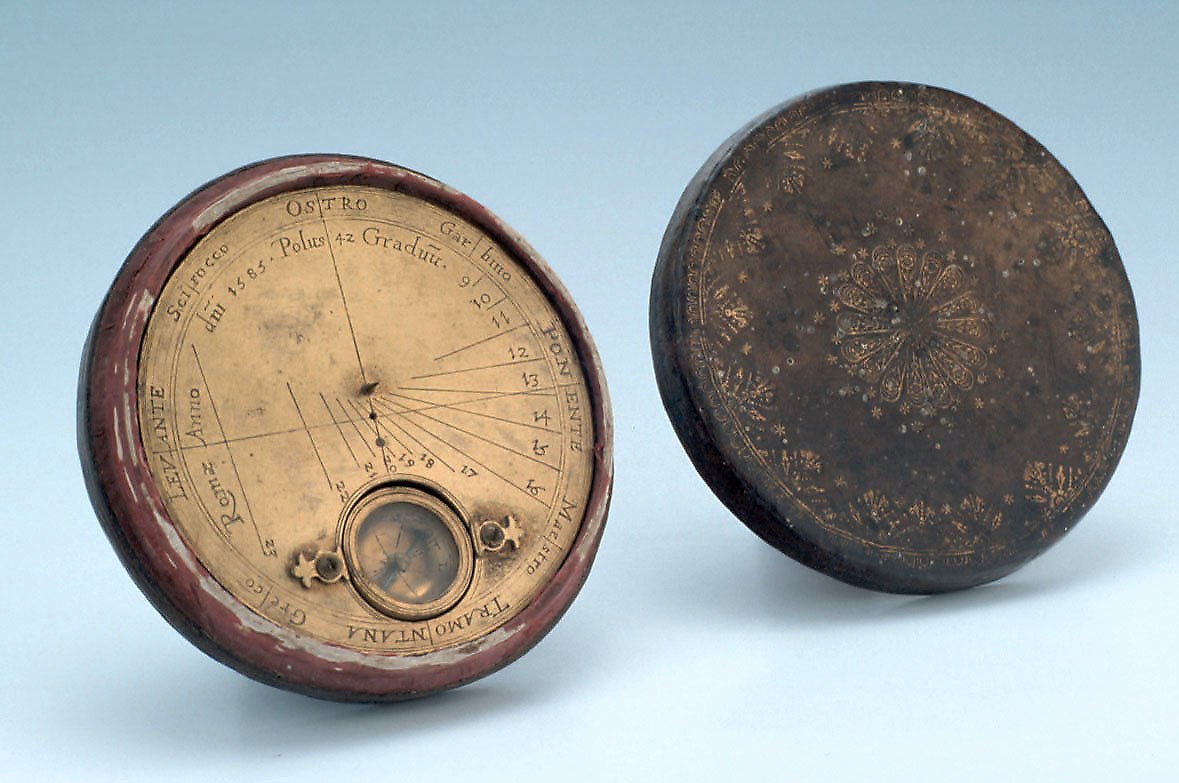
This circular horizontal pin gnomon dial is crafted from brass and measures 89 mm in diameter. It is housed within a pasteboard case, finished with gold-tooled leather and lined with silk. The dial features a central, pivoted compass designed for use on both sides of the disc. One side is engraved with wind names in Latin and cardinal points, while the opposite side displays wind names in Italian. Both faces of the instrument feature pin gnomon dials calibrated for Italian hours, marked from 9 to 23. The instrument bears inscriptions specifying the latitude and its origin in Rome in 1585. While unsigned, the dial is attributed to the Roman maker Carlo Plato, based on stylistic comparison with existing instruments, such as Epact inventory number 75343, which share identical construction characteristics and engraving styles.

A brass horizontal pin gnomon dial with its leather-covered pasteboard case, featuring compass and inscriptions in Latin and Italian.
A brass horizontal pin gnomon dial with its leather-covered pasteboard case, featuring compass and inscriptions in Latin and Italian. — Museum of the History of Science, Oxford. Rights pending — permission not yet requested. Original source

Catalogue identity

Source
www.mhs.ox.ac.uk
Category
Tool · Italian horizontal dial
Maker / attribution
Carlo Plato
Reference
Not recorded
Catalogue / lot identifier
49535
Source-reported date
1585
Source-reported place
Rome

Source-reported attribution and specifications are not independent authentication. A listing does not establish present ownership, current display, availability or permission to reproduce.

Object description

Construction and Design

The dial is a circular, brass instrument measuring 89 mm in diameter, contained within a protective pasteboard case. The exterior of the case is decorated with gold-tooled leather, and the interior is lined with silk to ensure the preservation of the instrument. The core of the design is a central, pivoted compass, which allows for consistent orientation when using either side of the disc for timekeeping.

The device operates as a pin gnomon dial, with markings specifically calibrated to indicate Italian hours. The hours on both sides are marked from 9 to 23. The versatility of the design is further emphasized by the inclusion of wind directions and cardinal points in both Latin and Italian, accommodating different linguistic and navigational contexts within the Italian region.

Evidence for this section
  • “This circular horizontal pin gnomon dial is contained in a pasteboard case, covered with gold-tooled leather and lined with silk.”
  • “The compass is pivoted so that it can be used for both sides of the dial”
  • “In the centre is a pin gnomon dial for Italian hours marked from 9 to 23”

Inscriptions and Markings

The instrument is heavily inscribed, providing both technical data and geographical context. One side of the disc includes the Latin cardinal points and wind names, such as 'MERIDIES' and 'SOLANVS', alongside the inscription 'Latitudo 45 Graduu' and the date '1585'. This side is explicitly associated with Rome.

The reverse side of the disc features wind names in Italian, including 'TRAMONTANA', 'LEVANTE', and 'PONENTE'. It also records the inscription 'Romae Anno d{omi}ni 1585 Polus 42 Graduu'. These inscriptions reflect the precise astronomical and cartographic concerns of the period, tying the instrument's function to specific latitudes and the Roman locale.

Evidence for this section
  • “The names of the main winds are engraved on one side in Latin and on the other in Italian.”
  • “the inscriptions 'Latitudo 45 Graduu' and 'Romae anno d{omi}ni 1585'”
  • “On the other side of the disc are the Italian names of the winds: 'TRAMONTANA', 'Greco', 'LEVANTE', 'Scirocco', 'OSTRO', 'Garbino', 'PONENTE', and 'Maestro'.”

Attribution and History

Although the dial does not bear a maker's signature, it has been attributed to the Roman instrument maker Carlo Plato. This attribution is derived from direct comparative study with other pieces, most notably Epact 75343, which is also held in the Museum of the History of Science in Oxford. The stylistic, structural, and decorative parallels between these instruments support the assertion of a common origin.

The history of the piece is anchored within the Epact collection, which catalogued and documented scientific instruments across Europe.

Evidence for this section
  • “The dial is not signed, but it is very similar to other dials (for example Epact 75343 in the Museum of the History of Science in Oxford) by the same maker, Carlo Plato of Rome”
  • “The dial has been attributed to Carlo Plato (Carolus Platus or Platel) of Rome, on the basis of comparison with instruments such as Epact 75343 to which it is very similar.”

Open research questions

  • What specific evidence exists within the engraving style of Epact 75343 to confirm the attribution to Carlo Plato?
  • How do the specific latitude inscriptions of 45 degrees and 42 degrees align with the geographical knowledge of 16th-century Rome?

Source evidence

Recorded claims and source quotations for Horizontal Pin Gnomon Dial by Carlo Plato
FieldSource-reported valueSource quotation
MaterialBrass“Brass; 89 mm in diameter”
Diameter89 mm“89 mm in diameter”
Date1585“Dated 1585; Rome”
Place of originRome“Romae anno d{omi}ni 1585”
CasePasteboard covered in gold-tooled leather“contained in a pasteboard case, covered with gold-tooled leather and lined with silk”
Maker attributionCarlo Plato“The dial has been attributed to Carlo Plato (Carolus Platus or Platel) of Rome”
CompassPivoted 8-direction compass“The compass is pivoted so that it can be used for both sides of the dial”
Inventory number49535“Inventory number: 49535”

Visible details

  • The dial includes a pivoted compass with eight directional markings.
  • The case exterior features intricate gold-tooled patterns with floral and star motifs.
  • Both sides of the brass disc are engraved with wind names in distinct languages.
  • The central pin gnomon is visible on the dial face currently depicted.

Research qualifications

  • The dial is not physically signed by the maker.
  • Attribution to Carlo Plato is based on comparative analysis with other instruments.

Photograph identity and source facts were screened before import; rights clearance remains pending.

Consulted source

Horizontal Dial

Reviewed 2026-10-26 · Record f800c99697

Terms in this record

Glossary explanations for terms named in this object’s record.