
Skip to content
The Encyclopedia of Horology

Tool · Italian horizontal dial

Horizontal Sundial

Partially verified

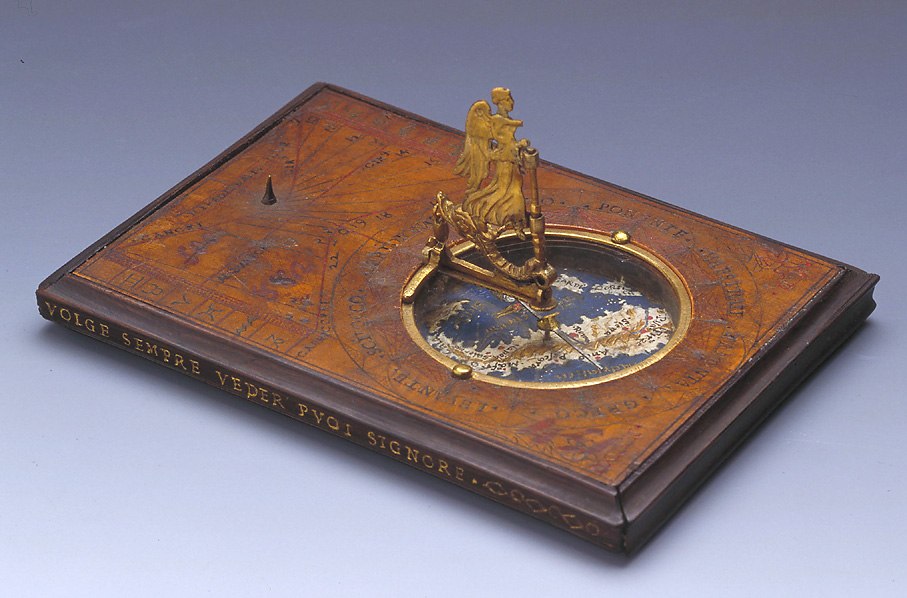
This 177 x 84 mm rectangular horizontal sundial is crafted from boxwood and housed in an ebony frame. Attributed to the workshop of Camillo della Volpaia, the instrument is dated 1542 and originates from Florence. The dial features a pin-gnomon for Italian hours, marked with tropic lines and zodiac scales. A compass is inset into the base, displaying a hand-painted map of Italy including Sicily, Sardinia, and Corsica, complete with a straight compass needle featuring a T-shaped end. Decorative elements include a folding mount shaped like a monstrous fish supporting a plumb bob and an angel-shaped wind vane. The reverse contains a solar course diagram and astrological signs. The ebony frame is decorated with a gilded Italian motto, and further inscriptions appear on the dial plate. The object is held by the Istituto e Museo di Storia della Scienza in Florence.

Horizontal sundial in boxwood, attributed to Camillo della Volpaia, 1542.
Horizontal sundial in boxwood, attributed to Camillo della Volpaia, 1542. — Istituto e Museo di Storia della Scienza, Firenze. Rights pending — permission not yet requested. Original source

Catalogue identity

Source
www.mhs.ox.ac.uk
Category
Tool · Italian horizontal dial
Maker / attribution
Attributed to Camillo della Volpaia
Reference
Not recorded
Catalogue / lot identifier
2503
Source-reported date
1542
Source-reported place
Italy

Source-reported attribution and specifications are not independent authentication. A listing does not establish present ownership, current display, availability or permission to reproduce.

Object description

Dial Construction and Layout

The instrument is built upon a rectangular boxwood base, measuring 177 by 84 mm, which houses a horizontal pin-gnomon sundial. The dial is configured for Italian hours, ranging from 9 to 24, and includes markings for the equinoctial, the meridian line, and the tropics of Cancer and Capricorn. The sides of the dial are framed by the two halves of a zodiac scale.

The southern half of the instrument features an inset compass. The base of this compass is decorated with a painted map of the Italian mainland, Sicily, Sardinia, and Corsica, noting the central mountain range and several specific cities. Above the compass bowl, a folding mount in the form of a monstrous fish provides a support for an angel-shaped wind vane.

Evidence for this section
  • “Rectangular base carrying in its southern half an horizontal pin-gnomon dial for Italian hours”
  • “Straight compass needle with T end set above a map of Central and southern Italy painted on the base”

Inscriptions and Reverse Features

The reverse side of the wooden plate contains a circular solar course diagram. Positioned above this is a rampant Capricorn figure within a circle that incorporates astrological signs for the days of the week. This display is encircled by an elliptical scroll bearing the Latin inscription, 'DAT PLANETA DIEM. HORAM. DAT GRESSVS IN ORBE'.

The ebony frame enclosing the dial plate is inscribed in gold on three sides with an Italian motto: 'LOCO TEMPO STAGION FVGGER DEL HORE SOFFIAR DE VENTI QUE LA CALAMITA SI VOLGE SEMPRE VEDER PVOI SIGNORE'. Additionally, the compass rim is marked with an eight-point wind-rose featuring directional labels such as 'Meridional' and 'Tramontana'.

Evidence for this section
  • “On the reverse of the plate is a circular table containing a solar course diagram.”
  • “The edges of the plate are enclosed in an ebony frame marked in gold on three sides with the inscription 'LOCO TEMPO STAGION FVGGER DEL HORE SOFFIAR DE VENTI QUE LA CALAMITA SI VOLGE SEMPRE VEDER PVOI SIGNORE'.”

Attribution and Condition

While the sundial is not signed, it is attributed to the workshop of Camillo della Volpaia. Comparisons are drawn between this instrument and other signed examples by Camillo della Volpaia from 1542, particularly regarding the layout and the use of the inscription-carrying scroll. However, the exact letter forms do not permit a definitive attribution to any specific member of the della Volpaia family.

The object retains traces of rubrication on its incised dial lines, decorative flowers, and date. The museum records that the instrument is held within the collection of the Istituto e Museo di Storia della Scienza in Florence.

Evidence for this section
  • “The instrument is not signed, but its characteristic features are comparable to a sundial signed by Camillo della Volpaia”
  • “the dial lines, flowers and the date retaining traces of rubrication.”

Open research questions

  • Are there specific archival documents in the Istituto e Museo di Storia della Scienza that link this inventory number to a specific collection accession?
  • Does the painting technique used for the map of Italy align with known surface decoration methods employed in the della Volpaia workshop?

Source evidence

Recorded claims and source quotations for Horizontal Sundial
FieldSource-reported valueSource quotation
Dimensions177 x 84 mm“177 x 84 mm”
Date1542“Dated 1542”
OriginFlorence“Florence”
Inventory Number2503“Inventory number: 2503”
Compass DecorationHand-painted map of Italy“compass is complete and has a picture of Italy painted on its base”

Visible details

  • Painted map of Italy within the compass bowl
  • Angel-shaped wind vane and fish-shaped folding mount
  • Ebony frame with gold-lettered inscription
  • Rubricated markings on the dial plate

Research qualifications

  • Attribution to Camillo della Volpaia is based on stylistic comparison rather than a signature
  • Exact authorship remains uncertain due to insufficient letter-form evidence
  • The heraldry on the ship may be the Medici arms but is not confirmed

Photograph identity and source facts were screened before import; rights clearance remains pending.

Consulted source

Horizontal Dial

Reviewed 2026-10-26 · Record f95c33db78

Terms in this record

Glossary explanations for terms named in this object’s record.