
Skip to content
The Encyclopedia of Horology

Tool · Italian horizontal dial

Horizontal Dial by Camillo della Volpaia

Partially verified

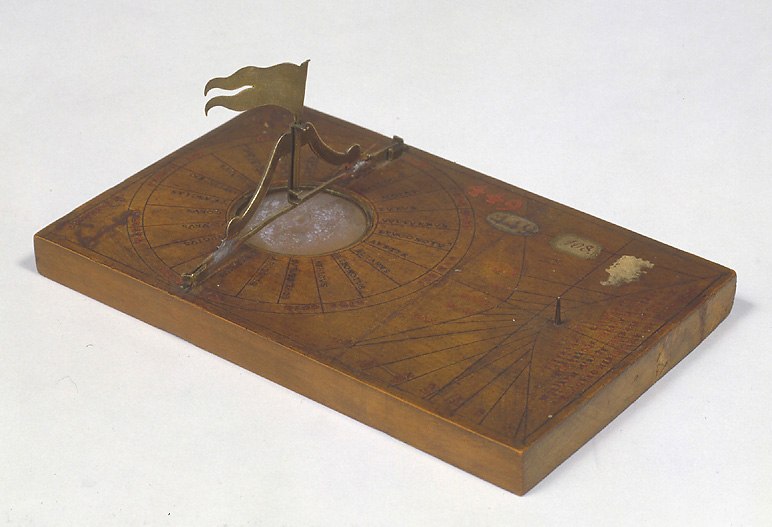
This horizontal dial, crafted from boxwood and measuring 152 x 94 mm, is a scientific instrument produced in 1542. It is signed by Camillo della Volpaia, who continued the instrument-making activities of his father, Lorenzo della Volpaia. The instrument is designed for the latitude of Florence, approximately 43° 44'. Its layout features a rectangular wooden table incorporating a compass, which is central to the design. A collapsible brass support for a banner-shaped wind vane is positioned above the compass. The instrument also includes a pin-gnomon dial calibrated specifically for Italian hours, marked from IX to XXIII. The compass is surrounded by a complex system of twenty-four wind direction names and an outer ring identifying eight cardinal and intercardinal compass directions in Italian. This object is currently held within the collection of the Istituto e Museo di Storia della Scienza in Florence.

Horizontal sundial signed by Camillo della Volpaia, 1542, featuring a collapsible brass wind vane and compass.
Horizontal sundial signed by Camillo della Volpaia, 1542, featuring a collapsible brass wind vane and compass. — Istituto e Museo di Storia della Scienza, Firenze. Rights pending — permission not yet requested. Original source

Catalogue identity

Source
www.mhs.ox.ac.uk
Category
Tool · Italian horizontal dial
Maker / attribution
Camillo della Volpaia
Reference
Not recorded
Catalogue / lot identifier
2488
Source-reported date
1542
Source-reported place
Italy

Source-reported attribution and specifications are not independent authentication. A listing does not establish present ownership, current display, availability or permission to reproduce.

Object description

Construction and Design

The instrument is composed of a rectangular boxwood base measuring 152 by 94 mm. It functions primarily as a horizontal sundial calibrated for the latitude of 43° 44', which relates to the city of Florence. The upper surface of the boxwood block serves as the table for the various astronomical and navigational markings.

Central to the device is an inset compass. Above this compass, a folding brass structure supports a small banner-shaped wind vane.

Evidence for this section
  • “This sundial , traced on a rectangular wooden table, is calibrated for a latitude of 43? 44', corresponding to the city of Florence .”
  • “Within the plane of the instrument is a compass , above which is a folding brass wind vane .”

Dials and Inscriptions

The surface of the dial features a pin-gnomon arrangement located on the south edge of the board. This specific dial is marked for Italian hours, with the indices running from IX to XXIII. These hours are left undivided on the wooden surface.

Surrounding the central compass are two concentric rings of information. The inner ring displays a list of twenty-four winds recorded in Latin, while the outer ring lists eight compass directions in Italian, such as 'Tramontana', 'Levante', and 'Scirocco'. This navigational detail accompanies the solar timekeeping function provided by the pin-gnomon dial.

Evidence for this section
  • “Beneath the signature on the south edge of the instrument is a pin-gnomon dial for the stated latitude for Italian hours (IX to XXIII undivided).”

Maker and Attribution

The instrument is signed by Camillo della Volpaia. The provenance and historical context identify him as one of the sons of Lorenzo della Volpaia.

The inventory number for this specific object is 2488, and it is currently held at the Istituto e Museo di Storia della Scienza in Florence. The signature is placed near the south edge of the instrument, proximal to the pin-gnomon dial.

Evidence for this section
  • “The instrument bears the signature of Camillo della Volpaia , one of the sons of Lorenzo della Volpaia”
  • “Istituto e Museo di Storia della Scienza, Firenze Inventory no. 2488”

Open research questions

  • How does the current condition of the pin-gnomon affect the accuracy of the Italian hours?
  • What specific uses were intended for the inclusion of twenty-four wind directions on a dial of this size?

Source evidence

Recorded claims and source quotations for Horizontal Dial by Camillo della Volpaia
FieldSource-reported valueSource quotation
MakerCamillo della Volpaia“Signed by Camillo della Volpaia”
Date1542“Dated 1542; Florence”
MaterialBoxwood“Boxwood; 152 x 94 mm”
Dimensions152 x 94 mm“152 x 94 mm”
Latitude43° 44'“calibrated for a latitude of 43? 44', corresponding to the city of Florence”
Inventory2488“Inventory no. 2488”

Visible details

  • Collapsible banner-style brass wind vane
  • Twenty-four Latin wind directions surrounding compass
  • Eight Italian compass point names in an outer ring
  • Pin-gnomon dial for Italian hours

Research qualifications

  • Specific functionality of the pin-gnomon in present condition
  • The exact provenance beyond the listed inventory location

Photograph identity and source facts were screened before import; rights clearance remains pending.

Consulted source

Horizontal Dial

Reviewed 2026-10-26 · Record b8ed62a2ee

Terms in this record

Glossary explanations for terms named in this object’s record.