
Skip to content
The Encyclopedia of Horology

Tool · Italian horizontal dial

Horizontal Dial by Carlo Plato

Partially verified

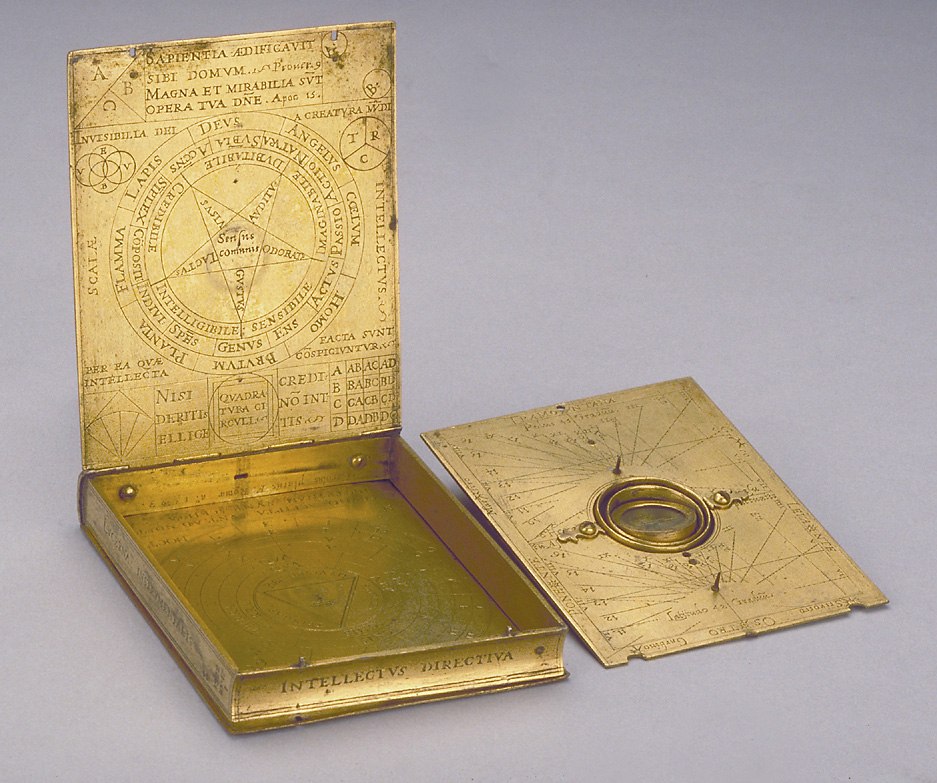
This horizontal dial is constructed in the form of a hinged, book-shaped box manufactured from gilt brass. Signed by Carlo Plato and dated 1593, it measures 87 by 113 by 16 mm. A central, gimbal-mounted compass is incorporated within the interior plate to ensure horizontal alignment. The exterior and interior surfaces of the hinged covers are extensively engraved with theological, philosophical, and religious inscriptions, including Biblical quotations, concentric circles with labels related to knowledge, and various geometrical figures such as a five-pointed star. Two catches secure the lid when not in use. The object is held in the collection of the British Museum, London.

Horizontal dial in the form of a hinged book, signed by Carlo Plato, 1593, showing the opened covers and interior brass plate.
Horizontal dial in the form of a hinged book, signed by Carlo Plato, 1593, showing the opened covers and interior brass plate. — © British Museum, London. Rights pending — permission not yet requested. Original source

Catalogue identity

Source
www.mhs.ox.ac.uk
Category
Tool · Italian horizontal dial
Maker / attribution
Carlo Plato
Reference
Not recorded
Catalogue / lot identifier
MLA 1922 10-17.1
Source-reported date
1593
Source-reported place
Rome

Source-reported attribution and specifications are not independent authentication. A listing does not establish present ownership, current display, availability or permission to reproduce.

Object description

Construction and Design

The object is constructed as a hinged, book-shaped gilt brass case measuring 87 x 113 x 16 mm. The design utilizes a fold-out construction where an internal plate, containing the compass and pin gnomon dials, sits within the body of the 'book'. Two metal catches are employed to keep the lid closed.

The surfaces of the object are densely covered with complex, multi-layered engravings. These include six concentric circles on the exterior, a five-pointed star on the interior lid, and various geometrical diagrams. The brass plate itself is intricately marked for different latitudes and hour systems, using a pin gnomon to cast shadows for timekeeping. The inclusion of a gimbal-mounted compass ensures the device remains level during use.

Evidence for this section
  • “This dial is made in the form of a book, with hinged front and back covers.”
  • “The actual dial is a gilt brass plate inside the box, and has pin gnomon dials for Italian hours , Babylonian hours , common hours and unequal hours .”
  • “Inside the box is a gilt brass plate with a compass in the centre with two armillae, with a weight inside so that it remains horizontal.”

Inscriptions and Symbolism

The instrument serves as a repository for theological and philosophical texts alongside its primary function as a horological tool. The outer leaf features a shield with the initials 'IHS' and numerous concentric circles labeled with categories such as 'BONITAS', 'SAPIENTIA', and 'CHAOS'. Biblical references, such as those to Proverbs and the Apocalypse, are engraved alongside scholarly and religious maxims.

The interior of the box contains further theological content, including the phrase 'FIGURA DEMONSTRATIVAE' and a circle centered on a triangle inscribed with 'T'. Various celestial and intellectual hierarchies are represented, such as the classification of senses and levels of knowledge. The inscription on the exterior edges refers to the device as an 'INSTRVMENTV SCIENDI', emphasizing its dual role as a scientific instrument and an intellectual guide.

Evidence for this section
  • “The lids of the box are extensively inscribed with theological, religious and philosophical inscriptions, relating to the development of human knowledge, and with Biblical quotations.”
  • “On the inner side of the box, near the hinge, is the signature 'Carolus Platus F. Romae A<nn>o 1593'.”

Provenance and Identification

The dial is signed 'Carolus Platus F. Romae A<nn>o 1593' on the inner side of the box near the hinge. This identifies it as a work of Carlo Plato, an instrument maker active in Rome in the late 16th century. The object is currently housed in the British Museum.

It is officially registered under the number MLA 1922 10-17.1 and was historically documented in F. A. B. Ward's 1981 publication on European scientific instruments.

Evidence for this section
  • “On the inner side of the box, near the hinge, is the signature 'Carolus Platus F. Romae A<nn>o 1593'.”
  • “The instrument was purchased in 1922 and is described in F. A. B. Ward, A Catalogue of European Scientific Instruments in the Department of Medieval and Later Antiquities of the British Museum (London, 1981), p. 44, no.109.”

Open research questions

  • What specific historical or philosophical texts served as the primary source for the intricate labeling system engraved on the covers?
  • How were the specific latitudes of 42 and 45 degrees selected for the engraving of the dials in relation to the maker's known commissions?

Source evidence

Recorded claims and source quotations for Horizontal Dial by Carlo Plato
FieldSource-reported valueSource quotation
MakerCarlo Plato“Signed by Carlo Plato”
Date1593“Dated 1593”
MaterialGilt brass“Gilt brass”
Dimensions87 x 113 x 16 mm“87 x 113 x 16 mm”
Accession numberMLA 1922 10-17.1“Registratio no. MLA 1922 10-17.1”
FunctionsItalian, Babylonian, common, and unequal hours“pin gnomon dials for Italian hours , Babylonian hours , common hours and unequal hours”

Visible details

  • The device features a hinged, book-shaped design with decorative inscriptions on the interior and exterior covers.
  • A central compass with a gimbal-style mounting is situated within a loose, removable brass plate.
  • Multiple pin gnomon dials for different hour systems and latitudes are engraved on the brass plate.
  • Side edges of the brass box are engraved with the phrases 'LVCERNA INSTRVMENTALIS' and 'INTELLECTVS DIRECTIVA'.

Research qualifications

  • The exact interpretation of some abbreviated theological Latin inscriptions remains subject to research.
  • The extent of wear or oxidation on the gilt brass surface is not detailed beyond its visible state in the photograph.

Photograph identity and source facts were screened before import; rights clearance remains pending.

Consulted source

Horizontal Dial

Reviewed 2026-10-26 · Record 3f162f91c2

Terms in this record

Glossary explanations for terms named in this object’s record.