
Skip to content
The Encyclopedia of Horology

Clock · Hooded wall clock

Hooded wall clock with calendar by Ahasuerus I Fromanteel

Partially verified

This hooded wall clock with a calendar function was made in London by Ahasuerus I Fromanteel, an English clockmaker active between 1607 and 1693. Dated to approximately 1660–65, the clock features a combination of ebony and oak, with the case finished in ebony veneer and ebonized wood, accented by gilded brass elements. The dial is composed of gilded brass with an applied silvered-brass chapter ring. The internal movement is constructed from brass and steel components. The overall dimensions of the object are approximately 19 1/2 inches in height, 12 inches in width, and 7 1/4 inches in depth, with the dial plate measuring 8 1/4 inches across. The Metropolitan Museum of Art maintains this specimen within its collection, which was acquired as part of the Bequest of Irwin Untermyer in 1973.

The dial plate of the hooded wall clock featuring the signature of Ahasuerus I Fromanteel.
The dial plate of the hooded wall clock featuring the signature of Ahasuerus I Fromanteel. — The Metropolitan Museum of Art — Bequest of Irwin Untermyer, 1973. Rights pending — permission not yet requested. Original source

Catalogue identity

Source
orbiscollectibles.com
Category
Clock · Hooded wall clock
Maker / attribution
Ahasuerus I Fromanteel
Reference
Not recorded
Catalogue / lot identifier
1974.28.93
Source-reported date
ca. 1660–65
Source-reported place
England

Source-reported attribution and specifications are not independent authentication. A listing does not establish present ownership, current display, availability or permission to reproduce.

Object description

Case and Dial Construction

The clock is housed in a case constructed from oak that has been veneered with ebony. The exterior aesthetic is further defined by the use of ebonized wood and gilded brass decorative elements. These materials characterize the construction of the wall-mounted housing for the clock movement.

The dial of the clock is crafted from gilded brass, which provides a contrasting base for the silvered-brass chapter ring. This ring carries the numerical indicators for timekeeping. The construction reflects the specific material choices noted in the Metropolitan Museum of Art's inventory for this object.

Evidence for this section
  • “Case: ebony and oak veneered with ebony, ebonized wood, gilded brass; Dial: gilded brass with silvered-brass chapter ring”

Movement and Mechanism

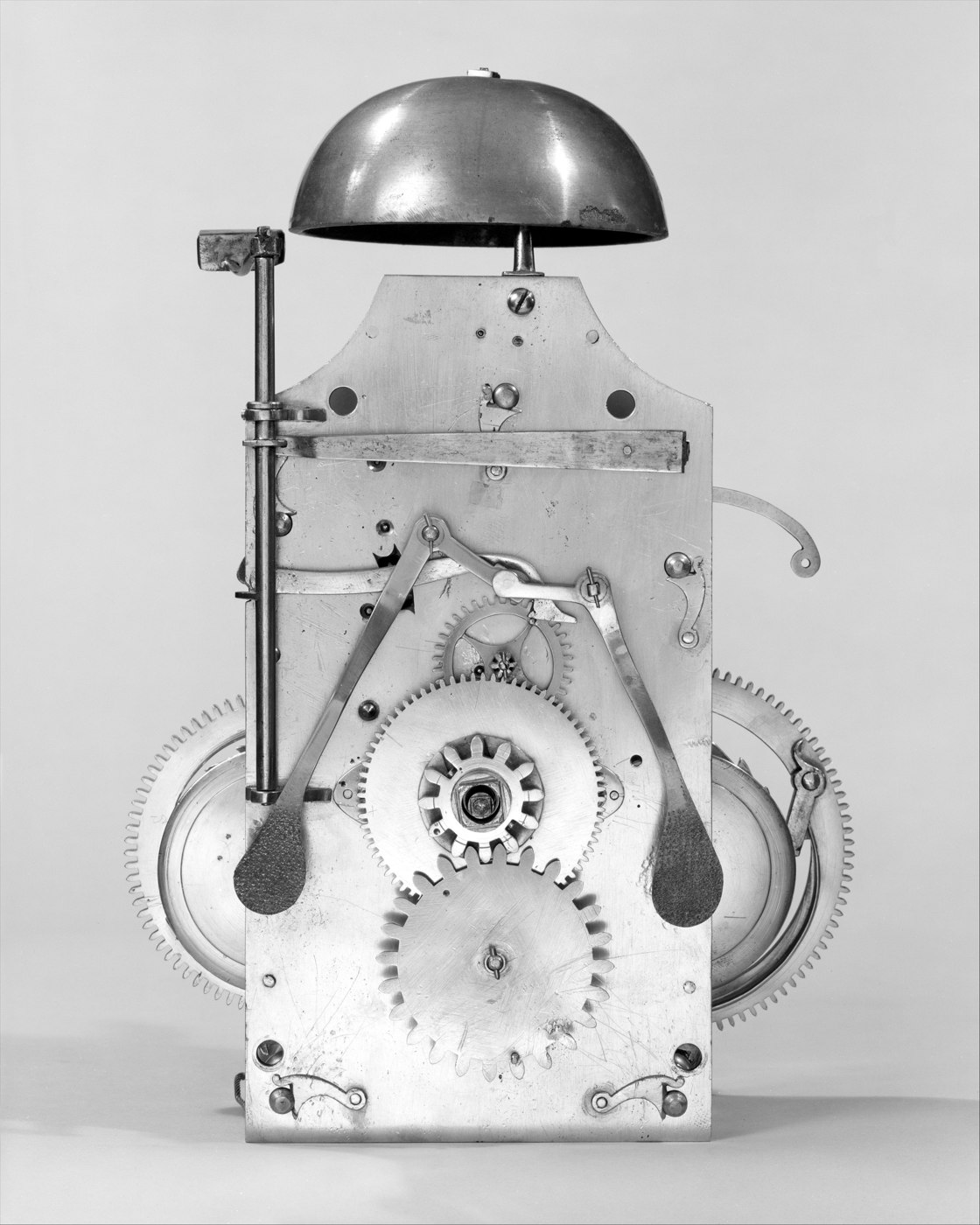
The internal mechanism of the clock is built using brass and steel. The arrangement of the movement, which is visible in the provided photographic documentation, includes the gear train, plates, and the striking mechanism topped by a bell.

The movement structure shows the layout of the timekeeping elements, including the wheel train and the mechanism responsible for the audible striking function. The integration of these brass and steel parts within the frame constitutes the core operational component of the wall clock.

Evidence for this section
  • “Movement: brass, steel”

Signatures and Provenance

The dial plate bears the signature of the maker, Ahasuerus I Fromanteel, engraved as 'A. Fromanteel Londini'. This inscription identifies the work with the London-based clockmaker who was active in the mid-17th century.

The clock is documented as part of the collection of The Metropolitan Museum of Art, assigned the accession number 1974.28.93. The object entered the museum's collection as a result of the Bequest of Irwin Untermyer in 1973.

Evidence for this section
  • “Clockmaker: Ahasuerus I Fromanteel (British, Norwich, England 1607–1693)”
  • “The Metropolitan Museum of Art — Bequest of Irwin Untermyer, 1973”

Open research questions

  • What specific calendar mechanisms are integrated into this movement beyond the timekeeping train?
  • How does the construction of this specific hooded clock compare to other extant examples by the Fromanteel workshop from the same period?

Source evidence

Recorded claims and source quotations for Hooded wall clock with calendar by Ahasuerus I Fromanteel
FieldSource-reported valueSource quotation
MakerAhasuerus I Fromanteel“Clockmaker: Ahasuerus I Fromanteel (British, Norwich, England 1607–1693)”
Dateca. 1660–65“ca. 1660–65”
MaterialsEbony, oak, ebonized wood, gilded brass, brass, steel“Case: ebony and oak veneered with ebony, ebonized wood, gilded brass; Dial: gilded brass with silvered-brass chapter ring; Movement: brass, steel”
Museum Object Number1974.28.93“1974.28.93”
Overall Dimensions19 1/2 × 12 × 7 1/4 in. (49.5 × 30.5 × 18.4 cm)“Overall: 19 1/2 × 12 × 7 1/4 in. (49.5 × 30.5 × 18.4 cm)”
Dial Plate Width8 1/4 in. (21 cm)“Width (dial plate): 8 1/4 in. (21 cm)”
OriginLondon, England“British, London”

Visible details

  • Signature engraved on the dial plate reads 'A. Fromanteel Londini'.
  • Movement plates are secured by brass and steel components with visible gear trains.
  • A bell is mounted at the top of the movement structure.
  • The dial plate features a silvered chapter ring with Roman numerals.

Research qualifications

  • The dating to ca. 1660–65 is an approximation.
  • The extent to which this specimen represents a wider clock type remains unverified.

Photograph identity and source facts were screened before import; rights clearance remains pending.

Consulted source

Hooded wall clock with calendar, Ahasuerus I Fromanteel, ca. 1660–65

Reviewed 2026-11-02 · Record 3378829278

Terms in this record

Glossary explanations for terms named in this object’s record.