
Skip to content
The Encyclopedia of Horology

Component · Pocket watch alarm attachment

Henri Laresche and Henri Robert Alarm Mechanism for a Pocket Watch

Partially verified

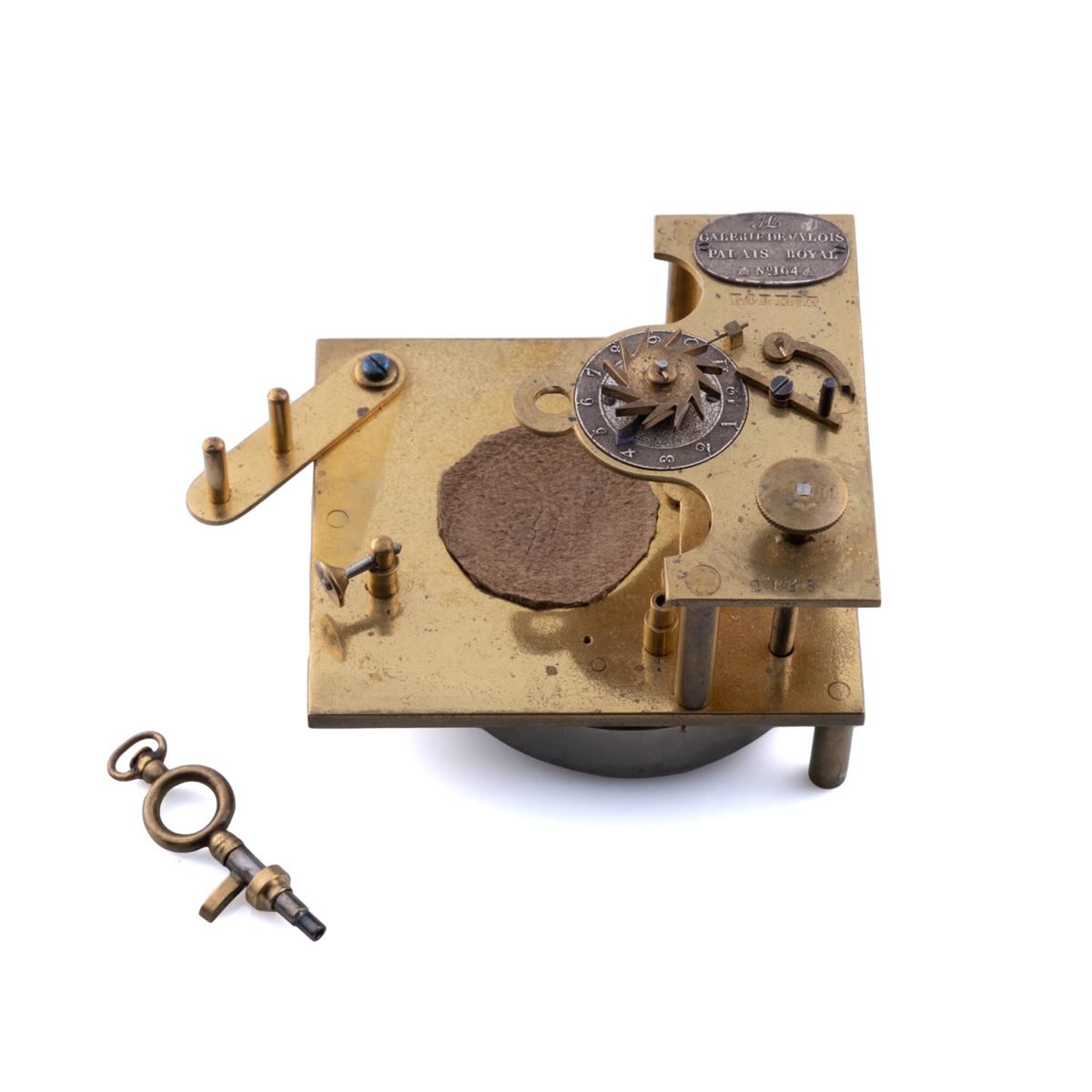
This brass and steel pocket watch alarm mechanism is attributed by the source to Henri Laresche and Henri Robert, Paris, dating to circa 1840. The standalone apparatus is designed to receive a pocket watch placed centrally on a padded rest after opening the watch's glass bezel. At the passage of the selected hour, the mechanism triggers and sounds a bell situated beneath the plate. The unit features an affixed silvered cartouche inscribed with the Galerie de Valois, Palais Royal address, an engraved movement number 2 168, an indexed dial with a star wheel, and an accompanying winding key.

Oblique view of the Henri Laresche and Henri Robert pocket watch alarm mechanism with accompanying key
Oblique view of the Henri Laresche and Henri Robert pocket watch alarm mechanism with accompanying key — Antiquorum. Rights pending — permission not yet requested. Original source

Catalogue identity

Source
catalog.antiquorum.swiss
Category
Component · Pocket watch alarm attachment
Maker / attribution
Henri Laresche and Henri Robert
Reference
Not recorded
Catalogue / lot identifier
462
Source-reported date
circa 1840
Source-reported place
France
Source-reported serial
2 168

Source-reported attribution and specifications are not independent authentication. A listing does not establish present ownership, current display, availability or permission to reproduce.

Object description

Identity and Attribution

The auction catalog attributes this brass and steel alarm mechanism to Henri Laresche and Henri Robert, Paris, dating the object to circa 1840. The catalog also records a signature on the case positioned inside a silvered metal cartouche.

Observation of the physical unit shows an oval silvered cartouche affixed to the upper corner inscribed 'GALERIE DE VALOIS / PALAIS ROYAL / No 164', alongside the engraved movement number '2 168' on the upper stepped brass plate.

Evidence for this section
  • “Brand Henri Laresche and Henri Robert, Paris (Galerie de Valois, Palais Royal, No. 164)”
  • “Year circa 1840”
  • “Signature case (inside a silvered metal cartouche)”
  • “An oval silvered cartouche is fixed at the upper corner inscribed 'GALERIE DE VALOIS / PALAIS ROYAL / No 164'.”
  • “The movement number '2 168' is engraved into the upper stepped brass plate.”

Physical Configuration and Operation

The piece is constructed from brass and steel, measuring 52.4 x 67.5 x 57.6 mm and weighing approximately 230 grams according to catalog measurements. It is structured as an auxiliary alarm platform intended to hold a pocket watch.

A circular brown cloth or felt pad is centered on the brass plate to support the pocket watch. The catalog states that the watch is positioned after opening its glass bezel, and at the passage of the chosen hour, the mechanism triggers and strikes a bell placed beneath the unit.

Evidence for this section
  • “Material brass and steel”
  • “Dimensions 52.4 x 67.5 x 57.6 mm.”
  • “Weight 230 gr. (approx.)”
  • “A circular brown cloth or felt pad is centered on the brass plate to cushion the watch.”
  • “designed to receive a pocket watch which is placed in the centre of the device by opening the glass bezel of the watch; at the passage of the chosen hour the mechanism is triggered and rings on a bell placed under the device.”

Dial Display and Accessories

Visible on the upper brass assembly is a calibrated circular index dial fitted with a central star-shaped wheel and a contact finger.

The mechanism is shown with an accompanying standalone brass and steel winding key.

Evidence for this section
  • “A calibrated circular index dial is fitted with a central star-shaped wheel and contact finger.”
  • “A separate brass and steel winding key accompanies the mechanism.”

Open research questions

  • What pocket watch case diameters and bezel geometries fit the central recessed felt pad?
  • What are the specific internal striking train mechanics, hammer shape, and bell design situated beneath the main brass plate?

Source evidence

Recorded claims and source quotations for Henri Laresche and Henri Robert Alarm Mechanism for a Pocket Watch
FieldSource-reported valueSource quotation
MaterialBrass and steel“Brass and steel, alarm mechanism”
Movement Number2 168“Movement No. 2 168”
Dimensions52.4 x 67.5 x 57.6 mm“Dimensions 52.4 x 67.5 x 57.6 mm.”
Weight230 gr. (approx.)“Weight 230 gr. (approx.)”
OriginParis (Galerie de Valois, Palais Royal, No. 164)“Brand Henri Laresche and Henri Robert, Paris (Galerie de Valois, Palais Royal, No. 164)”
Signature PlacementCase (inside a silvered metal cartouche)“Signature case (inside a silvered metal cartouche)”
Catalog Condition GradingGrade: A Good; Case: 3 Good; Movement: 3* Good (Overhaul recommended, at buyer's expense)“Grade: A Good Case: 3 Good Movement: 3* Good Overhaul recommended, at buyer's expense”

Visible details

  • A circular brown cloth or felt pad is centered on the brass plate to cushion the watch.
  • An oval silvered cartouche is fixed at the upper corner inscribed 'GALERIE DE VALOIS / PALAIS ROYAL / No 164'.
  • A calibrated circular index dial is fitted with a central star-shaped wheel and contact finger.
  • A separate brass and steel winding key accompanies the mechanism.
  • The movement number '2 168' is engraved into the upper stepped brass plate.

Research qualifications

  • The bell situated beneath the base plate is largely hidden from this overhead perspective.
  • Operating compatibility and specific pocket watch dimensions are not detailed in the source text.

Photograph identity and source facts were screened before import; rights clearance remains pending.

Terms in this record

Glossary explanations for terms named in this object’s record.