
Skip to content
The Encyclopedia of Horology

Wristwatch · Self-winding ladies wristwatch

Harwood Ladies Wrist Watch

Partially verified

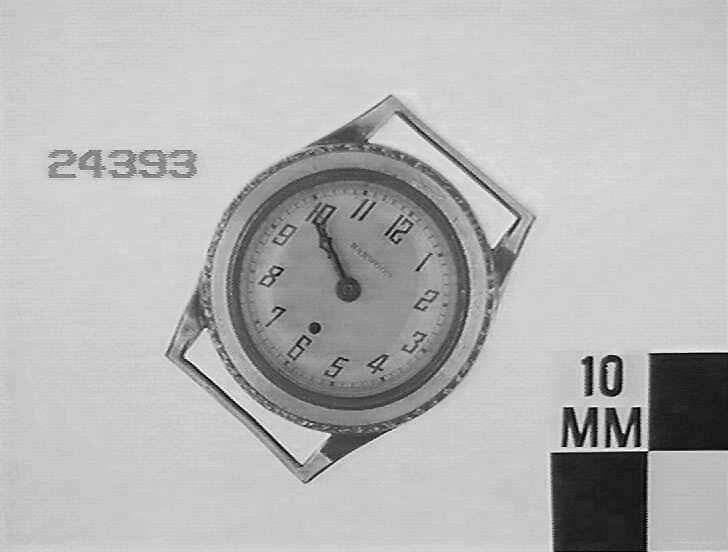
This ladies' wristwatch, registered under ST 24393, is a self-winding timepiece associated with John Harwood. The dial is white metal with black Arabic numerals and includes an indicator window above the six o'clock position that displays red when the setting mechanism is disengaged. Internally, the movement incorporates a self-winding spring and a lever escapement. The watch was acquired by the museum in 1958 directly from John Harwood. The design utilizes the self-winding system invented by Harwood in 1923, which employs an oscillating weighted arm and two buffer springs. The case back is fitted with a clear plastic cover to allow visibility of the internal mechanism. The watch is presented without a strap.

The watch features a rotating, foliage-patterned bezel for setting the time and a red indicator above the six o'clock marker.
The watch features a rotating, foliage-patterned bezel for setting the time and a red indicator above the six o'clock marker. — Museums Victoria. Rights pending — permission not yet requested. Original source

Catalogue identity

Source
collections.museumsvictoria.com.au
Category
Wristwatch · Self-winding ladies wristwatch
Maker / attribution
John Harwood
Reference
Not recorded
Catalogue / lot identifier
ST 24393
Source-reported date
1958
Source-reported place
England

Source-reported attribution and specifications are not independent authentication. A listing does not establish present ownership, current display, availability or permission to reproduce.

Object description

Case and Dial

The watch is housed in a round gold case, which is notable for its rotating bezel feature.

The dial is composed of white metal and features black Arabic numerals for hour markers. A specific visual indicator is positioned above the numeral six; it reveals a red color when the mechanism for setting the hands is disengaged, providing the user with status feedback on the operation of the movement.

Evidence for this section
  • “Round gold case. Foliage around edge of bezel can be rotated to set hands.”
  • “White metal dial has black arabic numerals. Indicator over 6 shows red when mechanism for setting hands is disengaged.”

Movement and Mechanism

The timepiece utilizes a self-winding system, a technology patented by John Harwood in 1923. The mechanism relies on an oscillating weighted arm that interacts with two buffer springs to provide tension.

The movement is designed to be visible to the user, as the case back is equipped with a clear plastic cover.

Evidence for this section
  • “The self-winding system was invented by John Harwood in 1923. It uses an oscillating weighted arm with two buffer springs.”
  • “Self-winding spring; lever escapement.”
  • “Has clear plastic cover on back to show movement.”

Provenance and Identification

The object is recorded in the museum collection under the registration number ST 24393. The museum obtained the watch through a direct purchase from John Harwood in 1958.

While the self-winding watches based on the Harwood patent were produced across multiple countries, including Switzerland and England, this specific example maintains a documented link to the inventor in the year 1958. The dial is marked with the Harwood signature.

Evidence for this section
  • “This movement was purchased by the museum directly from John Harwood in 1958.”
  • “Inscription: Dial marked 'Harwood'.”

Open research questions

  • Confirm the specific country of manufacture for this individual ST 24393 unit.
  • Determine if the clear plastic back cover is an original feature or a museum-added modification for display.

Source evidence

Recorded claims and source quotations for Harwood Ladies Wrist Watch
FieldSource-reported valueSource quotation
Registration numberST 24393“Registration number: ST 24393”
MakerJohn Harwood“Association: type: Maker, name: J. Harwood”
Mechanism typeSelf-winding“Self-winding spring; lever escapement.”
Setting mechanismRotating bezel“Foliage around edge of bezel can be rotated to set hands.”
Visual indicatorRed indicator“Indicator over 6 shows red when mechanism for setting hands is disengaged.”
Acquisition date1958“This movement was purchased by the museum directly from John Harwood in 1958.”
Case materialGold“Round gold case.”

Visible details

  • Rotating bezel with foliage decoration for hand setting
  • Indicator window above 6 o'clock showing red
  • Clear plastic back cover
  • White metal dial with black Arabic numerals

Research qualifications

  • Source mentions 'Switzerland' and 'England' regarding manufacture; specific origin of this piece is not explicitly stated beyond its 1958 purchase from Harwood in England.
  • The physical condition of the movement and internal spring is not detailed in the source.

Photograph identity and source facts were screened before import; rights clearance remains pending.

Consulted source

Wrist Watch - Harwood, England, 1958

Reviewed 2026-10-26 · Record 6c90528bbf

Terms in this record

Glossary explanations for terms named in this object’s record.