
Skip to content
The Encyclopedia of Horology

Tool · Nuremberg diptych dial

Hans Troschel Diptych Dial

Partially verified

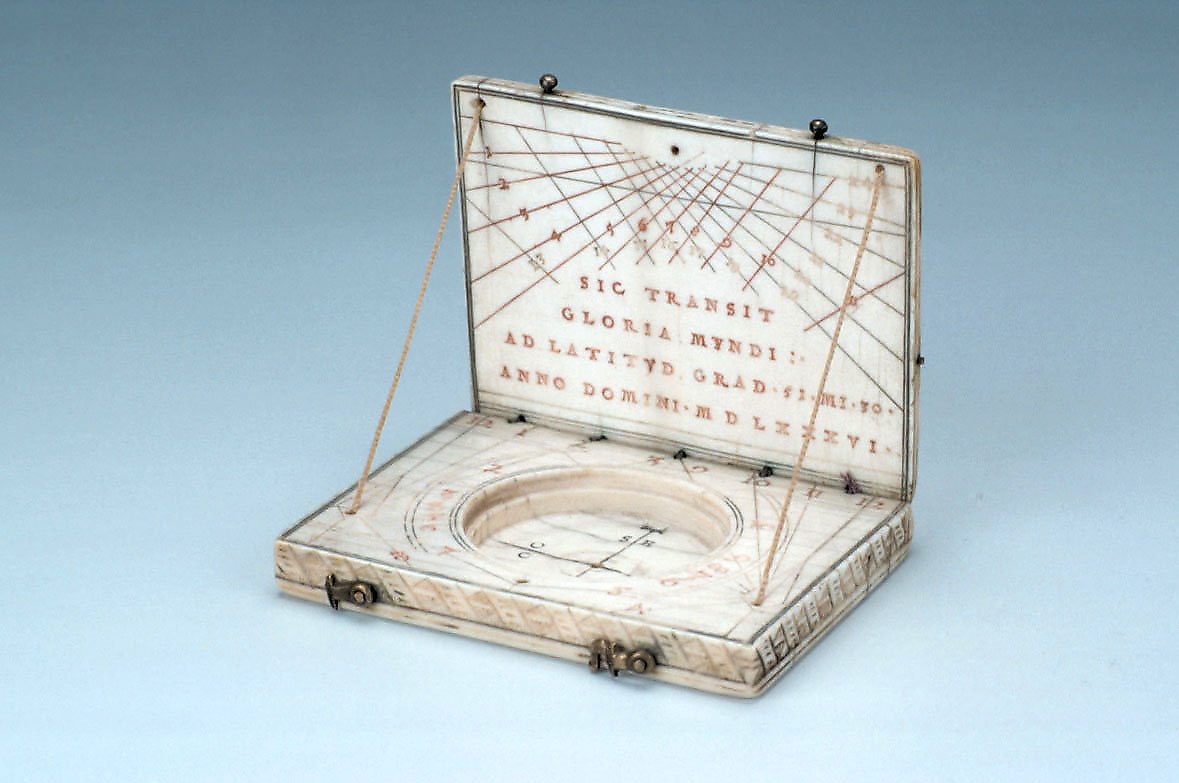
This diptych sundial, constructed in the form of a book measuring 70 x 55 x 12 mm, is crafted from ivory and brass. Signed by Hans Troschel and dated 1586, the instrument originates from Nuremberg. The exterior features engraved, coloured figures, including St. Helena holding a cross on the upper leaf and a bearded Constantine in Roman armour on the lower leaf. Internally, the upper leaf contains a pin gnomon dial, though the pin itself is missing. It displays markings for Italian and Babylonian hours alongside an engraved Latin inscription. The lower leaf houses a compass, currently missing its needle, ring, and glass, and features two horizontal string gnomon dials calibrated for common hours. The edges of the ivory leaves are decorated with geometrical motifs, and two conical holes are provided for stowing pins.

A diptych sundial in the form of an ivory book, signed by Hans Troschel, 1586.
A diptych sundial in the form of an ivory book, signed by Hans Troschel, 1586. — Museum of the History of Science, Oxford. Rights pending — permission not yet requested. Original source

Catalogue identity

Source
www.mhs.ox.ac.uk
Category
Tool · Nuremberg diptych dial
Maker / attribution
Hans Troschel
Reference
70006
Catalogue / lot identifier
70006
Source-reported date
1586
Source-reported place
Nuremberg

Source-reported attribution and specifications are not independent authentication. A listing does not establish present ownership, current display, availability or permission to reproduce.

Object description

Exterior and Iconography

The exterior of the diptych dial features figurative engravings on both the upper and lower leaves. These figures are rendered in green and red colours. The upper leaf depicts St. Helena, identified by the cross she holds in her right hand. The lower leaf features Constantine, described as a bearded man dressed in Roman armour, holding a pennant.

The lower leaf exterior also displays the maker's mark. The edges of the ivory book are detailed with a geometrical motif. Two conical holes are present on the object, serving as storage for the dial's pins.

Evidence for this section
  • “The colours used are red and green. Constantine is depicted as a bearded man in Roman armour, and holds a pennant in his right hand. The mark of Hans Troschel is punched on this side of the lower leaf.”
  • “The edges are decorated with a geometrical motif and there are two conical holes for stowing the pins.”

Internal Dialling and Inscriptions

The interior upper leaf is equipped with a pin gnomon dial, although the gnomon itself is missing. This dial is calibrated for Italian hours, marked 13 to 24, and Babylonian hours, which are marked in red from 1 to 11. Below these markings, the surface bears the Latin inscription 'SIC TRANSIT GLORIA MUNDI: AD LATITUD GRAD 51 MI 30 ANNO DOMINI M D L X X X V I'.

The lower leaf contains a compass, which is missing its needle, ring, and glass. The cardinal points are marked as 'SE', 'OR', 'ME', and 'OC'. Additionally, two horizontal string gnomon dials are integrated into the lower section, designed to indicate common hours from 4 a.m. to noon and from noon to 8 p.m.

Evidence for this section
  • “The inner face of the upper leaf has a pin gnomon dial (pin missing) for Italian (marked from 13 to 24) and Babylonian hours (marked in red from 1 to 11).”

Provenance and Documentation

The instrument is part of the collection at the Museum of the History of Science, Oxford, identified by inventory number 70006. It is catalogued as an example of an ivory diptych dial from Nuremberg, dated 1586. The object has been referenced in academic studies regarding the history of ivory sundials from the Nuremberg region.

The museum maintains strict rights over the documentation and reproduction of the images and information provided for this object. The scholarly context for this specific piece is situated within the broader study of sixteenth and seventeenth-century Nuremberg ivory dials.

Evidence for this section
  • “Inventory number 70006”
  • “See P. Gouk, The Ivory Sundials of Nuremberg 1500-1700 (Cambridge, 1988).”

Open research questions

  • What is the specific intended use of the indicated latitude of 51 degrees 30 minutes?
  • Were the colours on the exterior figures applied as part of the original production or at a later date?

Source evidence

Recorded claims and source quotations for Hans Troschel Diptych Dial
FieldSource-reported valueSource quotation
MakerHans Troschel“Signed by Hans Troschel”
Date1586“Dated 1586; Nuremberg”
MaterialIvory and brass“Ivory and brass; 70 x 55 x 12 mm”
Dimensions70 x 55 x 12 mm“70 x 55 x 12 mm”
InscriptionSIC TRANSIT GLORIA MUNDI: AD LATITUD GRAD 51 MI 30 ANNO DOMINI M D L X X X V I“'SIC TRANSIT GLORIA MUNDI: AD LATITUD GRAD?51?MI?30?ANNO DOMINI?M D L X X X V I?'”
Compass markingsSE, OR, ME, OC“cardinal points marked 'SE', 'OR', 'ME', 'OC'”
ProvenanceMuseum of the History of Science, Oxford“Museum of the History of Science, Oxford”

Visible details

  • Geometrical motif decoration on ivory edges
  • Two conical holes for stowage of pins
  • Engraved Latin inscription on upper inner leaf
  • Punched mark of maker on the lower leaf exterior

Research qualifications

  • Missing pin for the upper leaf gnomon dial
  • Missing compass needle, ring, and glass

Photograph identity and source facts were screened before import; rights clearance remains pending.

Consulted source

Diptych Dial

Reviewed 2026-10-26 · Record 4abdd47503

Terms in this record

Glossary explanations for terms named in this object’s record.