
Skip to content
The Encyclopedia of Horology

Wristwatch · Electric wristwatch

Hamilton Electric Pilot Lot Wristwatch

Partially verified

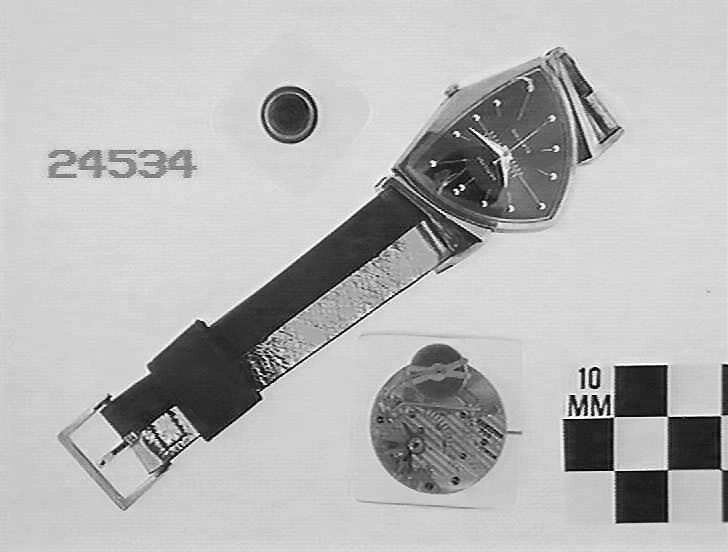
This 1956 Hamilton Electric wristwatch is part of a limited pilot lot produced by the Hamilton Watch Company in Lancaster, Pennsylvania, prior to the commercial launch of their electric movement technology in 1957. The timepiece features a distinctive triangular case, which was designed to house the company's battery-powered electric movement. This specific example was donated by the manufacturer to the museum collection in 1959. The watch is presented with its black dial marked with the brand name and hour markers composed of dots and lines. Internally, the movement incorporates a balance and hairspring, but replaces the traditional mainspring with a battery-powered system. In the current configuration, the movement mechanism and battery are detached from the case and preserved separately.

Hamilton Electric wristwatch with detached battery and movement mechanism, registration number ST 24534.
Hamilton Electric wristwatch with detached battery and movement mechanism, registration number ST 24534. — Museums Victoria. Rights pending — permission not yet requested. Original source

Catalogue identity

Source
collections.museumsvictoria.com.au
Category
Wristwatch · Electric wristwatch
Maker / attribution
Hamilton Watch Co
Reference
Not recorded
Catalogue / lot identifier
ST 24534
Source-reported date
1956
Source-reported place
United States

Source-reported attribution and specifications are not independent authentication. A listing does not establish present ownership, current display, availability or permission to reproduce.

Object description

Case and Dial Construction

The watch features a triangular case, a design choice intended to complement the non-traditional nature of the internal electric movement. The dial is black, finished with hour markers indicated by a combination of gold-colored dots and lines. The signature 'Hamilton Electric' is visible on the dial, identifying the manufacturer and the technological nature of the movement.

The case geometry relates to the futuristic styling adopted by the company for its early electric series, intended to set the product apart from conventional mechanical watches available at the time. This particular example originates from the pilot production phase, representing the company's efforts to finalize the design before its public debut in early 1957.

Evidence for this section
  • “triangular case”
  • “Black dial has hours marked by gold dots and lines.”
  • “Dial is marked 'Hamilton Electric'”

Movement and Technology

The watch is equipped with a battery-powered electric movement, which was a significant departure from traditional watchmaking technology of the mid-20th century. While the movement retains a balance and hairspring, the primary innovation is the replacement of the mechanical mainspring with a battery, which provides the energy necessary to drive the timekeeping mechanism.

In the museum's inventory, the internal works and the battery are presently separated from the main case, having been placed in a plastic housing to assist in the preservation of the watch components.

Evidence for this section
  • “Battery powered electric movement.”
  • “Although it had a balance and hairspring, the new movement replaced the mainspring with a tiny battery.”
  • “Works and battery have been removed and placed in plastic.”

Provenance and Production

This watch is identified as one of the pilot lot examples manufactured in 1956. These watches were produced specifically for testing and demonstration purposes by the Hamilton Watch Company before the 'World's First Electric Watch' was officially introduced at a press conference on January 3, 1957.

The museum acquired this specific object as a donation directly from the manufacturer in January 1959. This donation included samples from the company's early production lots, providing an archival record of the developmental stages of the Hamilton Electric series before the line was subjected to broader commercial mass production techniques later in the 1950s and 1960s.

Evidence for this section
  • “One of a small number of pilot lots produced by the company prior to its commercial release in 1957.”
  • “The company donated samples from the pilot lots to museums in 1958.”
  • “Acquisition: Donation from Hamilton Watch Co, Jan 1959”

Open research questions

  • Does the movement contain specific prototype markings distinct from later commercial Hamilton Electric movements?
  • Are there records detailing the specific quantity of watches produced in this 1956 pilot lot?

Source evidence

Recorded claims and source quotations for Hamilton Electric Pilot Lot Wristwatch
FieldSource-reported valueSource quotation
MakerHamilton Watch Co“Hamilton Watch Co”
LocationLancaster, Pennsylvania“Lancaster, Pennsylvania”
Registration NumberST 24534“ST 24534”
AcquisitionDonation from Hamilton Watch Co, Jan 1959“Donation from Hamilton Watch Co, Jan 1959”
Movement TypeBattery powered electric movement“Battery powered electric movement”

Visible details

  • Triangular case design
  • Black dial with dot and line hour markers
  • Movement mechanism and battery are detached from the watch case
  • Black leather strap attached

Research qualifications

  • Specific model name beyond Hamilton Electric is not confirmed in the source
  • Current working condition is not verified as parts are removed

Photograph identity and source facts were screened before import; rights clearance remains pending.

Consulted source

Wrist Watch - Hamilton Electric, Lancaster, Pennsylvania, 1956

Reviewed 2026-10-26 · Record d15fc4c335

Terms in this record

Glossary explanations for terms named in this object’s record.