
Skip to content
The Encyclopedia of Horology

Clock · Mantel clock

Genius of the Arts Mantel Clock

Partially verified

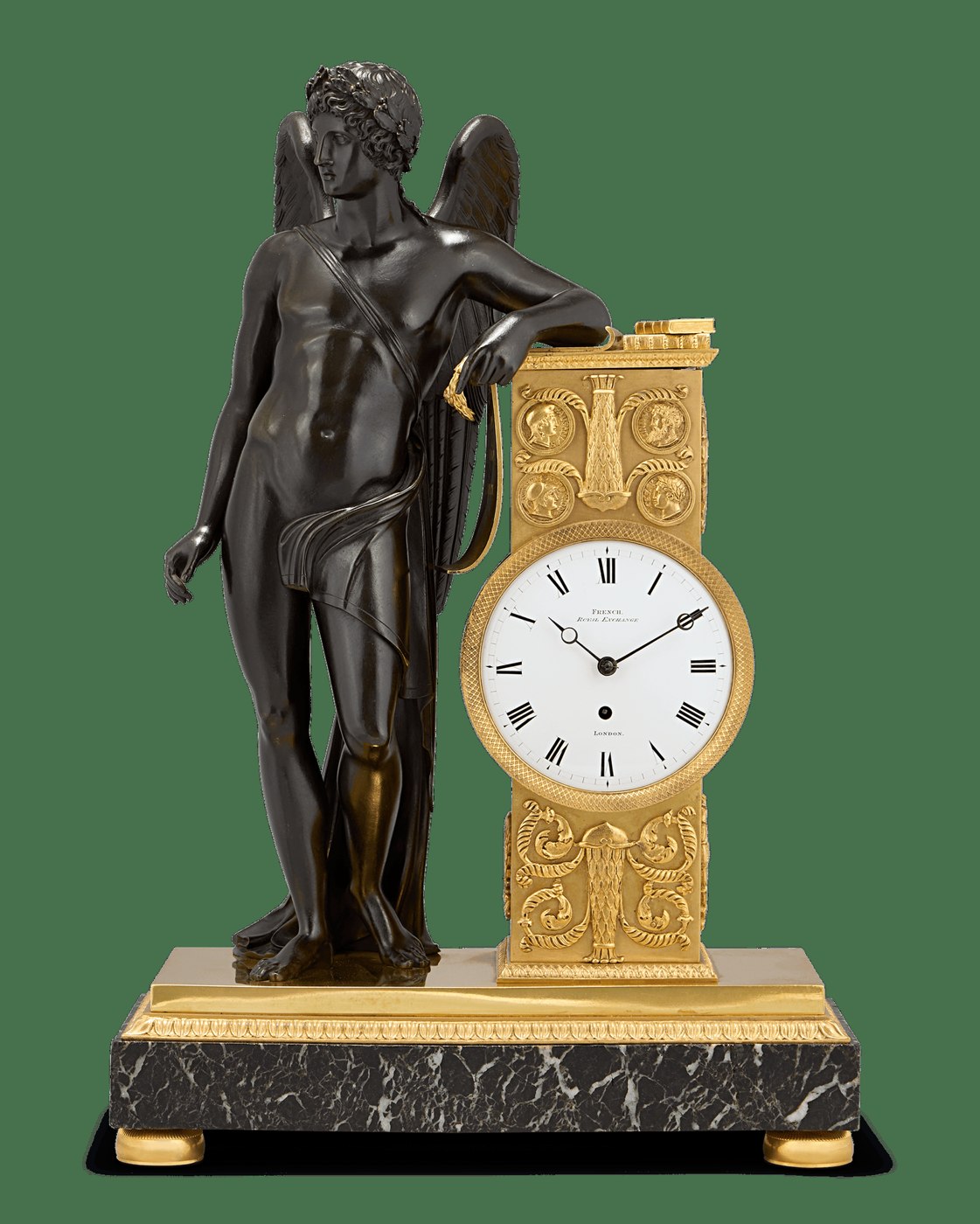
This mantel clock, dating to circa 1815, is signed by the clockmaker James Moore French of the Royal Exchange, London. The timepiece features a patinated bronze statue depicting the Genius of Literature, portrayed as a winged male figure leaning against a gilt bronze clock case. The case is set upon a Verde Antico marble plinth supported by ormolu bun feet. Decorative elements on the case include high-relief medallion portraits of classical writers and philosophers, accompanied by rope moldings, acanthus scrollwork, and architectural column motifs. The white enamel dial displays Roman numerals and blued steel hands, surrounded by an engine-turned gilt bezel. The movement is an eight-day fusee type with an original chain, a signed backplate, and a cylindrical pendulum. James Moore French maintained a presence at the Royal Exchange and produced clocks that incorporated sculptural elements alongside English horological mechanisms.

Genius of the Arts Mantel Clock by James Moore French, featuring the patinated bronze figure of the Genius of Literature.
Genius of the Arts Mantel Clock by James Moore French, featuring the patinated bronze figure of the Genius of Literature. — M.S. Rau. Rights pending — permission not yet requested. Original source

Catalogue identity

Source
rauantiques.com
Category
Clock · Mantel clock
Maker / attribution
James Moore French
Reference
Not recorded
Catalogue / lot identifier
Source URL identifies the listing
Source-reported date
circa 1815
Source-reported place
England

Source-reported attribution and specifications are not independent authentication. A listing does not establish present ownership, current display, availability or permission to reproduce.

Object description

Clock Case and Design

The clock is designed with an allegorical theme, featuring a monumental patinated bronze sculpture of the Genius of Literature. The figure is depicted as a winged male leaning against the clock's architectural housing. The housing is cast in gilt bronze and incorporates significant sculptural ornamentation, including high-relief medallion portraits that represent classical writers and philosophers.

These portraits are bordered by decorative rope moldings and acanthus leaf scrollwork, with column structures integrated into the design. The entire assembly is mounted upon a plinth composed of Verde Antico marble and rests on ormolu bun feet, providing a stable foundation for the vertical height of the object.

Evidence for this section
  • “monumental patinated bronze statue of the Genius of Literature”
  • “architectural clock case is densely ornamented in high relief with medallion portraits of celebrated classical writers and philosophers”
  • “The mechanism rests on a Verde Antico marble plinth raised on ormolu bun feet”

Dial and Movement

The clock features a white enamel dial marked with Roman numerals, utilizing blued steel hands for time indication. The dial is held within a gilt bezel that has been decorated with engine-turning.

The internal mechanism is an eight-day fusee movement, which includes its original chain and a cylindrical pendulum. The backplate of the movement is signed by the maker, ensuring the horological components align with the dial signature.

Evidence for this section
  • “features Roman numerals and blued steel hands within a finely engine-turned gilt bezel”
  • “the movement is an outstanding eight-day fusee with its original chain, a fully signed backplate and a rare cylindrical pendulum”
  • “Signed on dial and backplate: French, Royal Exchange, London”

Maker and Attribution

James Moore French operated his business from the Royal Exchange in London during the early 19th century. , and French is noted for the integration of sculptural cases with English timekeeping movements.

The clock represents an effort to combine English fusee mechanics with traditions of Continental bronze casting. The signature identifies the maker as operating from the Royal Exchange, which serves as the primary point of attribution for the manufacture.

Evidence for this section
  • “James Moore French operated from the Royal Exchange, London, one of the most prestigious commercial addresses in Regency England”
  • “French was celebrated for the exceptional quality of his movements and for commissioning sculptural cases of great ambition”

Open research questions

  • What specific classical writers are depicted in the medallions on the clock case?
  • Who was the sculptor or bronze caster commissioned by James Moore French for this specific case design?

Source evidence

Recorded claims and source quotations for Genius of the Arts Mantel Clock
FieldSource-reported valueSource quotation
MakerJames Moore French“James Moore French, Royal Exchange, London”
Datecirca 1815“Circa 1815”
Movement typeEight-day fusee“the movement is an outstanding eight-day fusee with its original chain”
Signature locationDial and backplate“Signed on dial and backplate: French, Royal Exchange, London”
Dimensions20 inches high x 13 1/4 inches wide x 7 inches deep“20" high x 13 1/4" wide x 7" deep”

Visible details

  • Patinated bronze figure of a winged male
  • Verde Antico marble base with ormolu bun feet
  • High-relief medallion portraits on the clock case
  • White enamel dial with Roman numerals

Research qualifications

  • Exact origin of the bronze figure not verified
  • Attribution of the case design to a specific artist not stated

Photograph identity and source facts were screened before import; rights clearance remains pending.

Consulted source

ساعت شومینه‌ای نابغه هنر؛ جیمز مور فرنچ

Reviewed 2026-11-02 · Record 4a366c8d50

Terms in this record

Glossary explanations for terms named in this object’s record.