
Skip to content
The Encyclopedia of Horology

Clock · Wall clock

Friesland Stoelklok

Partially verified

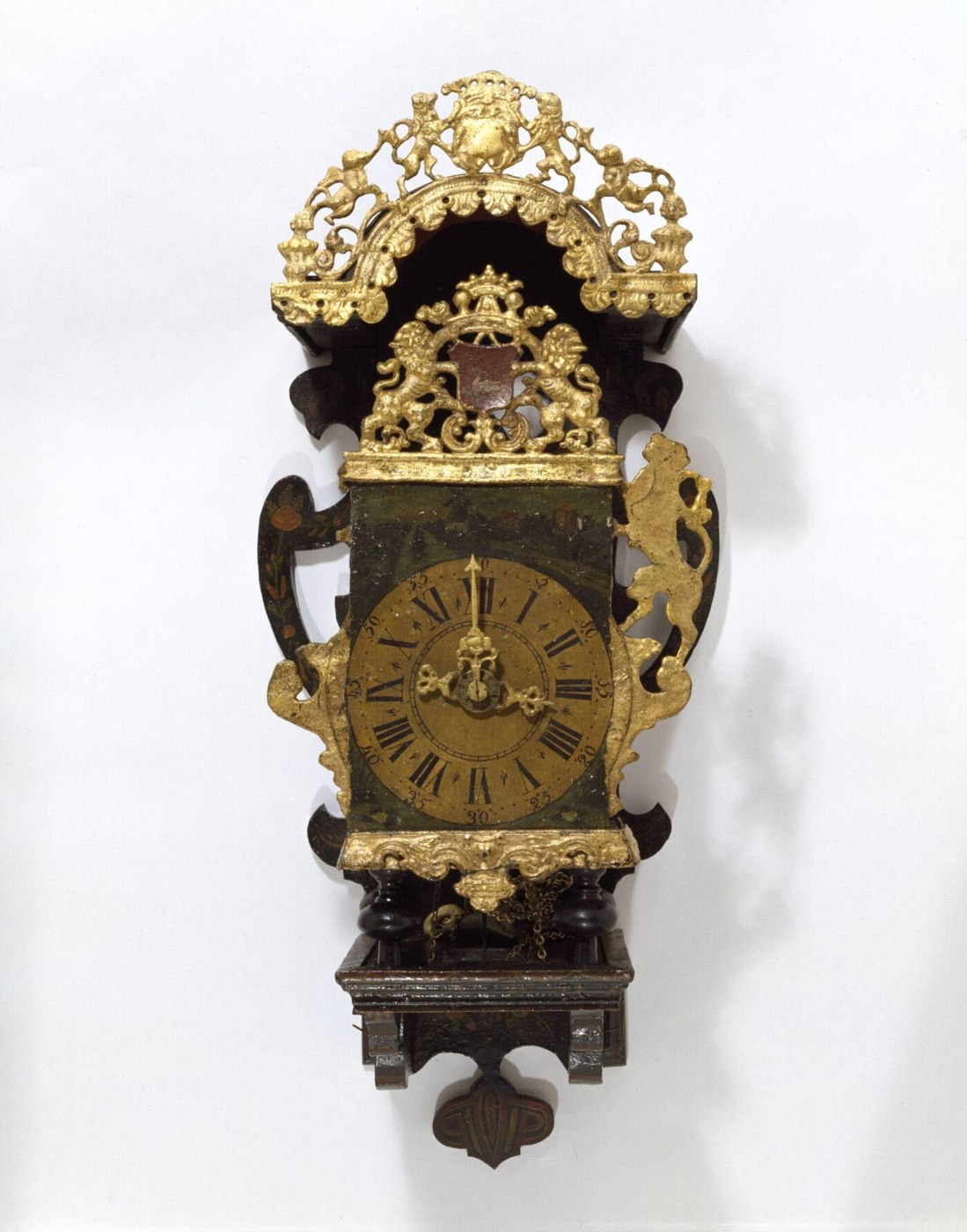
This wall-mounted clock, known as a Stoelklok (chair clock), originates from Friesland and dates to between 1770 and 1830. The architectural design features a wooden case with an arched canopy and a painted dial plate. The decoration incorporates gilded cast lead ornaments, including heraldic cresting with a swan on a red field and rampant lion supporters. The dial includes a Roman chapter ring, an outer Arabic minute ring, and brass hands, with an auxiliary pointer on the hour hand for an alarm mechanism. The iron movement is mounted on four balusters and enclosed within the wooden frame, which is painted with floral motifs on an olive green ground. The clock is suspended from a wall-mounted wooden bracket.

Front view of the Friesland Stoelklok showing the painted dial, gilded lead heraldic cresting, and wooden wall bracket.
Front view of the Friesland Stoelklok showing the painted dial, gilded lead heraldic cresting, and wooden wall bracket. — Victoria and Albert Museum. Rights pending — permission not yet requested. Original source

Catalogue identity

Source
collections.vam.ac.uk
Category
Clock · Wall clock
Maker / attribution
Not established
Reference
Not recorded
Catalogue / lot identifier
M.16:1 to 7 -1965
Source-reported date
1770-1830
Source-reported place
Friesland

Source-reported attribution and specifications are not independent authentication. A listing does not establish present ownership, current display, availability or permission to reproduce.

Object description

Casework and Decorative Elements

The clock is constructed with a rectangular wooden case designed for wall mounting, supported by a distinct wooden bracket. The exterior surfaces are painted, featuring decorative floral designs, specifically roses, set against an olive green background. The canopy is arched, surmounted by elaborate, pierced, and gilded lead cresting. A central armorial feature displays a crowned coat of arms depicting a white swan on a red field, while side ornaments consist of cast lead rampant lions, one of which exhibits breakage.

Additional gilded lead decorations include a pierced apron ornament attached below the dial plate and monogrammed cresting on the sides. The dial plate itself is hand-painted, showing a Dutch canal scene above the chapter ring and floral elements below.

Evidence for this section
  • “A rectangular case with side doors (now separate, but originally hinged and glazed) enclosing an iron movement with a bell at the top.”
  • “The brackets which attach the clock to the wall are, like the frames to the side doors, painted with roses against an olive green ground.”
  • “It is flanked by rampant lions cast in gilt lead (one is broken).”

Movement and Dial

The timekeeping mechanism is an iron movement supported by four balusters and surmounted by a bell. The dial plate features a standard Roman numeral chapter ring accompanied by an outer Arabic numeral minute ring. Time is indicated by brass hands. A specific feature of this movement is the alarm mechanism, identifiable by a secondary brass pointer fixed to the central hour hand, which interacts with an alarm dial.

While the clock is designed to be weight-driven, the current status of the internal components is incomplete regarding the external mechanism. The original museum documentation references a system of brass chains, pulleys, and four weights, consisting of both conical and cylindrical shapes in lead and brass. However, these specific parts have not been definitively associated with this object during subsequent cataloguing efforts.

Evidence for this section
  • “The dial has a Roman chapter ring, and outer Arabic minute ring and brass hands, the hour hand with a brass pointer attached to the central alarm dial.”
  • “The movement is supported by four balusters.”
  • “The brass chain and pulleys with four weights (two cylindrical, two conical, one of lead the other of brass) are listed in the original registered description but have not yet been identified or correctly numbered.”

Provenance and Condition

This clock was donated to the Victoria and Albert Museum in 1965 by Miss Frances M Rivers.

Regarding its preservation, the museum records note that the lead decorative elements sustained damage and required restoration. Annotations in the registered description indicate that parts of the lead ornamentation were broken and subsequently repaired by the museum, at which time the gilding on these components was also partially renewed to maintain the clock's visual consistency.

Evidence for this section
  • “Such clocks were known as 'Stoel Klok' (chair clock).”
  • “The registered description has been annotated at a later date as follows 'Lead decoration broken partly repaired in museum when gilding was also partly renewed'.”

Open research questions

  • Can the unidentified monogram on the side ornaments be traced to a specific family or guild in Leeuwarden?
  • Are the missing chain, pulleys, and weights held elsewhere in the V&A collection or were they permanently lost prior to 1965?

Source evidence

Recorded claims and source quotations for Friesland Stoelklok
FieldSource-reported valueSource quotation
Accession numberM.16:1 to 7 -1965“M.16:1 to 7 -1965”
Date1770-1830“1770-1830”
Place of originFriesland“Place of origin: Friesland (made)”
MaterialsWooden frame, iron movement, lead and brass ornaments“Wooden frame with painted dial and surround supporting gilded metal cresting, and iron movement”
Dimensions17 1/4 in x 11.5 in x 9.5 in“Height: 17 1/4 in; Width: 11.5 in; Height: 22 7/8 in; Depth: 9.5 in”

Visible details

  • The clock has a painted dial plate featuring canal scene and floral motifs.
  • One of the gilt lead rampant lion side ornaments is broken.
  • The hour hand is fitted with a secondary brass alarm pointer.
  • The clock is mounted on a wooden bracket base with a hanging decorative element.

Research qualifications

  • The brass chain, pulleys, and four weights listed in the original museum description have not been identified or correctly numbered.
  • Gilding on the lead ornamentation was partially renewed during museum maintenance.

Photograph identity and source facts were screened before import; rights clearance remains pending.

Consulted source

Clock

Reviewed 2026-10-26 · Record 70f39baaa9

Terms in this record

Glossary explanations for terms named in this object’s record.