
Skip to content
The Encyclopedia of Horology

Clock · Skeleton clock

French early 19th-century ormolu and marble greatwheel skeleton timepiece

Partially verified

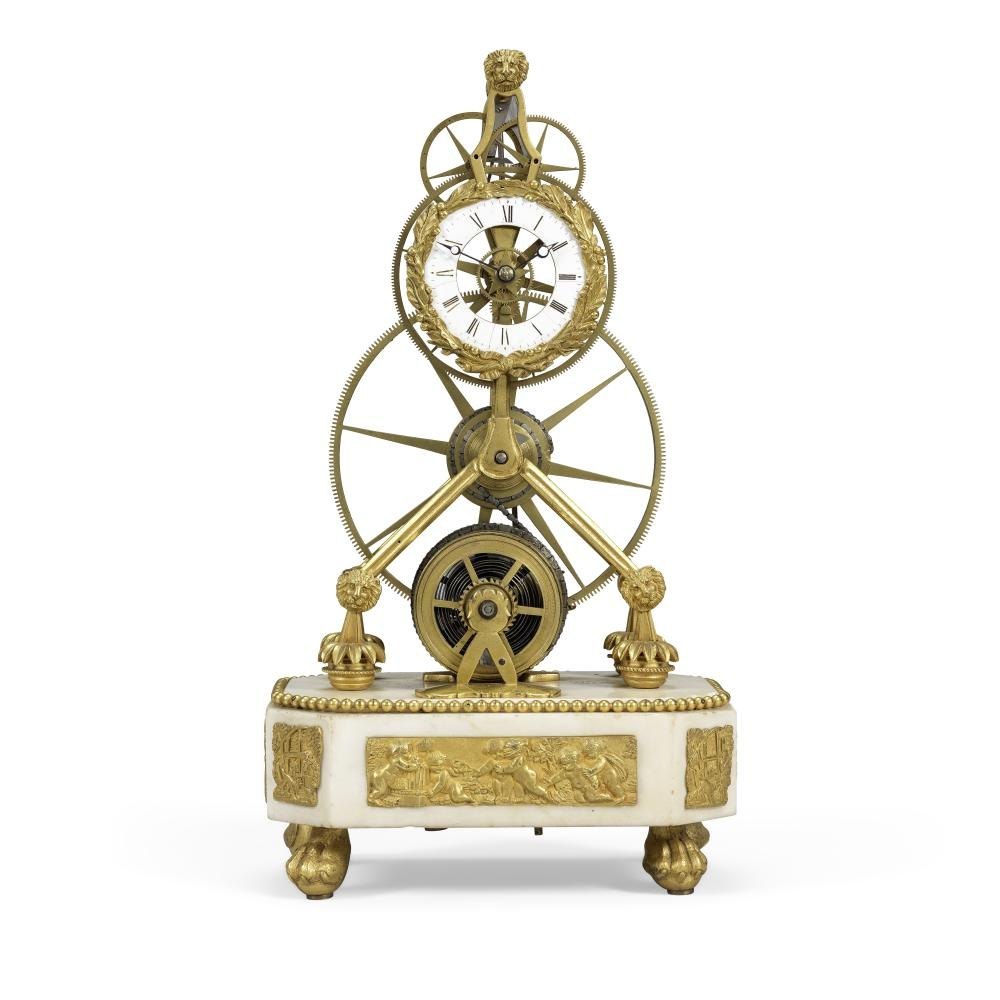
This early 19th-century French skeleton timepiece features an inverted Y-shaped ormolu frame decorated with burnished and matt finishes. The framework incorporates lion mask mounts and leaf-cast supports, set upon a white marble base with a beaded ormolu border and ball-and-claw feet. The 2.75-inch white enamel dial displays Roman numerals and Breguet-style hands, with an open center revealing a star-shaped center wheel. The timekeeping mechanism is a chain fusee movement with a prominent 5.75-inch diameter great wheel featuring eight tapering crossings, while other wheels in the train have five or six crossings. The movement terminates in a pin-wheel escapement. A large spring barrel is positioned between lower supports with skeletonized caps. The assembly stands approximately 35 centimeters high. The timepiece is currently documented within a paneled glass case on a mahogany base and is accompanied by a winding key.

A front view of the French early 19th-century skeleton timepiece, showing the movement, dial, and ormolu-mounted marble base.
A front view of the French early 19th-century skeleton timepiece, showing the movement, dial, and ormolu-mounted marble base. — Bonhams, via Invaluable. Rights pending — permission not yet requested. Original source

Catalogue identity

Source
orbiscollectibles.com
Category
Clock · Skeleton clock
Maker / attribution
Not established
Reference
Not recorded
Catalogue / lot identifier
Source URL identifies the listing
Source-reported date
early 19th century
Source-reported place
France

Source-reported attribution and specifications are not independent authentication. A listing does not establish present ownership, current display, availability or permission to reproduce.

Object description

Framework and Decorative Elements

The primary structure of this timepiece is an inverted Y-shaped ormolu frame, which provides the skeletonized visual effect. The metalwork features a combination of burnished and matt finishes, serving as a support for the gear train and dial. Integrated into the frame are several decorative motifs, including lion mask mounts and leaf-cast supports, which provide an ornamental aesthetic to the otherwise utilitarian skeleton design.

The clock is supported by a white marble base, which acts as the foundation for the vertical structure. This base is accented with a beaded ormolu border and is supported by ball-and-claw style feet. The overall presentation is elevated by the inclusion of a mahogany base and a paneled glass case, which houses the timepiece assembly.

Evidence for this section
  • “features an elaborate inverted Y-shaped ormolu frame decorated with burnished and matt finishes”
  • “The framework is punctuated by lion mask mounts and leaf-cast supports, resting upon a white marble base bordered with beaded ormolu mounts and standing on ball-and-claw feet”

Movement and Dial Mechanics

The dial is a 2.75-inch enamel plate featuring Roman numerals and open Breguet-style hands. A notable detail of the dial is its open center, which exposes a star-shaped center wheel, contributing to the timepiece's transparency. This design choice aligns with the overall aesthetic of exposing the internal mechanics to the observer.

The timekeeping element is a chain fusee movement. Its most prominent feature is a 5.75-inch diameter great wheel characterized by eight tapering crossings. The rest of the gear train is similarly skeletal, with wheels composed of five or six crossings. The movement terminates in a delicate pin-wheel escapement, and the large spring barrel is positioned between lower supports with skeletonized caps.

Evidence for this section
  • “The 2.75-inch enamel dial displays Roman numerals and open Breguet-style moon hands, with an open center showcasing a star-shaped center wheel.”
  • “The mechanism is a chain fusee movement featuring a prominent 5.75-inch diameter great wheel with eight tapering crossings”
  • “terminating in a delicate pin-wheel escapement”

Provenance and Documentation

The object is described as a piece of French horological design from the early 1800s. Its status is currently recorded in a source archive as an individual object type with credible evidence. The documentation notes that it is accompanied by a winding key, which is part of the current assembly.

While the record provides comprehensive measurements and material descriptions, it does not assign the work to a specific maker or workshop. The classification of the object as a 'greatwheel' skeleton timepiece is used by the source as a descriptive category rather than a brand-specific designation.

Evidence for this section
  • “The piece represents a significant example of French horological design from the early 1800s”
  • “The clock stands approximately 35 centimeters high and is accompanied by a winding key.”

Open research questions

  • Are there any maker's signatures located on the movement plates or the marble base not visible in the provided imagery?
  • Does the specific configuration of the pin-wheel escapement align with documented output from early 19th-century French skeleton clock makers?

Source evidence

Recorded claims and source quotations for French early 19th-century ormolu and marble greatwheel skeleton timepiece
FieldSource-reported valueSource quotation
Height35 cm“The clock stands approximately 35 centimeters high”
MaterialOrmolu, white marble, enamel, mahogany, glass“ormolu, white marble, enamel, mahogany, glass”
Dial Diameter2.75 inches“The 2.75-inch enamel dial”
EscapementPin-wheel“terminating in a delicate pin-wheel escapement”
Movement TypeChain fusee“The mechanism is a chain fusee movement”
Base DesignWhite marble with beaded border and ball-and-claw feet“resting upon a white marble base bordered with beaded ormolu mounts and standing on ball-and-claw feet”

Visible details

  • Inverted Y-shaped skeletonized ormolu framework
  • Large prominent 5.75-inch diameter great wheel
  • White marble base with ormolu lion mask mounts
  • Star-shaped wheel exposed within the dial center

Research qualifications

  • Maker is not identified
  • Full internal condition of the movement is not detailed

Photograph identity and source facts were screened before import; rights clearance remains pending.

Consulted source

French early 19th century ormolu and marble greatwheel skeleton timepiece

Reviewed 2026-11-02 · Record 3a3d6e090a

Terms in this record

Glossary explanations for terms named in this object’s record.