
Skip to content
The Encyclopedia of Horology

Pocket watch · Pocket watch

Ferdinand Berthoud Gold and Enamel Watch

Partially verified

This watch, identified by the Metropolitan Museum of Art as accession number 17.101.11, is an early nineteenth-century timepiece attributed to the watchmaker Ferdinand Berthoud (1727–1807). Produced in Paris, the watch features a construction of gold and enamel. The piece measures 2 1/8 inches (5.4 cm) in diameter. Berthoud, who became a master watchmaker in Paris in 1753 and served as Horologist-Mechanic by appointment to the King and the Navy, maintained a workshop that created personal horological pieces alongside his recognized work in marine chronometry. This item was acquired by the museum through the bequest of Laura Frances Hearn in 1917. The watch is classified within the Department of European Sculpture and Decorative Arts, reflecting Berthoud's ongoing production of personal watches into the opening years of the nineteenth century.

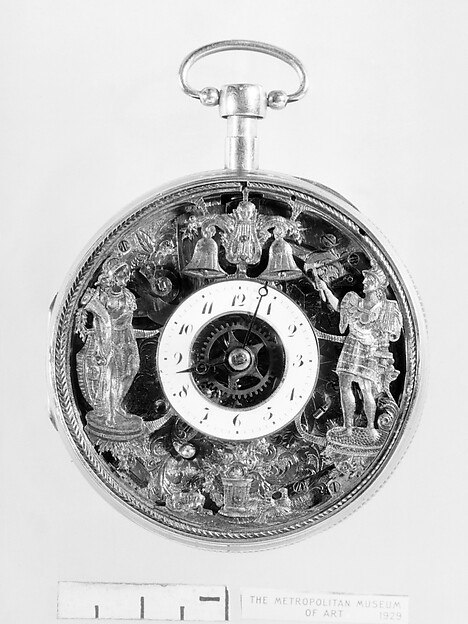
Front view of the Ferdinand Berthoud pocket watch showing the enamel dial and figurative metalwork.
Front view of the Ferdinand Berthoud pocket watch showing the enamel dial and figurative metalwork. — The Metropolitan Museum of Art, New York. Rights pending — permission not yet requested. Original source

Catalogue identity

Source
orbiscollectibles.com
Category
Pocket watch · Pocket watch
Maker / attribution
Ferdinand Berthoud
Reference
Not recorded
Catalogue / lot identifier
17.101.11
Source-reported date
early 19th century
Source-reported place
France

Source-reported attribution and specifications are not independent authentication. A listing does not establish present ownership, current display, availability or permission to reproduce.

Object description

Physical Description and Materials

The object is a pocket-style watch crafted in Paris during the early nineteenth century. It is constructed primarily of gold and enamel, measuring 2 1/8 inches (5.4 cm) in diameter. The visible face of the movement incorporates an intricate display featuring a central white enamel dial marked with Arabic numerals.

Beyond the central dial, the internal plate displays decorative metalwork including two sculpted figures placed on either side of the dial, alongside a bell apparatus. This combination of precious metals and enamel reflects the decorative standards for personal timepieces produced within the Berthoud workshop during this era.

Evidence for this section
  • “Diameter: 2 1/8 in. (5.4 cm)”

Maker and Historical Context

The watch is attributed to Ferdinand Berthoud (1727–1807), a notable figure in the history of horology. Berthoud gained recognition as a master watchmaker in Paris in 1753 and subsequently received the appointment of Horologist-Mechanic to the King and the Navy. His career was marked by significant contributions to the development of marine chronometers.

While Berthoud is documented for his technical advancements in chronometry, his Parisian workshop also facilitated the production of domestic and personal watches. This object serves as an example of that personal output, which continued into the early nineteenth century following his established success.

Evidence for this section
  • “Berthoud became a master watchmaker in Paris in 1753 and went on to hold the title of Horologist-Mechanic by appointment to the King and the Navy.”
  • “his workshop in Paris also produced domestic and personal horological pieces”

Provenance and Documentation

This timepiece is formally documented as object 17.101.11 within the holdings of The Metropolitan Museum of Art. It was added to the collection through the bequest of Laura Frances Hearn in 1917. The object is officially categorized under the museum's Department of European Sculpture and Decorative Arts.

Current museum records confirm the attribution to Ferdinand Berthoud and the dating of the object to the early nineteenth century. The collection status is publicly listed, and the item remains a part of the museum's decorative arts record.

Evidence for this section
  • “The Metropolitan Museum of Art holds this object as 17.101.11.”
  • “Credit line: Bequest of Laura Frances Hearn, 1917.”
  • “Department: European Sculpture and Decorative Arts.”

Open research questions

  • What are the specific hallmarks or maker's marks located on the internal case back?
  • Does the movement bear a serial number that correlates with Berthoud's recorded output for personal watches?

Source evidence

Recorded claims and source quotations for Ferdinand Berthoud Gold and Enamel Watch
FieldSource-reported valueSource quotation
MakerFerdinand Berthoud“Watchmaker: Ferdinand Berthoud (French, 1727–1807)”
Accession Number17.101.11“The Metropolitan Museum of Art holds this object as 17.101.11.”
MaterialsGold and enamel“The museum records its materials as: Gold, enamel.”
Diameter2 1/8 in. (5.4 cm)“Diameter: 2 1/8 in. (5.4 cm).”
OriginParis, France“Watch by Ferdinand Berthoud, French, Paris, early 19th century”
Credit LineBequest of Laura Frances Hearn, 1917“Credit line: Bequest of Laura Frances Hearn, 1917.”

Visible details

  • The watch features a central white enamel dial with Arabic numerals.
  • The movement plate is decorated with figurative metal appliqués including two standing figures and a bell mechanism.
  • The case is constructed from gold and enamel materials.

Research qualifications

  • The specific production date within the early 19th century is not definitively fixed.
  • The provenance or internal movement components have not been fully verified against individual maker's marks in the provided source text.

Photograph identity and source facts were screened before import; rights clearance remains pending.

Consulted source

Watch by Ferdinand Berthoud, French, Paris, early 19th century

Reviewed 2026-11-02 · Record a64df40d06

Terms in this record

Glossary explanations for terms named in this object’s record.