
Skip to content
The Encyclopedia of Horology

Clock · Bracket clock

English ebonised bracket clock, Markwick Londini

Partially verified

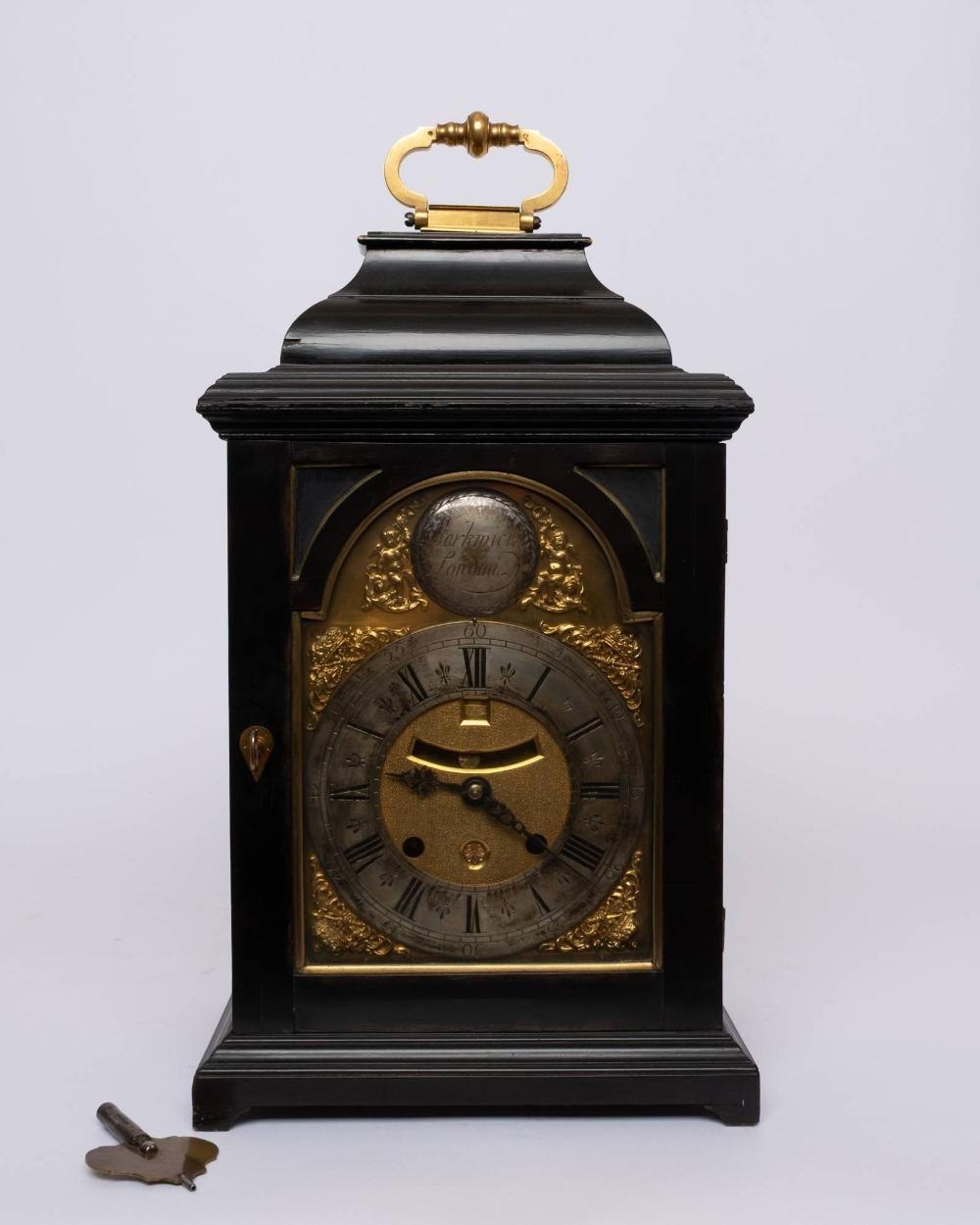
This English bracket clock is attributed to the first half of the 18th century and features an ebonised case with glazing on all sides, designed to permit viewing of the internal mechanism. The case is surmounted by a tapering gable, which supports a brass handle intended for transport. The dial consists of a central silver-plated hour ring marked with Roman hour numerals and an Arabic minute track. This assembly is complemented by gilded decorative appliqués and a silver cartouche engraved with the signature "Markwick Londini". The movement includes an engraved plate and a pendulum regulated by a thread suspension. It features a striking mechanism that operates on a bell and includes an hour repeating function. The clock measures 44 cm in height. The signature refers to James Markwick the Younger, who was admitted to the Freedom of the Clockmakers’ Company in 1692.

Front view of the English ebonised bracket clock, signed "Markwick Londini", showing the dial layout, handle, and glazed case.
Front view of the English ebonised bracket clock, signed "Markwick Londini", showing the dial layout, handle, and glazed case. — Auktionshaus Plückbaum, via Invaluable. Rights pending — permission not yet requested. Original source

Catalogue identity

Source
orbiscollectibles.com
Category
Clock · Bracket clock
Maker / attribution
James Markwick the Younger
Reference
Not recorded
Catalogue / lot identifier
Source URL identifies the listing
Source-reported date
first half of the 18th century
Source-reported place
England

Source-reported attribution and specifications are not independent authentication. A listing does not establish present ownership, current display, availability or permission to reproduce.

Object description

Case and Exterior Features

The clock is housed in an ebonised case that is glazed on all sides, providing a transparent view of the internal movement. The structure is finished with a tapering gable at the top, which incorporates a brass carrying handle for transport.

This ring displays Roman numerals for the hours and an Arabic track for the minutes. The dial is decorated with gilded appliqués located in the corners, and a silver cartouche positioned above the central dial components displays the maker's signature.

Evidence for this section
  • “ebonised case that is glazed on all sides, allowing for visibility of the internal mechanics.”
  • “topped with a tapering gable finished with a brass handle for transport.”
  • “centered on a silver-plated hour ring featuring classic Roman hour numerals and an Arabic minute track.”
  • “crowned by a prominent silver cartouche bearing the signature "Markwick Londini".”

Movement and Technical Details

The clock's internal components include an engraved plate and a pendulum system suspended by thread.

The timekeeping mechanism is augmented by a strike train that functions using a bell. Furthermore, the clock incorporates an hour repeating function, allowing the user to trigger the strike mechanism to count the hour on demand.

Evidence for this section
  • “includes an engraved plate, a pendulum regulated by a thread suspension”
  • “a striking mechanism that sounds on a bell.”
  • “It also incorporates an hour repeating function.”

Maker and Attribution

The clock is signed "Markwick Londini" on a silver cartouche. This signature is attributed to James Markwick the Younger, who followed in the professional footsteps of his father, James Markwick.

Historical records indicate James Markwick the Younger was a figure in London clockmaking, having achieved the status of Master in 1720 after previously being admitted to the Freedom of the Clockmakers’ Company in 1692.

Evidence for this section
  • “crowned by a prominent silver cartouche bearing the signature "Markwick Londini".”
  • “James Markwick the Younger, was a prominent figure, admitted to the Freedom of the Clockmakers’ Company in 1692 and achieving master status in 1720”

Open research questions

  • Does the movement bear a serial number on the plate to further refine the production date?
  • Are there interior stamps on the brass plates that might confirm the specific workshop of James Markwick the Younger?

Source evidence

Recorded claims and source quotations for English ebonised bracket clock, Markwick Londini
FieldSource-reported valueSource quotation
MakerJames Markwick the Younger“James Markwick the Younger, was a prominent figure, admitted to the Freedom of the Clockmakers’ Company in 1692”
Height44 cm“The clock stands 44 cm tall.”
SignatureMarkwick Londini“crowned by a prominent silver cartouche bearing the signature "Markwick Londini".”
MaterialsEbonised wood, brass, silver-plated metal, gilded metal“ebonised wood, brass, silver-plated metal, gilded metal”
SuspensionThread suspension“a pendulum regulated by a thread suspension”
MechanismStriking and repeating“a striking mechanism that sounds on a bell. It also incorporates an hour repeating function.”

Visible details

  • Ebonised wooden case with brass carry handle
  • Silver-plated dial components with Roman numerals
  • Glazed side panels for movement visibility
  • Gilded corner spandrel appliqués visible on the dial

Research qualifications

  • The attribution of the specific clock to James Markwick the Younger is based on the signature "Markwick Londini"
  • The exact date within the first half of the 18th century remains unverified by specific maker records

Photograph identity and source facts were screened before import; rights clearance remains pending.

Consulted source

English ebonised bracket clock, Markwick Londini, first half 18th century

Reviewed 2026-11-02 · Record 76eda3a1db

Terms in this record

Glossary explanations for terms named in this object’s record.