
Skip to content
The Encyclopedia of Horology

Clock · Skeleton clock

English Brass Fusée Skeleton Clock by William Boyle

Partially verified

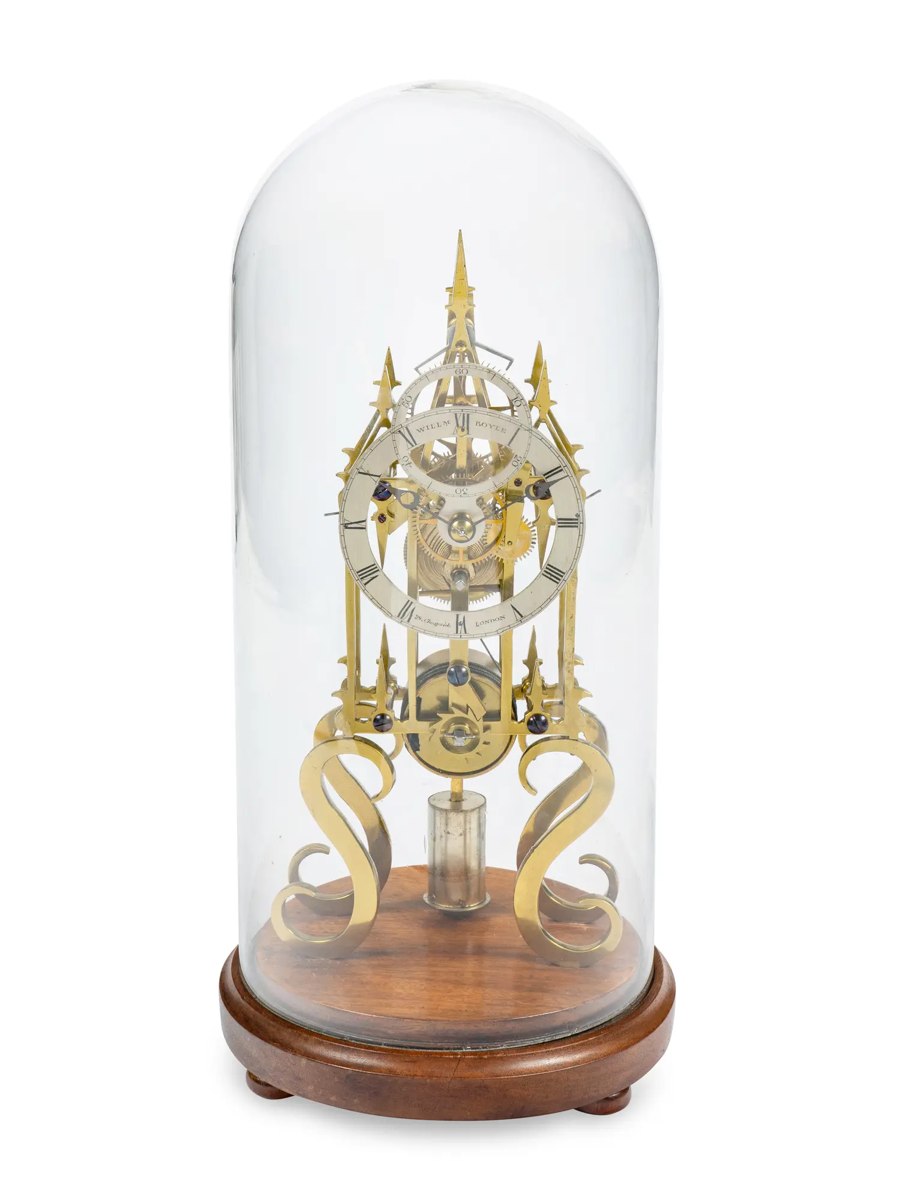
This 19th-century English brass fusée skeleton clock is attributed by the auction source to William Boyle of London. The exposed brass framework features gothic-style pierced spires and architectural pinnacles supported on pronounced S-scroll legs over a stepped wooden circular base. The time display features an open silvered chapter ring with Roman numerals, topped by an auxiliary subsidiary seconds dial ring inscribed with the maker's name. A tall cylindrical glass dome encases the entire clock, with the movement standing 13 inches tall and reaching an overall height of 17 inches.

Front view of the William Boyle brass fusée skeleton clock under glass dome on wood base
Front view of the William Boyle brass fusée skeleton clock under glass dome on wood base — Freeman's. Rights pending — permission not yet requested. Original source

Catalogue identity

Source
freemansauction.com
Category
Clock · Skeleton clock
Maker / attribution
William Boyle
Reference
Not recorded
Catalogue / lot identifier
350
Source-reported date
19th Century
Country
United Kingdom

Source-reported attribution and specifications are not independent authentication. A listing does not establish present ownership, current display, availability or permission to reproduce.

Object description

Identity and Attribution

This timepiece is listed as an English brass fusée skeleton clock. The auction source attributes the piece to the 19th-century London-based maker William Boyle.

The item is supplied with a tall cylindrical glass dome enclosure.

Evidence for this section
  • “William Boyle, London, 19th Century”
  • “An English Brass Fusée Skeleton Clock”
  • “with a glass dome.”

Construction and Visual Elements

The movement features an architectural skeletonized brass frame, which includes gothic-style pinnacles and spires. The structure is supported by curved S-scroll legs resting on a circular wooden plinth.

The dial assembly includes an open silvered chapter ring with Roman numerals. An upper subsidiary dial is present, though the second hand for this dial is not recorded as being present in the source.

Evidence for this section
  • “Architectural skeletonised brass frame adorned with gothic-style pinnacles and spires”
  • “Substantial curved S-scroll front support legs affixed to a round wooden plinth”
  • “For the smaller dial at the top, no second hand is present.”

Operational and Condition Notes

The clock includes a pendulum. When set in motion, the mechanism runs and appears to keep time, though the source notes that it has not been tested for duration or accuracy.

Documented condition issues include an age split running across the top of the wood base and minor chips observed along the bottom edge of the glass dome.

Evidence for this section
  • “When pendulum is set in motion, the clock runs and appears to keep time, but has not been tested for duration or accuracy.”
  • “There is an age split running across the top of the wood base.”
  • “The dome with a few minor chips to its bottom edge”

Open research questions

  • What is the historical evidence confirming William Boyle as a maker of this specific style of skeleton clock?
  • Does the age split in the wooden base affect the stability of the movement or its supporting legs?

Source evidence

Recorded claims and source quotations for English Brass Fusée Skeleton Clock by William Boyle
FieldSource-reported valueSource quotation
Maker Attribution and OriginWilliam Boyle, London“William Boyle, London, 19th Century”
Clock Height13 inches“Height of clock 13 inches.”
Overall Height17 inches“Height overall : 17 inches.”
EnclosureGlass dome“with a glass dome.”
Clock Height13 inches“Height of clock 13 inches.”
Overall Height17 inches“Height overall : 17 inches.”

Visible details

  • Architectural skeletonised brass frame adorned with gothic-style pinnacles and spires
  • Substantial curved S-scroll front support legs affixed to a round wooden plinth
  • Silvered openwork chapter ring with black Roman numerals and a subsidiary ring near the top
  • Visible pendulum bob suspended below the central movement plates
  • Fitted with a tall clear glass dome

Research qualifications

  • Source reports that no second hand is present for the upper subsidiary dial
  • Movement was not tested by the source for duration or accuracy
  • Source notes an age split running across the wood base and minor chips to the dome's bottom rim

Photograph identity and source facts were screened before import; rights clearance remains pending.

Consulted source

An English Brass Fusée Skeleton Clock | Freeman's

Reviewed 2026-10-25 · Record 962233e08f

Terms in this record

Glossary explanations for terms named in this object’s record.