
Skip to content
The Encyclopedia of Horology

Clock · Table clock

Empire period Baccarat crystal and gilded bronze amphora clock

Partially verified

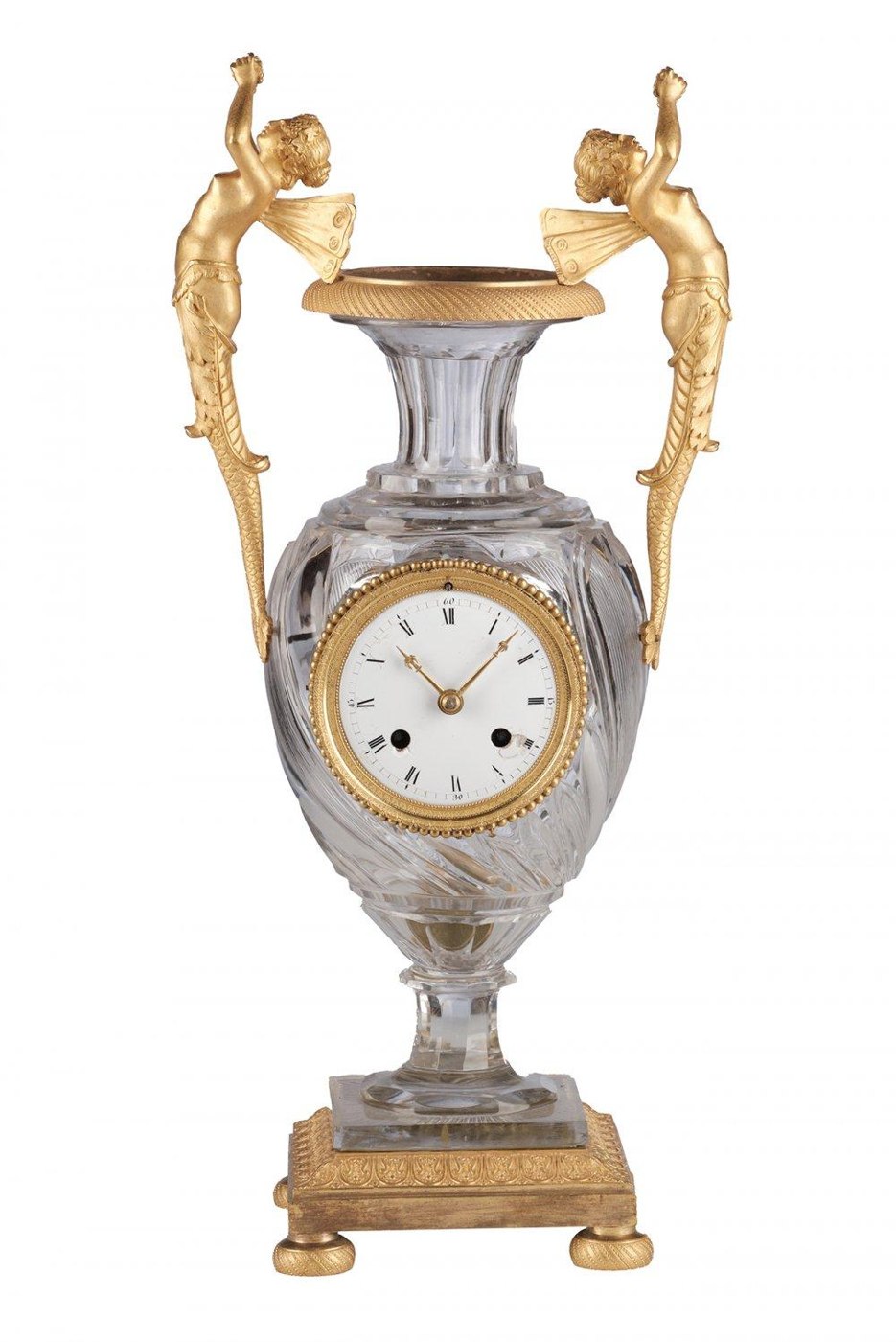
This table clock, attributed to France and dated to approximately 1800, features a distinctive amphora-shaped design composed of clear Baccarat crystal and gilded bronze. The timepiece is supported by a square, bronze base decorated with an ornamental frieze and four ball feet. The crystal body exhibits a carved surface with a baluster-shaped profile, a biconical neck, and a beveled shaft. Two symmetrical gilded bronze handles, cast in the form of winged female figures, are affixed to the body of the vessel. The clock dial is centrally mounted within the crystal, framed by a decorative outer perimeter. The clock measures 43 cm in height and maintains an overall aesthetic associated with early nineteenth-century decorative horological pieces.

Front view of the Empire-period amphora clock in Baccarat crystal and gilded bronze.
Front view of the Empire-period amphora clock in Baccarat crystal and gilded bronze. — Setdart Auction House (via Invaluable). Rights pending — permission not yet requested. Original source

Catalogue identity

Source
www.invaluable.com
Category
Clock · Table clock
Maker / attribution
Attributed to Baccarat
Reference
Not recorded
Catalogue / lot identifier
115
Source-reported date
ca. 1800
Source-reported place
France

Source-reported attribution and specifications are not independent authentication. A listing does not establish present ownership, current display, availability or permission to reproduce.

Object description

Design and Composition

The clock is designed as an amphora, a form often utilized in the decorative arts of the period. The body is fashioned from transparent Baccarat crystal, which has been carved with geometric or rhythmic patterns that enhance its light-reflecting qualities. This crystal vessel is set into a square bronze base, which serves as the anchor for the entire assembly. The base is decorated with an ornamental frieze and rests on four ball feet, providing a stable foundation.

The upper portion of the clock includes a biconical neck and a beveled shaft, contributing to the vessel's overall profile. Attached to the shoulders of the crystal are two elaborate gilded bronze handles. These handles are modeled in the likeness of winged female figures, which serve both as structural supports and as primary decorative motifs, consistent with the classical influences observed in the design.

Evidence for this section
  • “The piece follows the popular model of amphora with square base with ornamental frieze on four ball feet”
  • “The body is made of transparent baccarat glass and carved with bronze handles that take the form of a winged young woman.”
  • “The base has a beveled shaft, baluster-shaped body with descending shoulder and biconical neck.”

Dial and Functionality

The timepiece is integrated directly into the crystal body. The dial is located on the front face, featuring a white surface with Roman numerals for time indication. The dial is surrounded by a gilded bronze bezel that includes a decorative border, which helps to separate the clock movement visually from the cut glass of the body.

The dial is relatively simple, allowing the ornate bronze and crystal elements of the housing to remain the focal points of the object.

Evidence for this section
  • “The dial is decorated on the outer perimeter.”

Provenance and Historical Context

The clock is identified as an Empire-period object, reflecting the neoclassical aesthetics prominent in France at the beginning of the nineteenth century. The auction documentation suggests that this style of clock was a common feature in domestic interiors of the era, serving both functional timekeeping purposes and as a statement of refinement.

The description explicitly links the design to broader trends in decorative arts where classical elements, such as human figures on pedestals and rigid, straight lines, were favored. This particular piece represents a type of table clock that was manufactured in France around 1800, utilizing both Baccarat crystal and gilded bronze in its construction.

Evidence for this section
  • “Empire clock; France, ca. 1800.”
  • “This type of clocks were very common in the I Empire”
  • “the influence of classical decorative elements is clear, both in the reliefs and in the human figures on the pedestals, always with marked straight lines.”

Open research questions

  • Does the movement contain any specific maker's marks or serial numbers?
  • Are there any signs of later modifications to the crystal or bronze components?

Source evidence

Recorded claims and source quotations for Empire period Baccarat crystal and gilded bronze amphora clock
FieldSource-reported valueSource quotation
Maker/AttributionFrance, ca. 1800“Empire clock. France, ca. 1800.”
MaterialsBaccarat crystal and gilded bronze“Baccarat crystal and gilded bronze.”
Height43 cm“Measurements: 43 cm.”
Base designSquare base with frieze and ball feet“square base with ornamental frieze on four ball feet”
Handle formWinged young woman“bronze handles that take the form of a winged young woman.”
Body shapeAmphora-style“follows the popular model of amphora”
Lot number115“Lot 115”

Visible details

  • Gilded bronze handles modeled as winged female figures
  • Crystal body features carved, swirling decorative patterns
  • Square base adorned with an ornamental frieze and ball feet
  • Dial displays Roman numerals and two winding arbors

Research qualifications

  • The exact manufacturing date of circa 1800 is an attribution by the source
  • The attribution to Baccarat crystal is reported by the source without additional verification

Photograph identity and source facts were screened before import; rights clearance remains pending.

Consulted source

Empire clock. France, ca. 1800. Baccarat crystal and gilded bronze.

Reviewed 2026-10-26 · Record 803e955cf7

Terms in this record

Glossary explanations for terms named in this object’s record.