
Skip to content
The Encyclopedia of Horology

Clock · Table clock

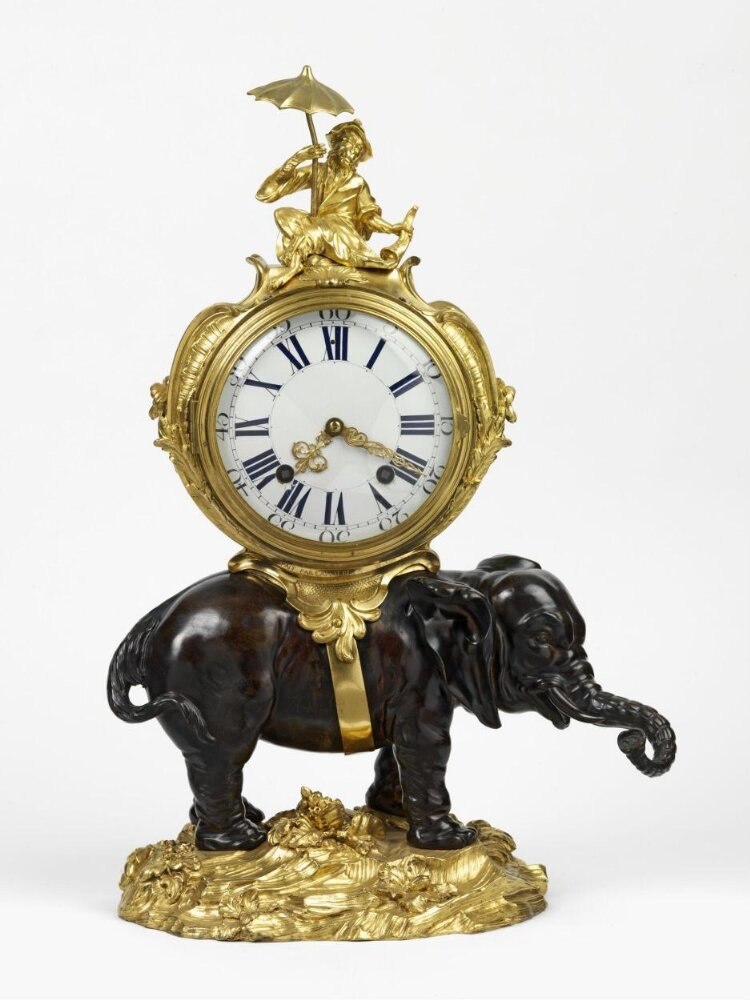
Elephant table clock

Partially verified

This table clock features a drum-shaped case of chased gilded bronze, resting on the back of a bronze elephant standing upon a base of gilded bronze rockwork. The top of the drum is surmounted by a seated, draped monkey figure holding a parasol and a horn. The white enamel dial measures 17.8cm in diameter with blue roman numerals for hours and arabic numerals for five-minute intervals. The movement is signed by Jerome Martinot, while the striking train bears a signature attributed to Alexis Magny. The case is engraved with a signature attributed to the Caffieri family, and the dial back is signed by Antoine-Nicolas Martinière. It was bequeathed to the South Kensington Museum by John Jones in 1882. The clock stands 65cm high, 44cm wide, and up to 30cm deep.

Elephant table clock, 1742-1745
Elephant table clock, 1742-1745 — Victoria and Albert Museum, London. Rights pending — permission not yet requested. Original source

Catalogue identity

Source
collections.vam.ac.uk
Category
Clock · Table clock
Maker / attribution
Jerome Martinot, Alexis Magny, Antoine-Nicolas Martinière, Jacques or Philippe Caffieri
Reference
Not recorded
Catalogue / lot identifier
1008:1-1882
Source-reported date
1742-1745
Source-reported place
France

Source-reported attribution and specifications are not independent authentication. A listing does not establish present ownership, current display, availability or permission to reproduce.

Object description

Case and Construction

The clock case consists of a chased gilded bronze drum featuring a scroll design. It is surmounted by a seated monkey figure holding a parasol and a horn. The drum is positioned on the back of a bronze elephant, which stands on a base of gilded bronze rockwork. The elephant features a characteristic reddish patina noted in eighteenth-century work.

The case is engraved 'fait par Caffieri'. It remains uncertain whether the case is the work of Jacques Caffieri or his son Philippe Caffieri, who entered into a partnership in 1747.

Evidence for this section
  • “The drum of chased gilded bronze, scroll design, surmounted by the seated figure of a draped monkey”
  • “The slightly reddish patina of the elephant is characteristic of 18th century work.”
  • “A rectangular ebony stand with gilded bronze mounts that accompanied the clock when it entered the collection is probably a later addition.”
  • “it is not certain which of them was responsible for the case and assemblage of this clock.”

Movement and Dial

The movement is signed by Jerome Martinot and contains two large going barrels. The going train utilizes a verge escapement with a 23.8cm long pendulum and a lenticular bob. The striking train is located to the left and includes an external count-wheel for half-hourly strikes; a spring within the train bears the signature of Magny, possibly Alexis Magny.

The 17.8cm diameter dial is constructed of white enamel with blue markings. Roman numerals represent the hours, while arabic numerals indicate five-minute intervals. and is signed by Antoine-Nicolas Martinière on the reverse. The museum reports that the dial might have been re-enamelled in the nineteenth century.

Evidence for this section
  • “the movement is signed by Jerome Martinot”
  • “The going train is to the right, with a verge escapement and crutch attached to the pivoted verge.”
  • “The locking-plate striking train is to the left, with an external count-wheel coaxial with a second wheel of the striking train”
  • “the dial, despite Martinière's eighteenth-century signature, may well have been re-enamelled in the nineteenth century.”

Provenance and History

The clock was part of the collection owned by the businessman John Jones and kept at his Piccadilly residence. Following his death in 1882, the object was transferred to the South Kensington Museum per his 1879 will and 1880 codicil. The clock is one of sixteen examples bequeathed by Jones to the museum.

The object was documented in the 1883 Handbook to the Jones bequest, which noted the high value of the collection.

Evidence for this section
  • “This clock was among a large collection of furniture, porcelain, metalwork, paintings and books owned by the tailor and businessman John Jones”
  • “Jones bequeathed the objects to the South Kensington Museum, and they were transferred there after his death in 1882.”
  • “The number of signatures reflects how such clocks were assembled by 'marchands merciers'”
  • “Such elaborate clocks often included an organ in the base, although this does not survive for the V&A example.”

Open research questions

  • Was the clock originally fitted with an organ in the base?
  • Is there definitive evidence to distinguish between the work of Jacques and Philippe Caffieri on the case?

Source evidence

Recorded claims and source quotations for Elephant table clock
FieldSource-reported valueSource quotation
Accession number1008:1-1882“1008:1-1882”
Dial signatureAntoine-Nicolas Martinière“Painted on the back of the enamelled dial: 'Antoine-Nicola Martinière, 1742'”
Case signatureCaffieri“Engraved on the case, below the clock face, in French: 'fait par Caffieri'”
Striking train signatureMagny“Engraved on a spring, 'Magny 1743'.”
MaterialsGilded bronze, bronze, enamel, ebony“gilded bronze, French, 1742-1755 (with later alterations)”

Visible details

  • Monkey figure holds a parasol and horn
  • Dial has large winding holes at III and VIII
  • Elephant has a reddish patina
  • Enamel dial features blue markings

Research qualifications

  • Uncertain whether Jacques or Philippe Caffieri created the case
  • Possibility that the dial was re-enamelled in the 19th century
  • Original organ in the base is absent

Photograph identity and source facts were screened before import; rights clearance remains pending.

Consulted source

Table clock, Philippe Caffieri, Paris, 1742-1745

Reviewed 2026-11-02 · Record 0519cf247f

Terms in this record

Glossary explanations for terms named in this object’s record.