
Skip to content
The Encyclopedia of Horology

Clock · Carriage clock

Early Victorian Rosewood Giant Carriage Clock

Partially verified

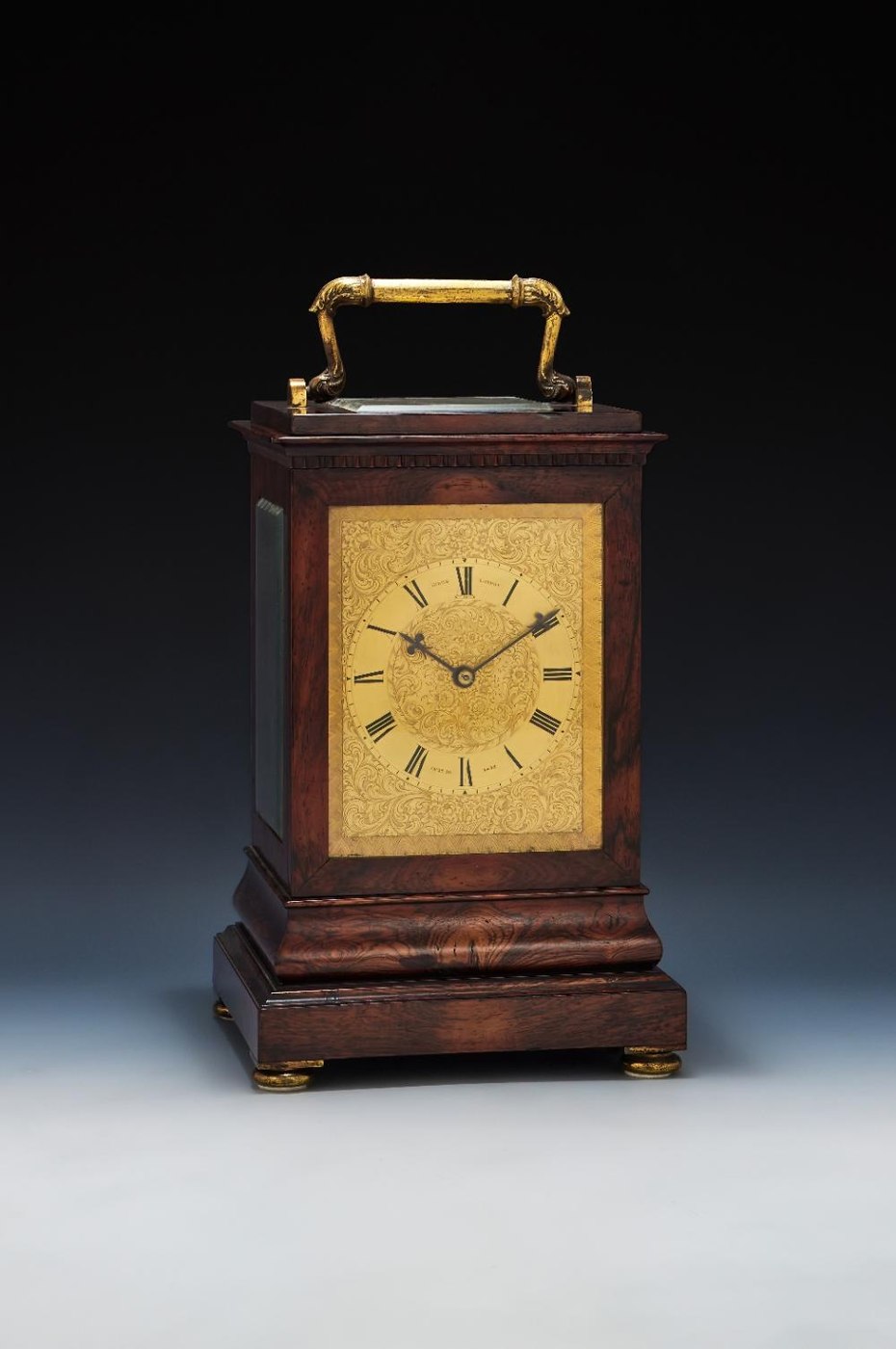
This early Victorian giant carriage clock is encased in rosewood and measures 30.5cm in height with the handle down. The clock features a 4.5-inch wide rectangular gilt brass dial, which is engraved with a central floral spray motif, a radial hatched ground, and a foliate gadroon border. The chapter ring is inscribed "GIBBS, LONDON, No. 1848" at twelve o'clock and "OCT'R 16, 1848" at six o'clock. The dial includes blued steel fleur-de-lys hands and further foliate scroll infill in the margins. The five-panel glazed case is mounted with a hinged, cast and chased gilt brass faceted-baton handle. Structural details include a cavetto cornice, fluted frieze band, and an ogee-shaped apron moulding resting on compressed bun feet.

A rosewood carriage clock with a gilt brass dial and faceted handle, dated 1848.
A rosewood carriage clock with a gilt brass dial and faceted handle, dated 1848. — Dreweatts 1759 Fine Sales / Invaluable. Rights pending — permission not yet requested. Original source

Catalogue identity

Source
orbiscollectibles.com
Category
Clock · Carriage clock
Maker / attribution
George Gibbs
Reference
Not recorded
Catalogue / lot identifier
205843842
Source-reported date
OCT'R 16, 1848
Source-reported place
London, England
Source-reported serial
No. 1848

Source-reported attribution and specifications are not independent authentication. A listing does not establish present ownership, current display, availability or permission to reproduce.

Object description

Case and Dial Construction

The clock is housed in a rosewood case featuring a five-panel glazing system, providing visibility into the movement. The top of the case is fitted with a substantial hinged gilt brass handle, which is cast and chased in a faceted-baton pattern. The case body incorporates a cavetto cornice and a fluted band across the frieze. The front features a hinged door with a gilt, canted surround engraved with stylized lappet leaves. The base of the case sits on an ogee-shaped moulding supported by compressed bun feet.

The dial consists of a 4.5-inch wide rectangular gilt brass plate. It is decorated with a radial hatched ground and a central floral spray. A foliate gadroon border surrounds the dial center, and additional foliate scrollwork is engraved in the upper and lower margins, including a flower basket below the six o'clock position. The time is indicated by blued steel fleur-de-lys hands.

Evidence for this section
  • “the five-panel glazed case with generous hinged foliate cast and chased gilt brass faceted-baton handle”
  • “the 4.5 inch wide rectangular gilt brass Roman numeral dial finely engraved with a central floral spray motif”
  • “the front with full-width hinged door inset with gilt canted stylised repeating lappet leaf engraved dial surround”

Signatures and Chronology

The clock bears a specific signature and date engraved onto the dial. The chapter ring identifies the maker as George Gibbs and the location as London. The serial number 'No. 1848' is prominently displayed at the twelve o'clock position, while the date 'OCT'R 16, 1848' is engraved at the six o'clock position. These inscriptions appear as part of the dial's primary decorative program.

George Gibbs is documented in historical horological records, specifically Brian Loomes' 'Watchmakers & Clockmakers of the World, Volume 2'. He is recorded as an active practitioner in London from 1832 through 1851. While the dial inscription provides a specific date for the object, other clocks attributed to the same maker have been identified elsewhere with the business address of 38 Banner Street, London.

Evidence for this section
  • “inscribed GIBBS, LONDON, No. 1848 at twelve o'clock opposing OCT'R 16, 1848 at six o'clock”
  • “George Gibbs is recorded in Loomes, Brian Watchmakers & Clockmakers of the World, Volume 2 as working in London 1832-51.”

Condition and Material Notices

The object is constructed using rosewood, a material subject to international trade regulations. The auction listing notes that the item may be restricted under CITES regulations when exported, and that such imports are banned in certain jurisdictions. The physical configuration includes bevelled glass panels on the side and rear doors, which are integrated into the rosewood frame.

The description provided by the auction house specifies the dimensions and materials. The auction house confirms the presence of the gilt brass fittings, including the handle and bun feet, as well as the bevelled glass components. There is no independent authentication provided beyond the auction house reporting, and interested parties are advised that type attribution remains subject to research.

Evidence for this section
  • “this lot may be subject to CITES regulations when exported.”
  • “The import of lots that are subject to CITES regulations are banned in certain countries.”
  • “Attribution and measurements are the auction house’s statements about the photographed example; independent type authentication remains research required.”

Open research questions

  • What is the internal movement configuration and escapement type associated with this specific giant carriage clock?
  • Can the provenance of this clock be traced through private collections to confirm its production history at 38 Banner Street?

Source evidence

Recorded claims and source quotations for Early Victorian Rosewood Giant Carriage Clock
FieldSource-reported valueSource quotation
MakerGeorge Gibbs“George Gibbs is recorded in Loomes, Brian Watchmakers & Clockmakers of the World, Volume 2 as working in London 1832-51.”
Serial NumberNo. 1848“London over serial number No. 1848 to lower margin”
Dial DateOCT'R 16, 1848“OCT'R 16, 1848 at six o'clock”
Dimensions30.5cm high, 18.5cm wide, 16.5cm deep“30.5cm (12ins) high with handle down, 18.5cm (7.25ins) wide, 16.5cm (6.5ins) deep.”
MaterialRosewood“ROSEWOOD”
Inscription LocationDial chapter ring“within chapter ring inscribed GIBBS, LONDON, No. 1848 at twelve o'clock opposing OCT'R 16, 1848 at six o'clock”

Visible details

  • The gilt brass handle is of a faceted-baton design with foliate detailing.
  • The dial features an intricate engraved central floral motif on a hatched background.
  • The base is elevated on four small, compressed gilt brass bun feet.
  • The case is constructed of rosewood with bevelled glass panels on the sides and doors.

Research qualifications

  • The exact address of the maker George Gibbs is not present on the piece, though other works are linked to 38 Banner Street.
  • The clock may be subject to CITES regulations due to the rosewood construction.

Photograph identity and source facts were screened before import; rights clearance remains pending.

Consulted source

EARLY VICTORIAN ROSEWOOD GIANT CARRIAGE CLOCK

Reviewed 2026-11-02 · Record cf46983d7a

Terms in this record

Glossary explanations for terms named in this object’s record.