
Skip to content
The Encyclopedia of Horology

Clock · Wall clock

Dutch Wall Clock by Dirk Engel

Partially verified

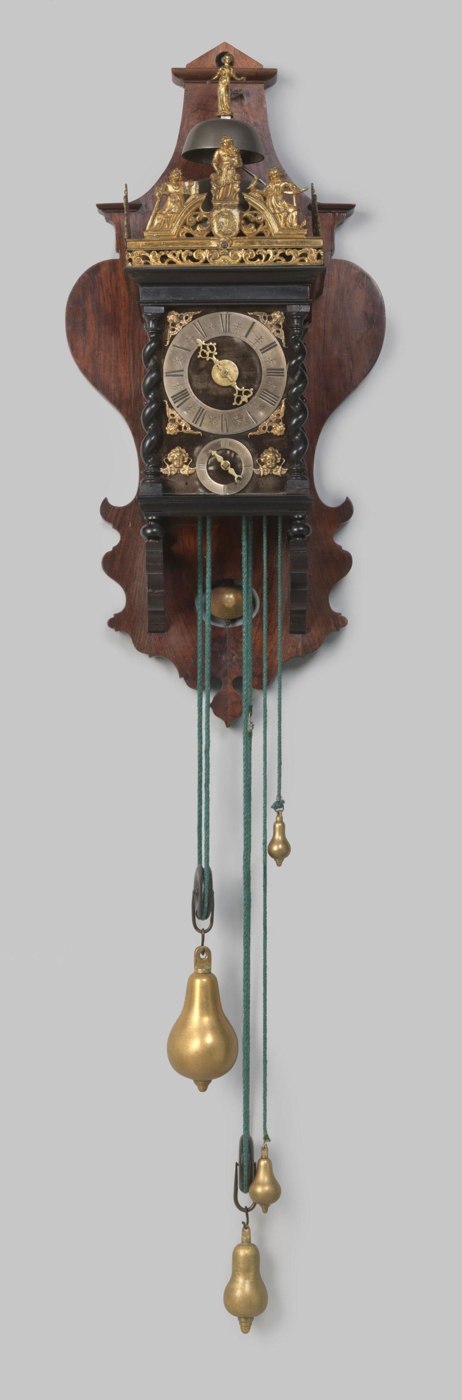
The timepiece features a distinctive construction including a vase-shaped wooden backboard that supports the main clock movement and dial. The clock housing is finished in black wood and is characterized by its molded base and cornice, with twisted columns adorning the corners. A notable decorative element is the cresting, which features allegorical representations of faith, hope, and love. The movement is weight-driven, with pear-shaped weights suspended by cords. The clock displays the inscription "Nu elck zijn sin" on the side frontons and includes the arms of the city of Amsterdam, indicating its specific regional origin.

Front view of the Dutch wall clock featuring the allegorical cresting and hanging weights.
Front view of the Dutch wall clock featuring the allegorical cresting and hanging weights. — Rijksmuseum. Rights pending — permission not yet requested. Original source

Catalogue identity

Source
www.rijksmuseum.nl
Category
Clock · Wall clock
Maker / attribution
Dirk Engel
Reference
Not recorded
Catalogue / lot identifier
BK-NM-3136
Source-reported date
ca. 1700
Source-reported place
Netherlands

Source-reported attribution and specifications are not independent authentication. A listing does not establish present ownership, current display, availability or permission to reproduce.

Object description

Case Architecture and Aesthetic Design

The clock is mounted on a shaped wooden backboard, described as vase-formed, which serves as a decorative foundation for the movement and dial assembly. The primary housing is constructed from black-stained wood and features traditional Dutch proportions, marked by a defined molded base and cornice. The aesthetic is further elevated by the inclusion of twisted columns positioned at each corner of the case, a common architectural detail for the period.

The top of the clock is adorned with elaborate copper ornamentation. A central sculptural group depicts the allegorical figures of Faith, Hope, and Charity. Flanking these figures are side frontons that carry the inscription "Nu elck zijn sin".

Evidence for this section
  • “Hangklok met geprofileerde voet- en kroonlijst en geslingerde hoekstijlen, op vaasvormige blad”
  • “Zwart hout, koperen ornamenten. Bekroning voorstellende geloof, hoop en liefde en het opschrift "Nu elck zijn sin". Aan de zijdes het wapen van de stad Amsterdam.”

Dial and Maker Identification

The clock face is signed by the maker, Dirk Engel, who is listed as active in Westzaan. This signature is found on the dial, providing a clear attribution for the piece. The dial features a main chapter ring with a secondary sub-dial located below the primary display, consistent with standard Dutch wall clock configurations of this era.

The physical components of the dial assembly include metallic hands and engraved or applied markers, set against a background plate that matches the ornate aesthetic of the case. The combination of the maker's signature and the specific geographic attribution to Westzaan anchors the clock within the documented output of Dutch clockmakers active around 1700.

Evidence for this section
  • “signatuur, wijzerplaat: ‘D. Engel, Westzaan’”
  • “uurwerkmaker: Dirk Engel (uurwerkmaker), Westzaan”

Acquisition and Object Documentation

The object was acquired by the Rijksmuseum in 1877, specifically on January 25th of that year. It has been catalogued under the reference number BK-NM-3136 and is currently designated as being in the public domain. The documentation provided confirms the materials used as being black wood with copper ornaments and provides accurate physical dimensions measuring 78 cm in height by 36 cm in width and 22.5 cm in depth.

The object's status as a "Hangklok" (hanging clock) identifies its original installation method, and it is listed under the broad category of furniture and mechanical clocks within the museum's collection.

Evidence for this section
  • “aankoop 1877-01-25”
  • “Objectnummer BK-NM-3136”
  • “hoogte 78 cm x breedte 36 cm x diepte 22,5 cm”

Open research questions

  • What is the internal escapement type and movement train configuration?
  • Does the inscription "Nu elck zijn sin" carry a specific historical significance related to the patron or location of the clock?

Source evidence

Recorded claims and source quotations for Dutch Wall Clock by Dirk Engel
FieldSource-reported valueSource quotation
MakerDirk Engel“Dirk Engel (uurwerkmaker)”
Datecirca 1700“ca. 1700”
SignatureD. Engel, Westzaan“signatuur, wijzerplaat: ‘D. Engel, Westzaan’”
InscriptionNu elck zijn sin“opschrift, frontons zijkanten: ‘Nu elck zijn sin’”
MaterialsBlack wood and copper“Zwart hout, koperen ornamenten”
Dimensions78 x 36 x 22.5 cm“hoogte 78 cm x breedte 36 cm x diepte 22,5 cm”
Accession numberBK-NM-3136“Objectnummer BK-NM-3136”

Visible details

  • Crest depicting Faith, Hope, and Charity figures
  • Twisted wooden corner columns
  • Two separate sub-dials or indicators on the main plate
  • Pear-shaped weights suspended by green cords

Research qualifications

  • The exact mechanism inside the case is not detailed beyond the external appearance
  • The origins of the Amsterdam city crest application require further historical verification

Photograph identity and source facts were screened before import; rights clearance remains pending.

Terms in this record

Glossary explanations for terms named in this object’s record.