
Skip to content
The Encyclopedia of Horology

Clock · Carriage clock

Drocourt Gilt Repeating Carriage Clock

Partially verified

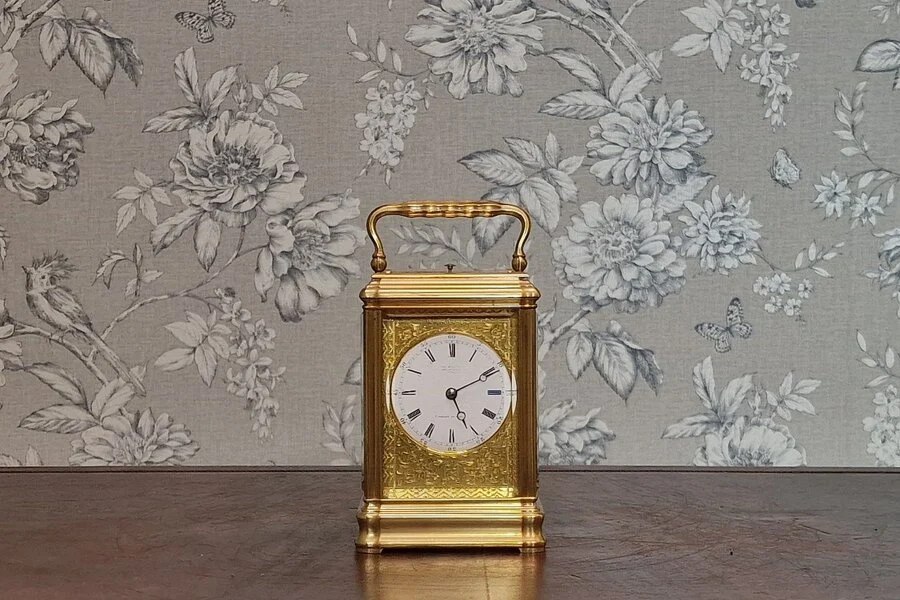
This 19th-century carriage clock is identified as a Drocourt production, circa 1870. The timepiece features an eight-day, key-wound movement with Drocourt markings on the rear plate and an English lever silvered brass platform escapement. It strikes the hours and half-hours on a mellow gong, with a repeat button located on the top of the case that activates the strike for the last hour. The enamel dial displays Roman numerals within an outer minute track and is fitted with blued steel Breguet-style hands. The dial is set within an engraved gilt mask. The clock is housed in a gilt brass gorge case featuring facetted glass panels on all sides and a glazed rear door providing access to the winding and setting arbors. A gilt carrying handle is mounted to the top. The clock measures 17cm in height, 9.5cm in width, and 8cm in depth, with a dial diameter of 6cm.

Front view of the gilt brass Drocourt carriage clock showing the dial, engraved gilt mask, and carrying handle.
Front view of the gilt brass Drocourt carriage clock showing the dial, engraved gilt mask, and carrying handle. — W J Morris Clocks. Rights pending — permission not yet requested. Original source

Catalogue identity

Source
wjmorrisclocks.co.uk
Category
Clock · Carriage clock
Maker / attribution
Drocourt
Reference
Not recorded
Catalogue / lot identifier
Source URL identifies the listing
Source-reported date
circa 1870
Source-reported place
France

Source-reported attribution and specifications are not independent authentication. A listing does not establish present ownership, current display, availability or permission to reproduce.

Object description

Movement and Escapement

The clock is powered by an eight-day, key-wound movement, which features markings attributed to Drocourt on the rear plate. It is equipped with an English lever platform escapement constructed from silvered brass.

The clock provides an hourly and half-hourly strike on a mellow gong. Additionally, a repeat button situated on the top of the case allows for the manual activation of the strike to repeat the last hour indicated by the clock.

Evidence for this section
  • “Exquisite 8 day key wound movement Drocourt markings to rear plate”
  • “original high quality English lever silvered brass platform escapement”
  • “Striking to a mellow gong on the hours fully & 1/2 hour, repeat button on top which strikes the last hour struck.”

Case and Dial

The clock is housed in a gilt brass gorge case. Visibility of the internal mechanism is provided by facetted glass panels on the sides. Access to the movement's winding and setting arbors is via a glazed door located at the rear. The case is topped with a gilt handle.

The dial consists of a circular enamel plate displaying Roman numerals and an outer minute track. The hands are blued steel and styled in the Breguet manner. The dial is positioned within an engraved gilt mask.

Evidence for this section
  • “Superb gilt brass gorge case, facetted glass panels to all sides for full visibility of mechanism, rear glazed door giving access to the winding & setting arbors.”
  • “Surmounted by a typical gilt carrying handle.”
  • “Circular enamel dial is set in a fine elaborately engraved gilt mask, Roman chapter ring with a outer minute track, fine blued steel Breguet hands.”

Maker and Attribution

The timepiece is attributed to the makers Pierre and Alfred Drocourt, who maintained a factory in Saint-Nicolas-d’Ailermont, France, alongside premises in Paris at Rue Debelleyme 28 and Rue de Limoges. The source notes that the son, Alfred Drocourt, took over the business in the 1870s.

Drocourt carriage clocks were known for their decorative elements and earned multiple awards at international exhibitions, including medals in Paris in 1867, 1878, and 1889.

Evidence for this section
  • “Pierre & Alfred Drocourt were one of the top makers of carriage clocks in the mid to late Victorian period”
  • “having a factory at Saint-Nicolas-d’Ailermont in France”
  • “They produced superb carriage clocks that were often decorative and were awarded numerous awards at exhibitions, such as the Bronze Medal at Paris 1867, the Silver at Paris 1878 and the gold at Paris in 1889.”

Open research questions

  • What is the specific movement serial number stamped on the rear plate?
  • Does the escapement platform show signs of later modification or replacement, as is common for carriage clocks of this age?

Source evidence

Recorded claims and source quotations for Drocourt Gilt Repeating Carriage Clock
FieldSource-reported valueSource quotation
MakerPierre & Alfred Drocourt“Pierre & Alfred Drocourt were one of the top makers of carriage clocks”
EscapementEnglish lever platform“original high quality English lever silvered brass platform escapement”
Movement8-day key wound“Exquisite 8 day key wound movement”
Striking mechanismHour and half-hour with repeat function“Striking to a mellow gong on the hours fully & 1/2 hour, repeat button on top which strikes the last hour struck.”
Height17 cm“Height 17cm”
Dial Diameter6 cm“dimeter of face 6cm”
Case styleGorge case“Superb gilt brass gorge case”
Location of manufactureSaint-Nicolas-d’Ailermont, France“having a factory at Saint-Nicolas-d’Ailermont in France”

Visible details

  • Engraved gilt mask surrounding the dial
  • Gilt brass gorge style case
  • Facetted glass panels on the sides
  • Blued steel Breguet hands

Research qualifications

  • The exact serial number is not provided in the source
  • The source does not explicitly state the clock's current timekeeping status or condition beyond a general warranty claim

Photograph identity and source facts were screened before import; rights clearance remains pending.

Consulted source

19th Century Gilt Drocourt Repeating Carriage Clock

Reviewed 2026-11-02 · Record bff2fa749f

Terms in this record

Glossary explanations for terms named in this object’s record.