
Skip to content
The Encyclopedia of Horology

Tool · Latin-inscribed astrolabe

Dodecagonal Astrolabe by Erasmus Habermel

Partially verified

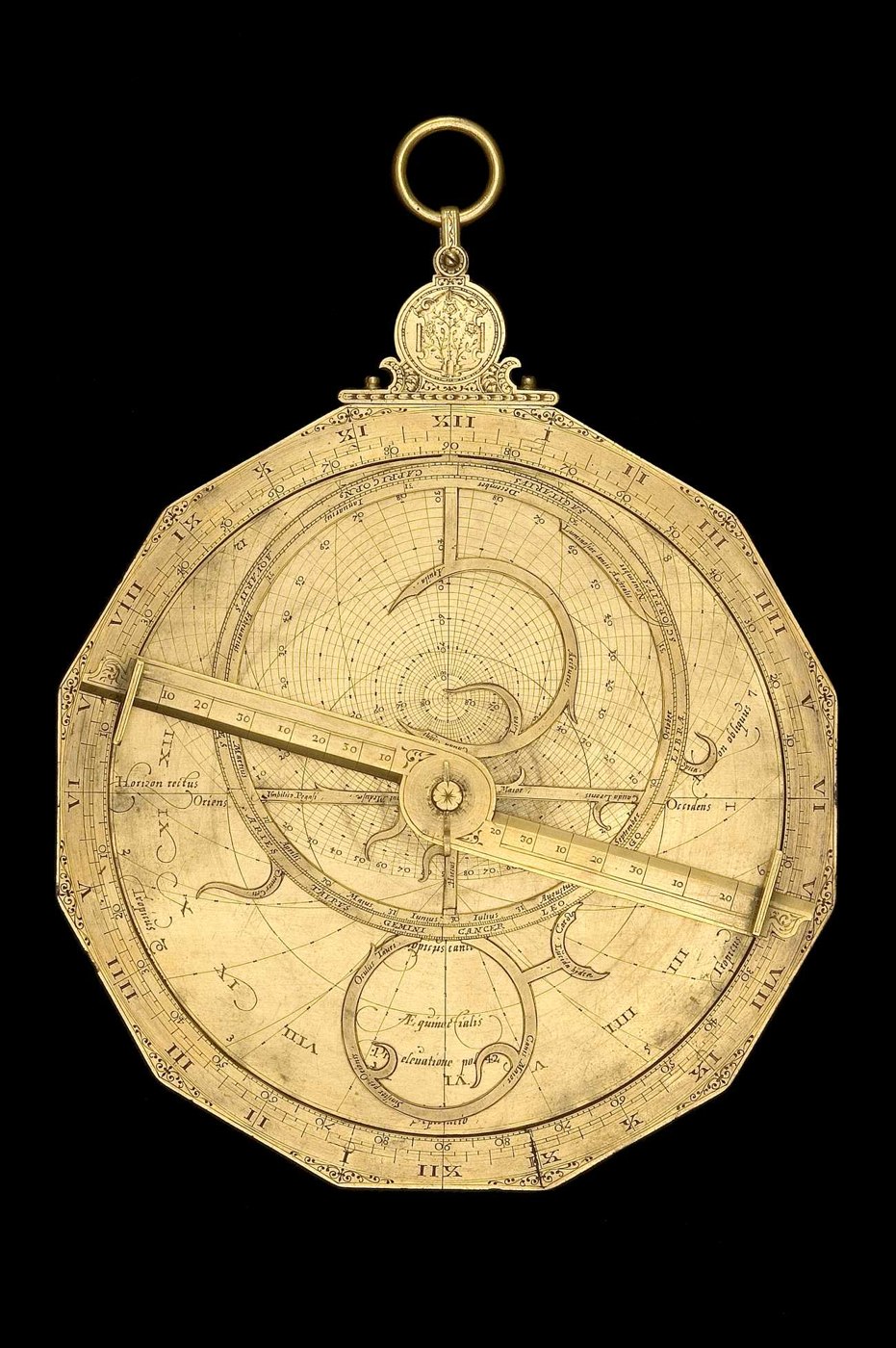
This dodecagonal brass astrolabe is attributed to the maker Erasmus Habermel, dating to approximately 1585. The instrument is distinguished by its twelve-sided form, a configuration described as unusual for the maker. The throne features an engraved coat of arms belonging to Franciscus Paduanius of Forli, a physician whose clientele included Pope and Emperor Rudolf II. The rete is of an ecliptic design, housing 18 star pointers, and the back displays a Gemma Frisius style universal projection. Construction components include a three-piece mater and limb assembly, with a limb composed of a dodecagonal band fixed to a circular inner band. Acquired in 1924 via donation by Lewis Evans, the instrument reflects historical links to the Strozzi family collection and the broader patronage of Paduanius, who is associated with approximately 28 other signed instruments by Habermel.

Front view of the dodecagonal astrolabe showing the rete, scales, and alidade.
Front view of the dodecagonal astrolabe showing the rete, scales, and alidade. — History of Science Museum, University of Oxford. Rights pending — permission not yet requested. Original source

Catalogue identity

Source
www.mhs.ox.ac.uk
Category
Tool · Latin-inscribed astrolabe
Maker / attribution
Erasmus Habermel
Reference
Not recorded
Catalogue / lot identifier
37297
Source-reported date
ca. 1585
Source-reported place
Germany

Source-reported attribution and specifications are not independent authentication. A listing does not establish present ownership, current display, availability or permission to reproduce.

Object description

Construction and Design

The instrument is constructed from brass and features a distinctive dodecagonal exterior shape. The limb consists of a twelve-sided outer band attached to a circular inner band, providing a unique geometry for the frame. The throne, which supports the ring and omega-type shackle, is engraved with the coat of arms of Franciscus Paduanius. The shackle itself is decorated with a seven-petalled flower design.

The mater is part of a three-piece construction. The interior womb includes an ornate Quadratum nauticum featuring a full wind-rose, and the back of the instrument is engraved with a Gemma Frisius style universal projection, which integrates various meridians, parallels, and scales for astronomical calculations.

Evidence for this section
  • “its dodecagonal (twelve-sided) form is extremely unusual”
  • “The throne is a single lob, engraved on the front and the back. The front bears Franciscus Paduanius of Forli's coat of arms.”
  • “The mater and limb are of three pieces construction. The limb is composed of two parts: a twelve-sided band attached to the outside of the circular band.”

Rete and Astronomical Features

The rete is an ecliptic-type design containing 18 stars, each marked by a flamant-style pointer. The zodiac labels are present, and the rete is secured to the mater using a pin and horse, with the pin head decorated in an ornate floral pattern. The rete has documented evidence of repair where the meridian and east-west straps once detached from the ecliptic band.

The instrument includes three plates for varying latitudes, a double-ended counter-changed alidade, and a double-ended regula. The alidade bears the maker's initials, E.H., on the reverse side, confirming its association with Habermel.

Evidence for this section
  • “The rete contains 18 stars. The zodiac on the rete is labelled”
  • “The rete has been repaired where the meridian strap and the east-west strap both broke from the ecliptic band (as seen on the back of the rete).”
  • “Habermel's initials are found on the back of the alidade”

Provenance and History

The astrolabe was previously part of the Strozzi family collection before its sale in Amsterdam in 1911. Lewis Evans subsequently purchased the object from his London dealer, Percy Webster, in 1921. It was later presented to the university collection in 1924.

The presence of the Paduanius arms suggests a specific connection to the physician Franciscus Paduanius.

Evidence for this section
  • “Evans bought it from Percy Webster, his main London dealer, in 1921. It was part {??presly} of the collection of mathematical instruments from the Strozzi family collection”
  • “It is possible that his patronage led to Habermel's appointment as instrument maker to Rudolf II.”

Open research questions

  • Extent of the repair on the rete and its impact on functional integrity
  • Identification of the specific individual who commissioned the Paduanius instruments

Source evidence

Recorded claims and source quotations for Dodecagonal Astrolabe by Erasmus Habermel
FieldSource-reported valueSource quotation
MakerErasmus Habermel“Maker Erasmus Habermel”
Dateca. 1585“Date ca. 1585”
MaterialBrass“Material Brass”
Inventory Number37297“Inventory no. 37297”
FormDodecagonal“its dodecagonal (twelve-sided) form is extremely unusual”
ProvenanceStrozzi family collection“part {??presly} of the collection of mathematical instruments from the Strozzi family collection sold by Frederick Muller & Co., Amsterdam, on 28-29 November 1911”
AcquisitionPresented by Lewis Evans in 1924“Presented by Lewis Evans in 1924”

Visible details

  • Dodecagonal limb construction
  • Arms of Franciscus Paduanius engraved on throne
  • Ornate floral pattern on pin head
  • Omega-shaped shackle

Research qualifications

  • Repair to the rete meridian and east-west straps is mentioned in source
  • Cracked limb at XI o'clock

Photograph identity and source facts were screened before import; rights clearance remains pending.

Consulted source

Astrolabe, inventory 37297 (Germany, ca. 1585)

Reviewed 2026-10-26 · Record 818b7ffb7e

Terms in this record

Glossary explanations for terms named in this object’s record.