
Skip to content
The Encyclopedia of Horology

Tool · Nuremberg diptych dial

Diptych Sundial by Georg Hartmann

Partially verified

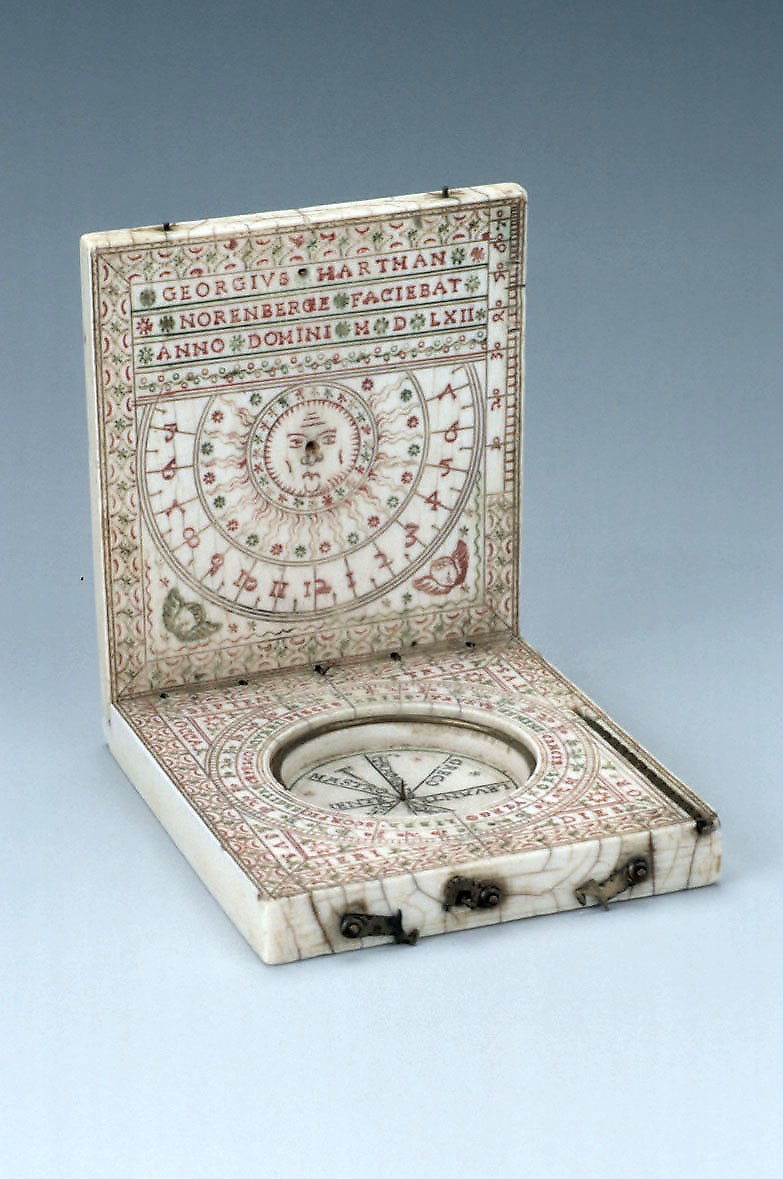
This diptych dial is crafted from ivory and brass, measuring 88 by 91 by 17 millimeters. Signed by Georg Hartmann and dated 1562, it originated in Nuremberg. The inner upper leaf contains a pin gnomon dial, though the pin itself is missing. The inner lower leaf houses a compass, currently missing its glass and needle, surrounded by a calendar scale with zodiacal signs. The instrument is extensively decorated with red and green geometrical motifs. On the outer side of the lower leaf, a table lists 34 towns and their corresponding latitudes. A specialized compartment is located on the bottom edge of the lower leaf for the storage of the dial's pin.

View of the open ivory diptych sundial, showing the interior upper leaf with sun effigy and the lower leaf with an empty compass well.
View of the open ivory diptych sundial, showing the interior upper leaf with sun effigy and the lower leaf with an empty compass well. — Museum of the History of Science, Oxford. Rights pending — permission not yet requested. Original source

Catalogue identity

Source
www.mhs.ox.ac.uk
Category
Tool · Nuremberg diptych dial
Maker / attribution
Georg Hartmann
Reference
Not recorded
Catalogue / lot identifier
81528
Source-reported date
1562
Source-reported place
Germany

Source-reported attribution and specifications are not independent authentication. A listing does not establish present ownership, current display, availability or permission to reproduce.

Object description

Case and Dial Configuration

The diptych dial is constructed from ivory and brass, organized into two hinged leaves. The outer upper leaf surface features a polar dial designed with a cherub standing on a grid, marking hours between 5 and 7. The exterior of the lower leaf contains a reference table listing 34 towns with their specific latitudes.

The inner surfaces of the device are adorned with intricate geometrical motifs rendered in red and green pigments. The inner upper leaf serves as the primary timekeeper, featuring a central sun effigy and a pin gnomon dial calibrated for common hours from 5 to 7. A latitude adjustment arm is mounted on the inner lower leaf, which also contains a compass well and calendar scales.

Evidence for this section
  • “Ivory and brass; 88 x 91 x 17 mm”
  • “The outer side of the upper leaf has a polar dial held by a cherub standing on a grid.”
  • “inner sides are extensively decorated with coloured geometrical motifs”
  • “on the right-hand side is the brass arm, decorated with a geometrical motif, for adjusting the latitude”

Signature and Inscriptions

The instrument bears a clear signature and date on the inner upper leaf, attributing the manufacture to Georg Hartmann in Nuremberg in 1562. The Latin text is inscribed as '[star] GEORGIVS HARTMAN [star] [star] [star] [star] NORENBERGE [star] FACIEBAT [star] [star] ANNO [star] DOMINI [star] M [star] D [star] LXII [star]'.

Beyond the maker's mark, the dial features various navigational and astronomical labels. The compass points are named in Italian, and the calendar includes signs of the zodiac. There is also a later addition of the inscription 'Polare Astronomica' written in black ink on the exterior of the upper leaf.

Evidence for this section
  • “inscribed '[star] GEORGIVS HARTMAN [star] [star] [star] [star] NORENBERGE [star] FACIEBAT [star] [star] ANNO [star] DOMINI [star] M [star] D [star] LXII [star]'”
  • “a later inscription 'Polare Astronomica' written in black ink”

Condition and Components

The physical state of the instrument shows missing functional components. The compass, located within the lower leaf, lacks both its glass cover and the magnetic needle. Similarly, the pin gnomon dial on the inner upper leaf is missing the pin, though a specialized compartment exists for its storage on the bottom edge of the lower leaf.

The object remains an important example of Hartmann's work, showing characteristic decoration styles.

Evidence for this section
  • “inner side of the lower leaf has a compass (glass and needle missing)”
  • “pin gnomon dial (pin missing)”
  • “Unlike most ivory diptych dials , this example does not include a horizontal string gnomon dial”

Open research questions

  • What specific town names are listed in the latitude table on the exterior base?
  • At what point in the object's history was the 'Polare Astronomica' ink inscription added?

Source evidence

Recorded claims and source quotations for Diptych Sundial by Georg Hartmann
FieldSource-reported valueSource quotation
MakerGeorg Hartmann“Signed by Georg Hartmann”
Date1562“Dated 1562”
MaterialIvory and brass“Ivory and brass”
Dimensions88 x 91 x 17 mm“88 x 91 x 17 mm”
OriginNuremberg“Nuremberg”
Compass windsEight names provided“eight winds named 'TRAMONTA', 'GRECO', 'LEVANTE', 'SIROCHO', 'OSTRO', 'LEBECHIO', 'PONENTE', 'MASTRO'”
Latitude table34 towns included“on the outer side of the lower leaf is a table with 34 towns and their latitudes”

Visible details

  • Ivory case construction with brass hardware
  • Polar dial on exterior lid featuring a cherub figure
  • Compass well with eight named cardinal points
  • Extensive polychrome decoration in red and green

Research qualifications

  • Pin gnomon missing from the inner upper dial
  • Glass and needle missing from the compass
  • Later black ink inscription 'Polare Astronomica' present

Photograph identity and source facts were screened before import; rights clearance remains pending.

Consulted source

Diptych Dial

Reviewed 2026-10-26 · Record 2be01991fa

Terms in this record

Glossary explanations for terms named in this object’s record.