
Skip to content
The Encyclopedia of Horology

Tool · Nuremberg diptych dial

Diptych dial (upper leaf)

Partially verified

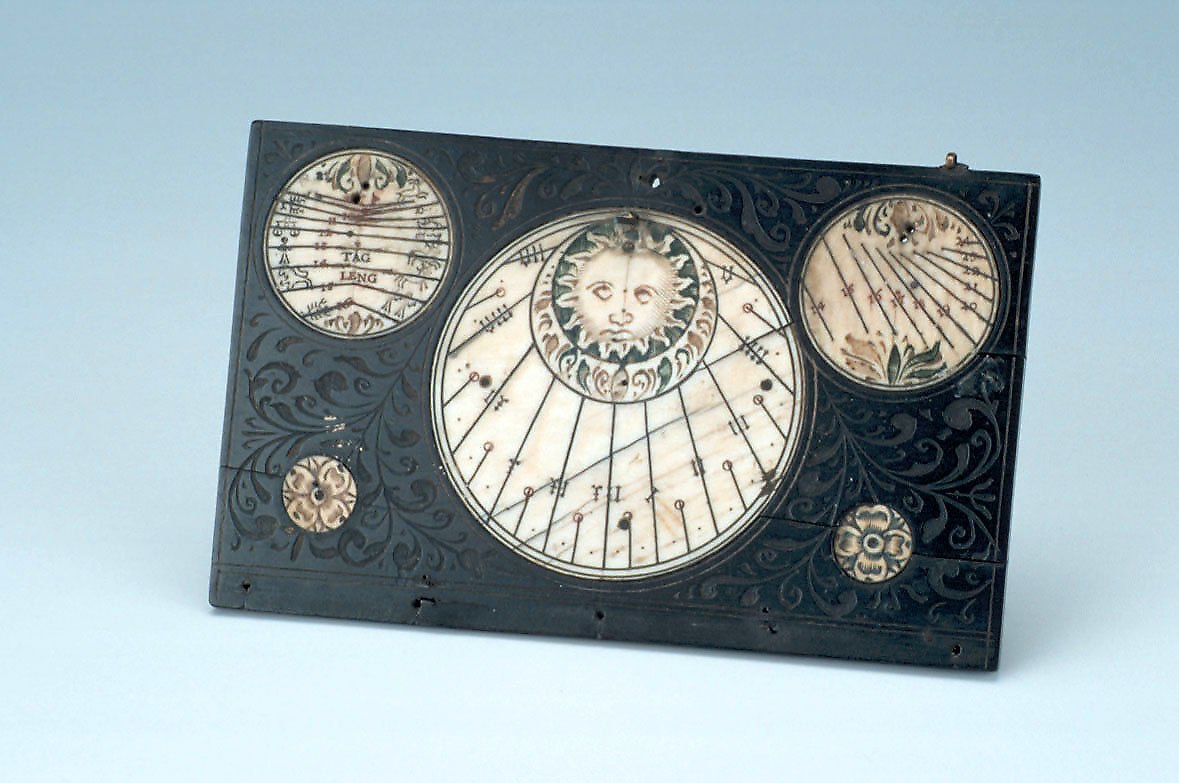
This object is the upper leaf of an unusual diptych sundial, originating from Nuremberg circa 1600. Unlike most diptych dials which were constructed entirely from ivory, this example features an ebony wooden base inlaid with ivory discs. It is unsigned. The interior face of this leaf includes a central string gnomon dial displaying common hours from VII to V, accented by a coloured sun effigy. Two smaller auxiliary ivory discs at the top corners formerly held pin gnomons: one for day length and solar declination labeled 'TAG LENG', and one for Italian hours. The wooden surface displays intricate foliage carving, suggesting the piece was intended as an ornamental gift rather than a utilitarian instrument.

The interior side of the upper leaf, showing the central string gnomon dial and the two smaller pin gnomon dials at the top.
The interior side of the upper leaf, showing the central string gnomon dial and the two smaller pin gnomon dials at the top. — Museum of the History of Science, Oxford. Rights pending — permission not yet requested. Original source

Catalogue identity

Source
www.mhs.ox.ac.uk
Category
Tool · Nuremberg diptych dial
Maker / attribution
Not established
Reference
Not recorded
Catalogue / lot identifier
49666
Source-reported date
circa 1600
Source-reported place
Germany

Source-reported attribution and specifications are not independent authentication. A listing does not establish present ownership, current display, availability or permission to reproduce.

Object description

Construction and Materials

The object represents the upper leaf of a diptych dial. Unlike conventional Nuremberg dials of the period, which were predominantly carved from solid ivory, this piece utilizes a black ebony base. This base serves as the substrate for various inlaid ivory elements, including a large central circular dial and four smaller auxiliary discs.

The surface of the ebony is decorated with carved foliage motifs. The combination of materials and the decorative treatment on the wooden sections suggest a departure from utilitarian production methods. The museum notes that the extensive ornamentation and the original material choice imply a function as a precious gift.

Evidence for this section
  • “this one has a wooden base with ivory discs on it”
  • “The wooden space is decorated with foliage motifs”
  • “The extensive decoration and originality suggest that it was probably meant to be a precious gift rather than an everyday instrument.”

Internal Dialing Functions

The interior face contains a central string gnomon dial. This dial features a central coloured sun effigy and tracks common hours from VII through XII to V, with subdivisions for half and quarter hours. The layout is designed for standard timekeeping purposes, supplemented by additional astronomical data on the secondary discs.

Two smaller ivory discs at the upper section of the leaf once held pin gnomons. The left disc provided information regarding day length and solar declination, indicated by the inscription 'TAG LENG' and various zodiacal symbols. The right disc was configured to record Italian hours, marked in red numerals from 14 to 24. Both of these secondary dials are currently missing their pins.

Evidence for this section
  • “The inner side has a string gnomon dial in the centre with a coloured sun effigy”
  • “The left one has a pin gnomon dial (pin missing) with the length of the day and the declination of the sun”
  • “The right one has a pin gnomon dial (pin missing) with Italian hours marked in red from 14 to 24.”

Provenance and Documentation

The item is held by the Museum of the History of Science in Oxford, catalogued as inventory number 49666. It is an unsigned piece, and only the upper leaf remains from the original diptych. The reference material for this object is noted in the publication 'The Ivory Sundials of Nuremberg 1500-1700' by P. Gouk.

The condition of the object reflects the loss of certain components over time, specifically the pin gnomons and one of the smaller ivory circles in the spandrel spaces on the outer side. The object is officially dated to approximately 1600 and linked to the craft environment of Nuremberg.

Evidence for this section
  • “Only the upper leaf of this wooden dial remains.”
  • “See P. Gouk, The Ivory Sundials of Nuremberg 1500-1700 (Cambridge, 1988).”
  • “Inventory number 49666”

Open research questions

  • What is the specific arrangement of the missing top-right ivory disc based on similar Nuremberg diptych dials?
  • Are there trace markers in the wood that indicate how the lower leaf was once attached to this upper leaf?

Source evidence

Recorded claims and source quotations for Diptych dial (upper leaf)
FieldSource-reported valueSource quotation
MaterialEbony and ivory“Ebony and ivory”
Datecirca 1600“circa 1600”
Place of originNuremberg“Nuremberg”
Dimensions125 x 78 x 4 mm“125 x 78 x 4 mm”
Inventory Number49666“Inventory number 49666”
InscriptionsTAG LENG“inscribed 'TAG LENG'”
ConstructionWooden base with ivory discs“this one has a wooden base with ivory discs on it”

Visible details

  • Ebony wooden base with carved foliage motifs
  • Central ivory disc with sun effigy and string gnomon
  • Two smaller upper ivory discs for specialized solar readings
  • Smaller decorative flower-patterned discs at lower corners

Research qualifications

  • The top right ivory circle is currently missing
  • The two pin gnomons on the inner dials are missing

Photograph identity and source facts were screened before import; rights clearance remains pending.

Consulted source

Diptych Dial

Reviewed 2026-10-26 · Record 2d75c84dc9

Terms in this record

Glossary explanations for terms named in this object’s record.