
Skip to content
The Encyclopedia of Horology

Tool · Nuremberg diptych dial

Diptych Dial

Partially verified

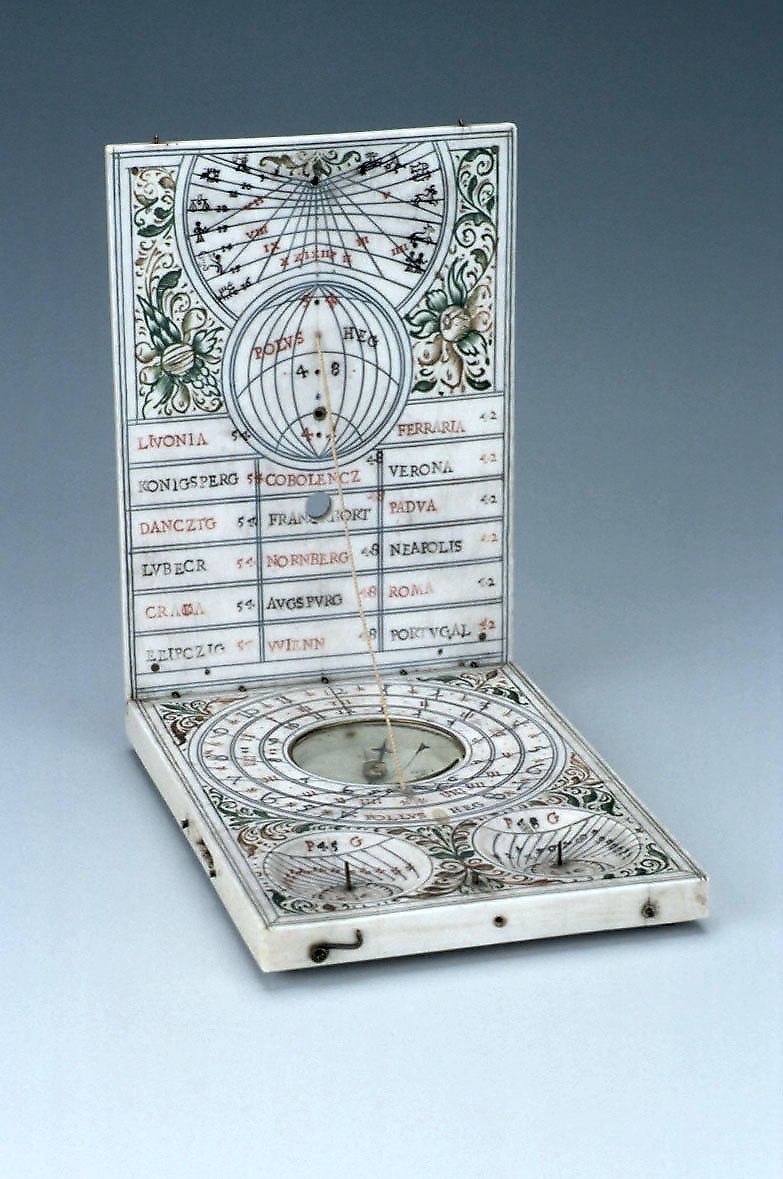
This diptych dial is constructed from ivory and brass, measuring 87 x 122 x 14 mm. Attributed to Thomas Tucher, the object is not signed, but features the maker's mark of a crowned snake punched twice within the compass bowl. The dial is decorated with green and brown foliate motifs and fruit and flower imagery. It includes a string gnomon, a pin gnomon, a lunar volvelle, and a table of 17 towns with their corresponding latitudes. The lower leaf contains two scaphe dials, one for Italian hours and one for Babylonian hours. Four bun feet are present on the exterior. The left edge of the lower leaf includes a compartment, although the associated wind vane is missing. The object is held in the collection of the Museum of the History of Science, Oxford.

Diptych dial by Thomas Tucher, showing the inner leaves with gnomons, town latitude table, and compass.
Diptych dial by Thomas Tucher, showing the inner leaves with gnomons, town latitude table, and compass. — Museum of the History of Science, Oxford. Rights pending — permission not yet requested. Original source

Catalogue identity

Source
www.mhs.ox.ac.uk
Category
Tool · Nuremberg diptych dial
Maker / attribution
Thomas Tucher
Reference
Not recorded
Catalogue / lot identifier
46994
Source-reported date
circa 1600
Source-reported place
Nuremberg

Source-reported attribution and specifications are not independent authentication. A listing does not establish present ownership, current display, availability or permission to reproduce.

Object description

Construction and Design

The diptych dial is a rectangular instrument composed of ivory and brass with dimensions of 87 x 122 x 14 mm. The surface is detailed with green and brown pigment, featuring foliate, flower, and fruit decorations across the leaves and spandrels. The object rests on four bun feet.

The upper leaf houses a pin gnomon dial with common hours marked from VII to XII to V, alongside a string gnomon dial adjusted for latitudes 42, 48, and 54 degrees. The outer leaf includes a wind rose showing 32 directions, a compass viewing hole, and a brass index arm.

Evidence for this section
  • “Ivory and brass; 87 x 122 x 14 mm”
  • “In the spandrel spaces and on the sides is foliate decoration in green and brown, and four bun feet.”
  • “The outer part of the upper leaf has a wind rose with 32 directions, a compass viewing hole and brass index arm.”

Compass and Scaphe Dials

The interior of the lower leaf contains a compass with cardinal points labeled 'S', 'ORI ENS', 'M', and 'OCCI DENS', with a fleur-de-lis indicating north. The maker's mark, a crowned snake, is punched twice into this section.

Two scaphe dials are situated below the compass: the left dial tracks Italian hours from 9 to 23, while the right dial displays Babylonian hours from 1 to 15. Both scaphes feature sun effigies and are positioned to support specific latitude readings, marked 'P 45 G' and 'P 48 G' respectively.

Evidence for this section
  • “The inner side of the lower leaf has a compass with the cardinal points marked 'S', 'ORI ENS', 'M', 'OCCI DENS' with a fleur-de-lis for the north and the maker's mark (a crowned snake) punched twice.”
  • “the left one for Italian hours numbered in red from 9 to 23 and 'P 45 G', the right one for Babylonian hours numbered in black from 1 to 15 and 'P 48 G'.”

Additional Features and Attribution

The exterior of the lower leaf contains a lunar volvelle labeled 'NACHT VHR' and a table of epacts beginning 17/7. A specific compartment on the left edge was intended to hold a wind vane, though this component is currently missing from the assembly.

Attribution to Thomas Tucher is based upon the presence of the crowned snake mark, which is associated with the Tucher workshops in Nuremberg. The latitude indicators are marked 'POLVS HEG', a specific phrasing observed on this dial.

Evidence for this section
  • “The outer side of the lower leaf has a lunar volvelle marked 'NACHT VHR' and a table of epacts starting 17 / 7.”
  • “The left edge of the lower leaf has a compartment for the wind vane (missing).”
  • “the maker's mark of a crowned snake, used by the Tucher workshops in Nuremberg , is punched twice inside the compass bowl.”

Open research questions

  • What was the specific function and appearance of the missing wind vane?
  • Are there variations in the Tucher workshop output that explain why the dial remains unsigned?

Source evidence

Recorded claims and source quotations for Diptych Dial
FieldSource-reported valueSource quotation
MakerThomas Tucher“Attributed to a Thomas Tucher”
Inventory Number46994“Inventory number 46994”
Dimensions87 x 122 x 14 mm“87 x 122 x 14 mm”
MaterialIvory and brass“Ivory and brass”
Maker's MarkCrowned snake“the maker's mark of a crowned snake, used by the Tucher workshops in Nuremberg , is punched twice inside the compass bowl.”
Place of OriginNuremberg“Nuremberg”

Visible details

  • Maker's mark of a crowned snake punched twice in the compass bowl
  • Includes a table of 17 towns with latitudes
  • Exterior features a lunar volvelle marked 'NACHT VHR'
  • Features green and brown foliate and fruit decoration

Research qualifications

  • Maker is attributed to Thomas Tucher rather than confirmed by signature
  • Wind vane is missing from the compartment on the left edge

Photograph identity and source facts were screened before import; rights clearance remains pending.

Consulted source

Diptych Dial

Reviewed 2026-10-26 · Record fd70636345

Terms in this record

Glossary explanations for terms named in this object’s record.