
Skip to content
The Encyclopedia of Horology

Tool · German diptych dial

Diptych dial by Ulrich Schniep

Partially verified

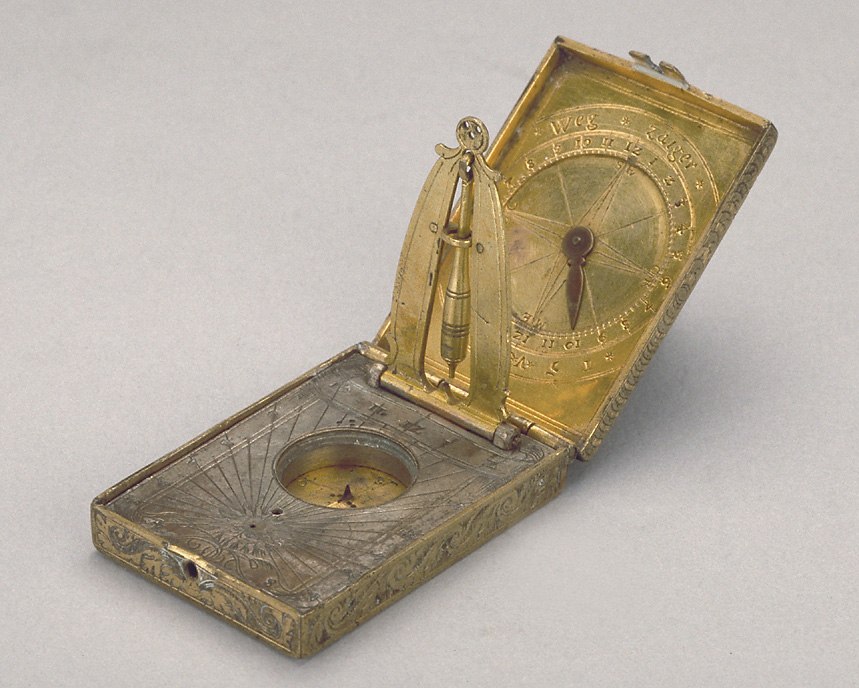
This 1579 diptych dial, also known as a viatorium, was crafted by Ulrich Schniep in Munich. Constructed from brass and silvered copper, the instrument measures 58 x 40 x 13 mm. It features two leaves containing complex horological data. The exterior of the upper leaf contains seven concentric rings providing astronomical information, including zodiac entry dates, day length, and month abbreviations. The interior of the upper leaf houses a 'wegweiser' with a rotating arm and various inscriptions. The lower leaf includes a central compass recess and a silvered brass plate engraved with a sun effigy and a time scale from 4 to 12 to 8. The object exhibits extensive strapwork engraving throughout its surfaces. The diptych mechanism is supported by a folding plummet-holder, though several original components, including the needle, compass glass, string gnomon, and closing catch, are now missing.

Diptych dial by Ulrich Schniep showing the open leaves and internal components.
Diptych dial by Ulrich Schniep showing the open leaves and internal components. — British Museum, London. Rights pending — permission not yet requested. Original source

Catalogue identity

Source
www.mhs.ox.ac.uk
Category
Tool · German diptych dial
Maker / attribution
Ulrich Schniep
Reference
Not recorded
Catalogue / lot identifier
MLA 1871, 11-15.11
Source-reported date
1579
Source-reported place
Germany

Source-reported attribution and specifications are not independent authentication. A listing does not establish present ownership, current display, availability or permission to reproduce.

Object description

Upper Leaf Exterior and Astronomical Data

The outer face of the upper leaf is composed of seven distinct concentric rings used for astronomical calculations. The outermost ring contains Latin inscriptions regarding solar longitude and zodiacal entry. Subsequent rings provide numerical data related to calendar dates, month abbreviations, day length in hours, and zodiac signs.

A central inscription identifies the elevation for which the dial was calculated as 49 degrees. The arrangement of numbers within the rings accounts for the varying speed of the sun along the ecliptic, with certain months assigned dual values to reflect these fluctuations. The surrounding spandrel spaces are decorated with engraved strapwork.

Evidence for this section
  • “The outer part of the upper leaf of this brass dial is engraved with seven rings.”
  • “The innermost ring is inscribed '[star] ELEVATIO POLI 49 GR'.”

Internal Components and Compass

The lower leaf contains a silvered brass plate and a recessed circular aperture for a compass. Although the original needle and glass cover are absent, the base of the recess is engraved with directional markers including 'S', 'OR', 'M', and 'OC'.

Above the compass, the silvered surface features engraved common hours ranging from 4 to 12 to 8, accompanied by a sun effigy. The folding plummet-holder, situated between the leaves, once served as the attachment point for the string gnomon, which is no longer present.

Evidence for this section
  • “The compass, at the centre of the leaf, is inscribed 'S', 'OR', 'M', 'OC' and magnetic deviation is indicated.”
  • “The string, working as a gnomon but now missing, was tied to a small hole in the upper part of the folding plummet-holder.”

Construction and Condition

The device is fashioned from brass and silvered copper with decorative strapwork covering the exterior leaves and the sides. While two mechanical catches remain to secure the instrument in an open position, the primary latch required to keep the unit closed is missing.

The object is catalogued as part of the British Museum's collection following its donation by A.W. Franks in 1871. It remains a documented example of Schniep's production, noted for its specific viatorium construction and integrated wegweiser.

Evidence for this section
  • “The catch for closing the instrument is missing, and there are two catches for keeping the instrument open when in use.”
  • “The instrument was presented by A.W. Franks in 1871”

Open research questions

  • What is the significance of the 'wegweiser' arm and its specific numerical inscriptions?
  • Did this model belong to a specific series of instruments produced by Ulrich Schniep for the 49-degree latitude?

Source evidence

Recorded claims and source quotations for Diptych dial by Ulrich Schniep
FieldSource-reported valueSource quotation
MakerUlrich Schniep“Ulrich Schniep”
Date1579“Dated 1579”
Place of manufactureMunich“Munich”
Dimensions58 x 40 x 13 mm“58 x 40 x 13 mm”
MaterialBrass and silvered copper“Brass, silvered copper”
Accession numberMLA 1871, 11-15.11“Registration no. MLA 1871, 11-15.11”
ProvenanceA.W. Franks“The instrument was presented by A.W. Franks in 1871”

Visible details

  • Missing compass glass, needle and suspension string
  • Folding plummet-holder assembly visible
  • Strapwork engraving on exterior surfaces
  • Engraved sun effigy below compass recess

Research qualifications

  • Original string gnomon is missing
  • Compass glass and needle are missing
  • Catch for closing the instrument is missing

Photograph identity and source facts were screened before import; rights clearance remains pending.

Consulted source

Diptych Dial

Reviewed 2026-10-26 · Record ab02f610d8

Terms in this record

Glossary explanations for terms named in this object’s record.