Construction and Design
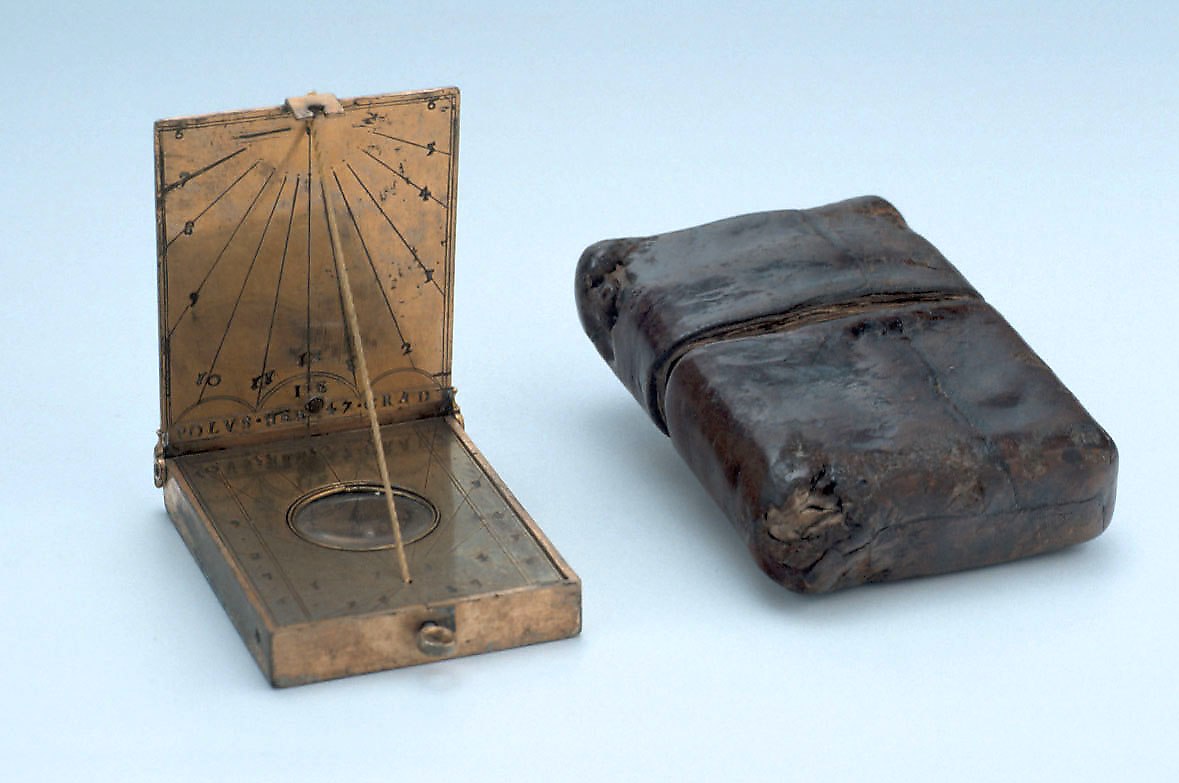
The diptych dial is fabricated from gilt brass and measures 51 x 38 x 8 mm. Its structure comprises a main box and a hinged lid, which allows it to function as a compact, portable timekeeping instrument. The lid can be maintained in a vertical position using a hook clasp, providing the necessary orientation for the vertical hour dial located on its interior. A suspension ring is attached to the exterior of the box, facilitating transport.
The exterior surfaces of the brass housing are decorated with detailed engravings depicting foliage, fruit, birds, and animals. The interior contains both vertical and horizontal hour scales, intended for use with the string gnomon that connects the two halves of the instrument. The design is specific to a latitude of 47 degrees, as noted by the inscription on the dial face.
Evidence for this section
- “This simple diptych dial consists of a main box and hinged lid, with vertical and horizontal string gnomon dials.”
- “The box has a suspension ring and the lid can be fixed vertical by a hook clasp.”
- “The outer face of the lid is engraved with foliage, birds and animals”
Instrumentation and Markings
Central to the horizontal dial plate is a compass with a diameter of 18 mm. This component is marked with the four cardinal points: 'SE', 'OR', 'ME', and 'OC', and also features markings for magnetic variation, which were necessary for the accurate alignment of the sundial. The vertical dial inside the lid is inscribed with hour lines ranging from 6 to 12 to 6, while the horizontal plate features hours marked from 4 to 12 to 8.
The maker is identified through the initials 'I E', found at the base of the dial, which are presumed by the museum to represent Johann Eicktet. The instrument also carries the Latin inscription 'POLVS . HEH . 47 . GRAD', which specifies the latitude for which the dial was calibrated. The date 1584 is engraved directly onto the main horizontal dial plate, serving as a primary indicator of the instrument's age.
Evidence for this section
- “At the base of the dial are the initials 'I E', presumed to be for Johann Eicktet and the inscription 'POLVS . HEH . 47 . GRAD'.”
- “The main box carries a horizontal dial plate with hours from 4 to 12 to 8 and the date 1584.”
- “In the centre of the plate is a compass of 18 mm diameter, marked for variation and the four cardinal points ('SE', 'OR', 'ME', 'OC').”
Provenance and Housing
The instrument includes its original protective carrying case, which is manufactured from vellum and pasteboard, finished with a leather covering. This case was designed to shield the gilt brass instrument from damage when not in use, reflecting the portable nature of the piece.
The dial's historical provenance is documented through its inclusion in two major collections: the Michel Collection and the Billmeir Collection (specifically recorded as 57-84/75). It is currently held by the Museum of the History of Science in Oxford, where it remains catalogued as part of their permanent collection under inventory number 53969.
Evidence for this section
- “The instrument has a carrying case made of vellum and pasteboard covered in leather.”
- “Provenance: Michel Collection; Billmeir Collection (57-84/75).”
- “Museum of the History of Science, Oxford
Inventory number 53969”