
Skip to content
The Encyclopedia of Horology

Tool · German diptych dial

Diptych Dial by Georg Karl

Partially verified

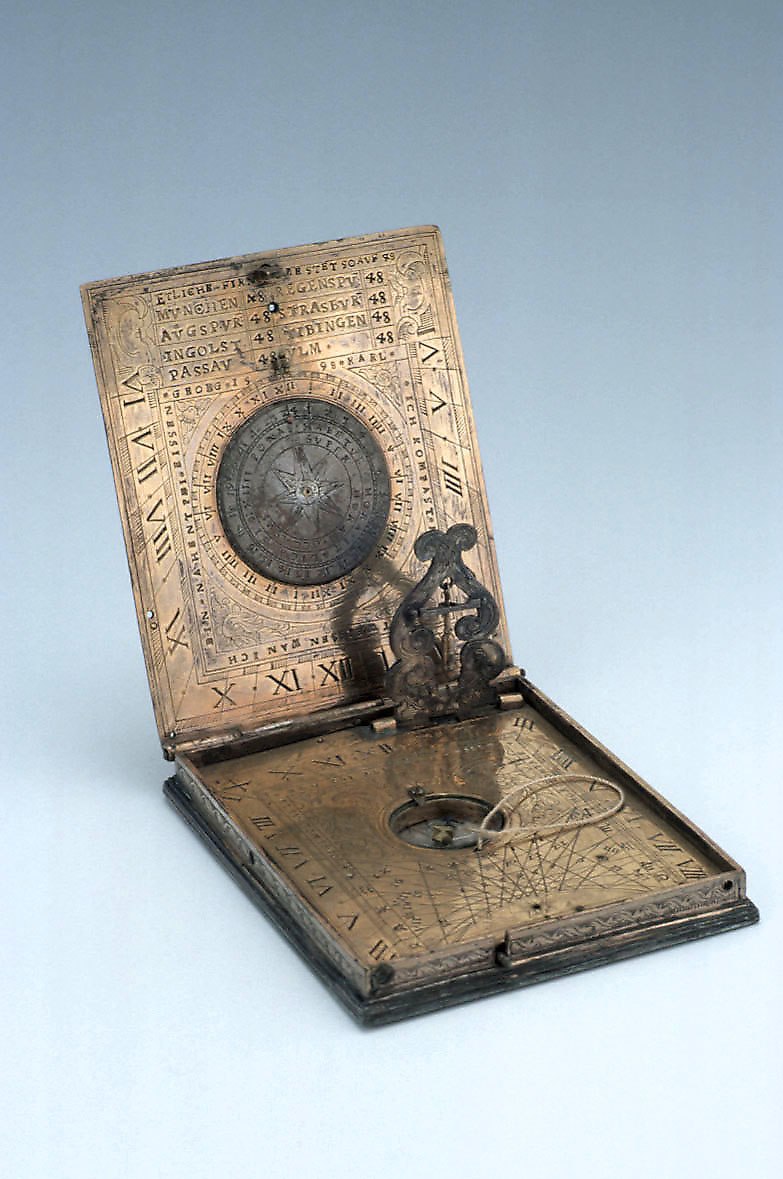
This diptych dial, created in 1598 by Georg Karl, is a gilt brass scientific instrument measuring 104 x 88 x 12 mm. It comprises a rectangular box featuring a cover secured by a spring catch, with sides decorated with engraved foliage. The instrument serves as a complex multifunctional device, housing two horizontal pin gnomon sundials, a vertical string gnomon sundial, a horizontal string gnomon sundial, a lunar volvelle, a horary volvelle, an integrated compass, a plumb level, and an astronomical table. The dial face incorporates diverse time-keeping scales, including common, Italian, and Babylonian hours, along with declination lines corresponding to zodiacal signs. This object is documented as the sole surviving instrument attributed to Georg Karl.

Interior view of the 1598 gilt brass diptych dial by Georg Karl, showing the lunar volvelle, hour scales, and integral compass.
Interior view of the 1598 gilt brass diptych dial by Georg Karl, showing the lunar volvelle, hour scales, and integral compass. — Museum of the History of Science, Oxford. Rights pending — permission not yet requested. Original source

Catalogue identity

Source
www.mhs.ox.ac.uk
Category
Tool · German diptych dial
Maker / attribution
Georg Karl
Reference
47563
Catalogue / lot identifier
47563
Source-reported date
1598
Source-reported place
Germany

Source-reported attribution and specifications are not independent authentication. A listing does not establish present ownership, current display, availability or permission to reproduce.

Object description

Construction and Functionality

The instrument is constructed from gilt brass and is configured as a rectangular box with a single hinged cover. The exterior and interior surfaces are heavily engraved with decorative leaf patterns, scrollwork, and various astronomical scales. The internal layout includes a compass, four distinct sundial configurations, a plumb level, and multiple volvelles.

It incorporates common, Italian, and Babylonian hour scales alongside a lunar volvelle and an aspectarium.

Evidence for this section
  • “The instrument has a rectangular box with a single cover, retained by a spring catch.”
  • “The sides of the box are engraved with leaf decoration.”
  • “This instrument, which has also been called a compendium , consists of four sundials , a lunar volvelle , a horary volvelle , a compass , a plumb level and an astronomical table.”

Signatures and Provenance

The instrument bears a clear signature from Georg Karl, dated to 1598. This dial is noted in the provided documentation as the only known surviving instrument produced by this maker. The signature is prominently displayed on the reverse of the cover.

The item is currently held by the Museum of the History of Science, Oxford. The inscriptions on the piece indicate it was specifically calibrated for a latitude of 48 degrees, referencing several German towns such as Munich and Strasbourg.

Evidence for this section
  • “Signed by Georg Karl”
  • “The dial appears to be the only surviving instrument by Georg Karl .”
  • “Within the hour scale is the signature '[star] GEORG [star] 1598 [star] KARL [star]'”

Condition and Specific Details

The object shows evidence of historical use and modification. The horizontal pin gnomon sundial on the cover is missing its gnomon. Additionally, a crude arrow has been added to the base plate to record magnetic variation, and a manufacturing error exists where the zodiacal symbol for Taurus was erroneously stamped in place of Aries.

The compass bowl is retained by a clasp mechanism, and the instrument's base features a comprehensive table detailing day and night lengths for sixteen specific days of the year.

Evidence for this section
  • “The plate carries a horizontal pin gnomon sundial titled 'HORIZONTALE HOROLOGIVM' for latitude 48? (gnomon missing).”
  • “each line being identified by the symbol for the appropriate sign (though Taurus was mistakenly first stamped in the place of Aries).”
  • “A crude arrow has later been scratched to record the variation of the compass.”

Open research questions

  • Are there any archival records of Georg Karl's activities in German horological guilds beyond this single instrument?
  • Does the later scratched arrow indicating compass variation correlate to a specific time period in the instrument's history?

Source evidence

Recorded claims and source quotations for Diptych Dial by Georg Karl
FieldSource-reported valueSource quotation
MakerGeorg Karl“Signed by Georg Karl”
Date1598“Dated 1598”
MaterialGilt brass“Gilt brass”
Dimensions104 x 88 x 12 mm“104 x 88 x 12 mm”
Inventory number47563“Inventory number 47563”
InscriptionsLatitude references and astronomical terminology“AVF POL GRAT 48 ANNO M D XCVIII”
Compass diameter23 mm“The bowl is 23 mm in diameter”

Visible details

  • The instrument features a centrally located 23 mm diameter compass with a silvered base plate.
  • The interior cover features a vertical string gnomon sundial alongside a horary conversion volvelle.
  • The base plate contains a plumb bob assembly with a sprung silvered support.
  • The engraving includes a table listing eight German towns, all assigned a latitude of 48 degrees.

Research qualifications

  • The gnomon on the horizontal pin gnomon sundial located on the cover is missing.
  • A Taurus symbol was reportedly stamped in the place of Aries during production.
  • The exact latitude settings and historical usage patterns remain specific to the design's 48-degree calibration.

Photograph identity and source facts were screened before import; rights clearance remains pending.

Consulted source

Diptych Dial

Reviewed 2026-10-26 · Record d393749b2c

Terms in this record

Glossary explanations for terms named in this object’s record.