
Skip to content
The Encyclopedia of Horology

Tool · Nuremberg diptych dial

Diptych Dial by Thomas Tucher

Partially verified

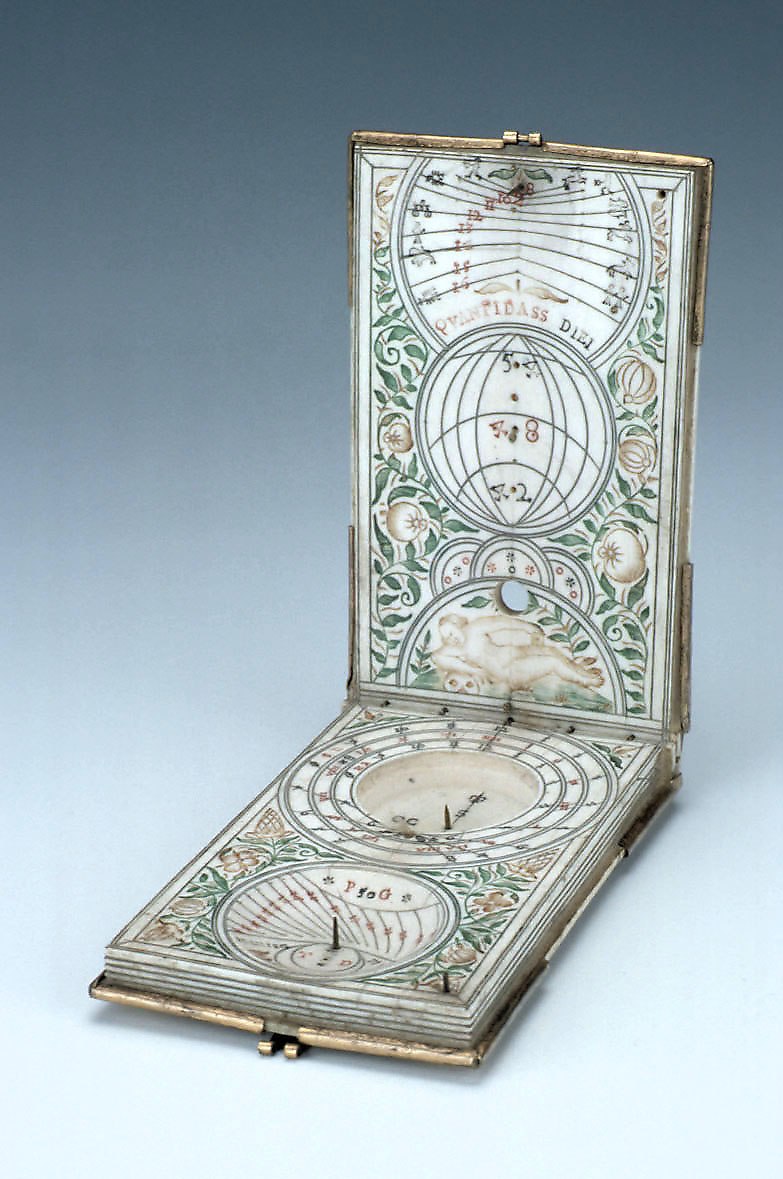
This diptych dial is constructed from ivory and gilt brass, measuring 76 x 125 x 15 mm. Signed by Thomas Tucher and originating from Nuremberg, it is attributed to circa 1620. The object features a folding design with outer brass plates and decoration consisting of fruits, flowers, and foliage in green and brown tones. The upper leaf contains a wind rose, a pin gnomon dial, and latitude adjustments. The lower leaf integrates a compass, a string gnomon dial, a scaphe dial for Italian hours, and a lunar volvelle with an epact table. The maker's mark, depicting a snake, is present alongside his initials.

A diptych dial in ivory and gilt brass by Thomas Tucher, circa 1620, showing the internal leaf layout with multiple sundial scales, decorative botanical motifs, and a recumbent female figure.
A diptych dial in ivory and gilt brass by Thomas Tucher, circa 1620, showing the internal leaf layout with multiple sundial scales, decorative botanical motifs, and a recumbent female figure. — Museum of the History of Science, Oxford. Rights pending — permission not yet requested. Original source

Catalogue identity

Source
www.mhs.ox.ac.uk
Category
Tool · Nuremberg diptych dial
Maker / attribution
Thomas Tucher
Reference
Not recorded
Catalogue / lot identifier
86072
Source-reported date
circa 1620
Source-reported place
Nuremberg

Source-reported attribution and specifications are not independent authentication. A listing does not establish present ownership, current display, availability or permission to reproduce.

Object description

Dial Construction and Surface Decoration

The diptych dial is crafted from ivory panels reinforced with gilt brass elements. The exterior leaves are adorned with engraved gilt brass plates featuring bun feet, which are set against a surface embellished with painted fruits, flowers, and foliage in shades of green and brown. These decorative plates are positioned in the spandrel spaces on both outer leaves.

The interior surfaces are intricately engraved with various scales and figures. The upper leaf displays a central recumbent female figure holding a smaller dial. The color palette of green and brown used for the botanical motifs extends to these internal decorative borders, providing a cohesive aesthetic across the ivory components of the instrument.

Evidence for this section
  • “Ivory and gilt brass”
  • “The rest of the decoration is made up of fruits, flowers and foliage coloured in green and brown.”
  • “In the spandrel spaces are four decorated brass plates with bun feet.”

Timekeeping and Astronomical Functions

The instrument integrates several distinct timekeeping mechanisms across its leaves. The upper leaf features a pin gnomon dial showing the length of the day, with scales ranging from 8 to 16, alongside markers for sun declination and zodiacal signs. Latitude adjustment is facilitated through a series of holes designed for 54, 48, and 42 degrees.

The lower leaf contains a compass area, a string gnomon dial for multiple latitudes, and a scaphe dial indicating Italian hours from 9 to 24. A lunar volvelle with a table of epacts is provided on the outer lower leaf. The maker’s mark, represented by a snake, appears on the dial, and the inscription 'POLNISCHE VHR' is engraved on the lower leaf, identifying specific regional timekeeping markers.

Evidence for this section
  • “The inner side of the upper leaf has a pin gnomon dial indicating the length of the day”
  • “Around it is a string gnomon dial (string missing) for the latitudes mentioned above”
  • “Below it is a scaphe dial inscribed '[star] P 50 G [star]' indicating Italian hours from 9 to 24.”
  • “the maker's mark (a snake) marked twice”

Condition and Attribution

The object is held by the Museum of the History of Science, Oxford, under inventory number 86072. The physical condition reflects the loss of several functional parts, specifically the glass and ring associated with the compass, the string required for the string gnomon dial, and a portion of the closing hinge.

The identification relies on the signature of Thomas Tucher and his characteristic snake mark, which appears twice on the lower leaf. The piece is dated to approximately 1620 based on the documentation provided by the museum, which attributes the manufacture to the workshops in Nuremberg.

Evidence for this section
  • “The inner side of the lower leaf has a compass (glass and ring missing)”
  • “a string gnomon dial (string missing)”
  • “there is a hinge to keep the dial closed when not in use (part of it is missing).”
  • “Signed by Thomas Tucher”

Open research questions

  • What is the exact interpretation of the inscription 'POLNISCHE VHR' in relation to the specific latitude settings provided?
  • Do other known diptych dials by Thomas Tucher share the specific layout of the pin gnomon dial and the scaphe dial configuration?

Source evidence

Recorded claims and source quotations for Diptych Dial by Thomas Tucher
FieldSource-reported valueSource quotation
MakerThomas Tucher“Signed by Thomas Tucher”
Datecirca 1620“circa 1620”
MaterialIvory and gilt brass“Ivory and gilt brass”
Dimensions76 x 125 x 15 mm“76 x 125 x 15 mm”
OriginNuremberg“Nuremberg”
Inventory Number86072“Inventory number: 86072”

Visible details

  • Decoration of fruits and foliage in green and brown
  • Engraved brass plates located in the corners of the leaves
  • Recumbent female figure on the inner surface of the upper leaf
  • Maker's mark featuring a snake and initials T D

Research qualifications

  • The compass glass and ring are currently missing
  • The string gnomon for the lower leaf dial is missing
  • Part of the hinge mechanism is missing

Photograph identity and source facts were screened before import; rights clearance remains pending.

Consulted source

Diptych Dial

Reviewed 2026-10-26 · Record ea7390d759

Terms in this record

Glossary explanations for terms named in this object’s record.