
Skip to content
The Encyclopedia of Horology

Tool · Nuremberg diptych dial

Diptych Dial by Paul Reinmann

Partially verified

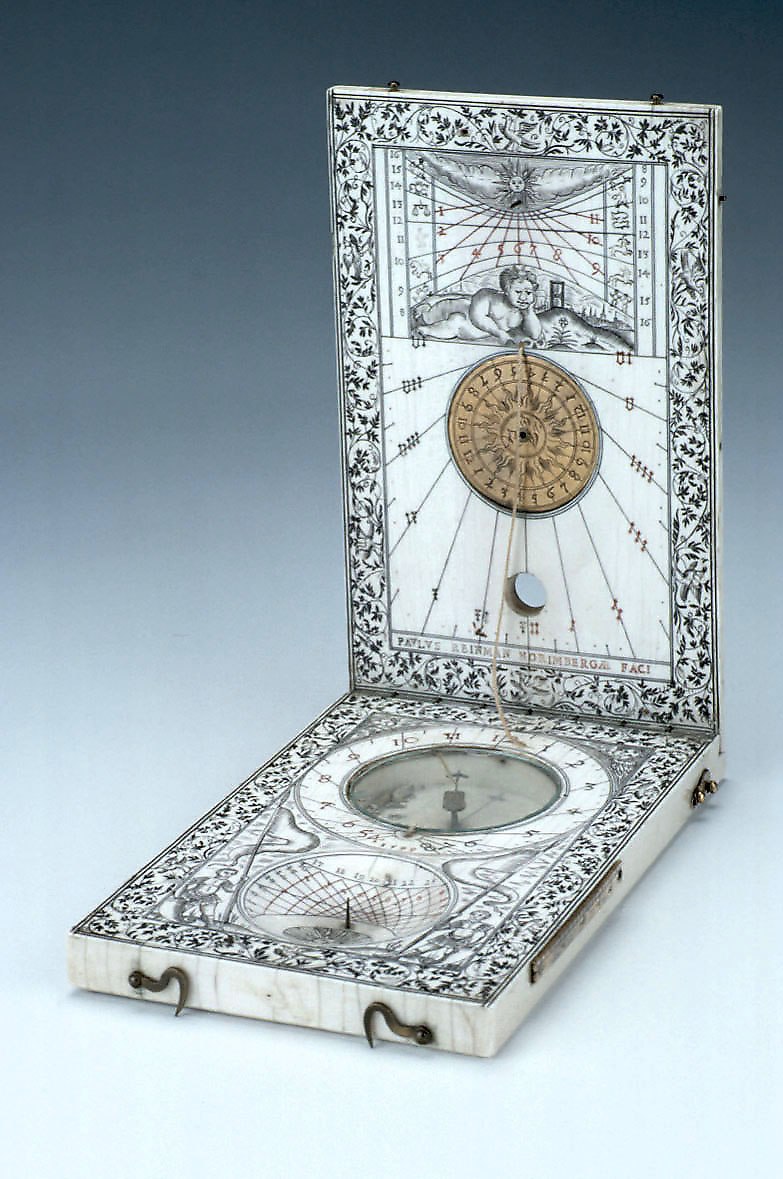
This diptych dial, created in 1599 by Paul Reinmann in Nuremberg, is constructed of ivory and gilt brass. Measuring 95 x 155 x 20 mm, the folding instrument functions as a multi-device timekeeper. The dial features extensive ornamentation, including foliage, birds, cherub heads, Roman soldiers, and a vignette of a putto with a skull and sand glass. The upper leaf incorporates a wind rose, a lunar volvelle, and a brass equatorial plate, while the inner surface provides a pin gnomon dial and a vertical string gnomon dial. The lower leaf contains a compass, a scaphe dial for Italian and Babylonian hours, and a latitude table. The instrument is signed 'PAVLVS REINMAN NOREMBERGAE FACI' and bears the maker's crown mark.

The open diptych dial, showing the ivory construction, internal brass dials, and intricate engraved iconography.
The open diptych dial, showing the ivory construction, internal brass dials, and intricate engraved iconography. — Museum of the History of Science, Oxford. Rights pending — permission not yet requested. Original source

Catalogue identity

Source
www.mhs.ox.ac.uk
Category
Tool · Nuremberg diptych dial
Maker / attribution
Paul Reinmann
Reference
Not recorded
Catalogue / lot identifier
70405
Source-reported date
1599
Source-reported place
Germany

Source-reported attribution and specifications are not independent authentication. A listing does not establish present ownership, current display, availability or permission to reproduce.

Object description

Structural Design and Materials

The diptych dial is a composite instrument made primarily of ivory with decorative and functional components of gilt brass. It consists of two leaves that fold together when not in use. The outer surfaces and borders are heavily decorated with engraved foliage, bird figures, and a central vignette depicting a putto resting on a skull.

This object utilizes complex astronomical timekeeping elements integrated into the ivory body, including a wind rose, lunar volvelle, and multiple gnomon styles. The internal brass equatorial dial and scaphe dial demonstrate the use of metal inlay within the ivory substrate to provide durability for rotating or recessed features.

Evidence for this section
  • “Ivory and gilt brass”
  • “The borders of the leaf are decorated with foliage”
  • “Below the compass is a scaphe dial for Italian (numbered in black from 8 to 23) and Babylonian hours (numbered in red from 1 to 16) with a sun face at the centre.”

Timekeeping and Astronomical Functions

The dial incorporates multiple methods for determining time and solar position. The upper leaf features a pin gnomon dial designed to indicate day and night lengths, alongside symbols for zodiacal signs to track solar declination. A vertical string gnomon dial provides common hours, marked in intervals of quarters and halves.

The lower leaf contains a compass for orientation and a specialized scaphe dial for measuring Italian and Babylonian hours. Additional latitude and epoch data are engraved on the edges and outer sections, allowing the user to adapt the instrument to different geographic locations. The presence of a lunar volvelle indicates the inclusion of moon-related chronological calculations.

Evidence for this section
  • “The inner part of the upper leaf has a pin gnomon dial for the length of the day and of the night marked in black from 8 to 16”
  • “The vertical string gnomon dial has common hours numbered from VI to XII to VI”
  • “On the left edge is engraved a table of epacts from the year 1600”

Signature and Identification

The instrument is signed by the Nuremberg maker Paul Reinmann on the inner face of the upper leaf. The Latin inscription 'PAVLVS REINMAN NOREMBERGAE FACI' confirms the origin and maker. Additionally, the maker’s mark, representing a crown, is struck twice near the compass assembly on the lower leaf, providing a secondary point of verification for the provenance of the piece.

The date 1599 is prominently featured at the center of the string gnomon dial on the lower leaf. These marks establish the object as a late 16th-century production from a recognized center of instrument-making. The documentation refers to the work as a significant example of the ivory sundials produced in Nuremberg during this period.

Evidence for this section
  • “At the bottom is the signature 'PAVLVS REINMAN NOREMBERGAE FACI'”
  • “The date '15 99' is at its centre.”
  • “See P. Gouk, The Ivory Sundials of Nuremberg 1500-1700 (Cambridge, 1988).”

Open research questions

  • What is the historical significance of the specific town list included on the dial for the original user's travel patterns?
  • How do the specific missing components, such as the equatorial pin, affect the dial's potential utility versus its display value?

Source evidence

Recorded claims and source quotations for Diptych Dial by Paul Reinmann
FieldSource-reported valueSource quotation
MakerPaul Reinmann“Signed by Paul Reinmann”
Date1599“Dated 1599”
Place of manufactureNuremberg“Nuremberg”
MaterialsIvory and gilt brass“Ivory and gilt brass”
Dimensions95 x 155 x 20 mm“95 x 155 x 20 mm”
SignaturePAVLVS REINMAN NOREMBERGAE FACI“At the bottom is the signature 'PAVLVS REINMAN NOREMBERGAE FACI'.”
Maker's markA crown“with the maker's mark (a crown) punched twice.”

Visible details

  • The dial is missing a pin for the equatorial plate
  • The compass ring is missing
  • The maker's crown mark is punched twice
  • The instrument features a string gnomon

Research qualifications

  • The current functionality of the equatorial dial is impaired due to the missing pin
  • The exact purpose of the brass arm scale is documented as unequal latitudes but its original deployment requires context

Photograph identity and source facts were screened before import; rights clearance remains pending.

Consulted source

Diptych Dial

Reviewed 2026-10-26 · Record cc90825e06

Terms in this record

Glossary explanations for terms named in this object’s record.