
Skip to content
The Encyclopedia of Horology

Tool · Nuremberg diptych dial

Diptych Dial by Paul Reinmann

Partially verified

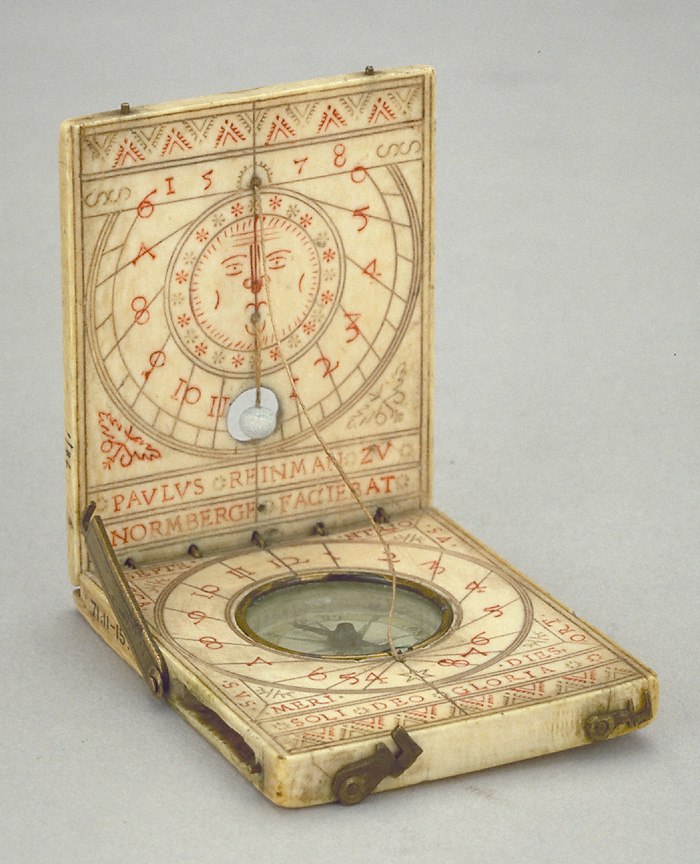
This diptych dial is constructed from ivory and brass with dimensions of 67 x 52 x 11 mm. Signed by Paul Reinmann and dated 1578, the instrument consists of two hinged leaves featuring red and black filled stamped inscriptions. The upper leaf includes an exterior wind rose with sixteen directions and an interior vertical string gnomon dial numbered 6 to 12 to 6, centered on a sun motif with a plumb bob. The lower leaf holds a horizontal string gnomon dial numbered 4 to 12 to 8, Latin cardinal directions, and the motto 'SOLI DEO GLORIA'. The central compass is identified as an 18th-century replacement with a card signed by E. Ch. Stockert. Two brass clasps secure the dial, while a pivoted arm on the lower leaf covers a cavity. The outer lower surface is marked with a crown stamp.

The diptych dial opened to show the sun-motif plumb bob and horizontal compass dial.
The diptych dial opened to show the sun-motif plumb bob and horizontal compass dial. — © British Museum, London. Rights pending — permission not yet requested. Original source

Catalogue identity

Source
www.mhs.ox.ac.uk
Category
Tool · Nuremberg diptych dial
Maker / attribution
Paul Reinmann
Reference
Not recorded
Catalogue / lot identifier
MLA 1871,11-15.15
Source-reported date
1578
Source-reported place
Nuremberg

Source-reported attribution and specifications are not independent authentication. A listing does not establish present ownership, current display, availability or permission to reproduce.

Object description

Construction and Design

The diptych dial is a portable instrument formed by two ivory leaves held together by brass hinges and secured by brass clasps. It measures 67 by 52 by 11 millimeters. The surfaces are decorated with engraved geometrical patterns and leaves, with the stamped inscriptions throughout the device filled with red and black colours. One brass clasp is attached to the edge to maintain the open position during use. A pivoted arm is located on the side edge of the lower leaf, functioning to cover a cavity.

The upper leaf serves multiple diagnostic functions. Its exterior face displays a wind rose with sixteen directions labelled in German and the names of eight winds in Italian, such as 'TRAMONTA' and 'LEVANTE'. Outside this wind rose, the markings indicate the cardinal directions for sun movement, specifically 'AVFGANG', 'MITTAG', 'NIDERGANG', and 'MITTERNACH'. A circular cutout in the northern section of this wind rose allows for the observation of the compass needle in the leaf below and provides clearance for the plumb bob suspended from the inner dial.

Evidence for this section
  • “The stamped inscriptions on this ivory dial are filled with red and black colours.”
  • “Two brass clasps allow the dial to be closed, one clasp attached to the opposite side would hold the dial in position while being used.”
  • “A pivoted arm on the side edge of the lower leaf covers a cavity.”
  • “The outer surface of the upper leaf contains a windrose with 16 directions in German and the names of eight winds in Italian”

Dials and Timekeeping

The interior of the upper leaf features a vertical string gnomon dial, with hours numbered anticlockwise from 6 to 12 to 6. The center of this dial is decorated with an engraving of the sun's face, from which a plumb bob is suspended, housed within the cutout when the dial is closed. Above and below the dial face are the date '1578' and the signature 'PAVLVS REINMANN ZV NORMBERGE FACIEBAT'.

The interior of the lower leaf houses a horizontal string gnomon dial with hours numbered clockwise from 4 to 12 to 8. Latin cardinal directions and the motto 'SOLI DEO GLORIA' are inscribed around the dial. The central compass is noted as a replacement, containing a card signed by E. Ch. Stockert, an eighteenth-century German maker. The outer surface of the lower leaf remains largely vacant, with the exception of the maker’s mark, which consists of a stamped crown.

Evidence for this section
  • “The inner surface of the upper leaf contains a vertical string gnomon dial with the hours numbered anticlockwise 6 to 12 to 6.”
  • “Above and below the dial are the date and signature given as '1578' and 'PAVLVS REINMANN ZV NORMBERGE FACIEBAT'.”
  • “The inner surface of the lower leaf contains a horizontal string gnomon dial with the hours numbered clockwise from 4 to 12 to 8.”
  • “The compass in the centre is a replacement and contains a compass card signed 'E. Ch. Stockert'”

Provenance and Documentation

The instrument was acquired by the British Museum in 1871 as part of the MLA collection, identified by the registration number 1871,11-15.15. The acquisition is attributed to a gift from A.W. Franks. The item is formally catalogued within the broader study of European scientific instruments.

The dial is further documented in the publication 'A catalogue of European Scientific Instruments in the Department of Medieval and Later Antiquities of the British Museum' by F. A. B. Ward, published in London in 1981. It is indexed there as item number 78 on page 35, providing a secondary reference for its history and physical description within museum archives.

Evidence for this section
  • “The instrument was given by A.W. Franks in 1871 and is described in F. A. B. Ward, A catalogue of European Scientific Instruments in the Department of Medieval and Later Antiquities of the British Museum (London, 1981), p. 35, no. 78.”

Open research questions

  • What specific cavity is concealed by the pivoted arm on the lower leaf?
  • To what extent does the 18th-century compass card differ from the original design expected of a Paul Reinmann instrument?

Source evidence

Recorded claims and source quotations for Diptych Dial by Paul Reinmann
FieldSource-reported valueSource quotation
MakerPaul Reinmann“Signed by Paul Reinmann”
Date1578“Dated 1578”
Dimensions67 x 52 x 11 mm“67 x 52 x 11 mm”
MaterialsIvory and brass“Ivory and brass”
Compass18th century replacement by E. Ch. Stockert“The compass is a replacement with the card signed by E. Ch. Stockert, a German sundial maker in the 18th century.”
MarkingsMaker's mark is a crown“the maker's mark, a crown, stamped twice.”
ProvenanceGift of A.W. Franks, 1871“The instrument was given by A.W. Franks in 1871”

Visible details

  • Red and black colored ink in stamped markings
  • Brass hardware includes two securing clasps and a side arm
  • Interior sun face motif features a suspended plumb bob
  • Exterior lid features wind rose with German and Italian nomenclature

Research qualifications

  • Compass identified as an 18th-century replacement
  • Precise function of the pivoted side arm is described as covering a cavity

Photograph identity and source facts were screened before import; rights clearance remains pending.

Consulted source

Diptych Dial

Reviewed 2026-10-26 · Record 6889ca2f1d

Terms in this record

Glossary explanations for terms named in this object’s record.