
Skip to content
The Encyclopedia of Horology

Tool · Nuremberg diptych dial

Diptych Dial by Paul Reinmann

Partially verified

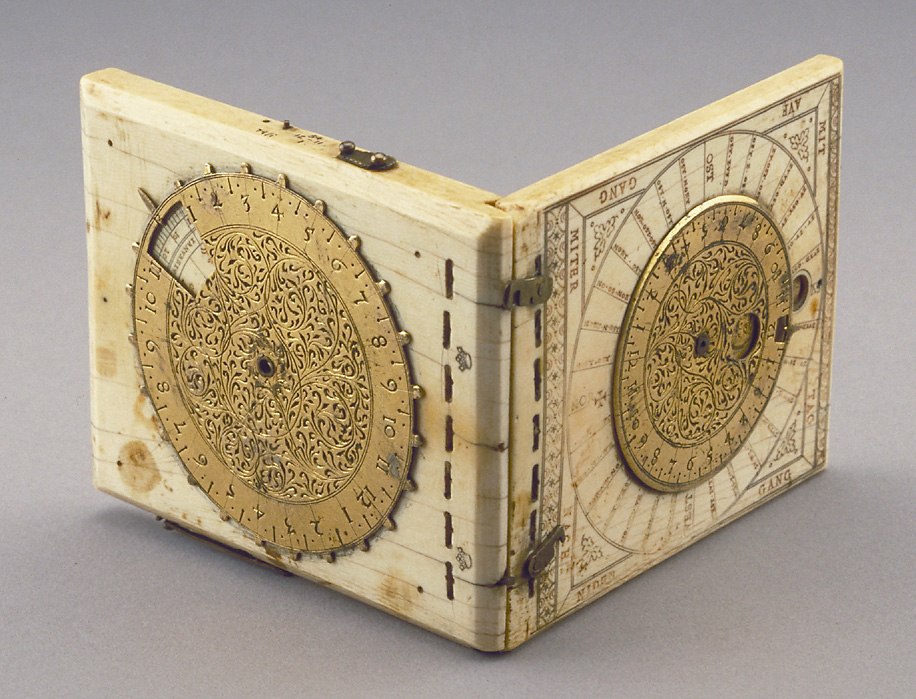
This diptych dial is an elaborate timekeeping instrument constructed from ivory and brass, measuring 105 x 85 x 15 mm. Signed by the Nuremberg-based maker Paul Reinmann and dated 1587, the object features numerous integrated astronomical and horological functions. These include a lunar volvelle, a wind rose, an equatorial dial, pin gnomon dials, horizontal and vertical string gnomon dials with Italian hour indications, and a nocturnal. The ivory surfaces are decorated with engraved geometrical patterns, sun effigies, and stars, with stamped inscriptions filled in red and black. Brass components include two holding clasps, a gilt brass lunar volvelle, and a gilt brass nocturnal volvelle. The instrument reflects a complex arrangement of solar and lunar timekeeping, though it is currently noted as incomplete, with certain pin gnomons missing and the equatorial dial incorrectly set.

Side view of the diptych dial showing the brass nocturnal volvelle on the left leaf and the windrose with the lunar volvelle on the right leaf.
Side view of the diptych dial showing the brass nocturnal volvelle on the left leaf and the windrose with the lunar volvelle on the right leaf. — British Museum, London. Rights pending — permission not yet requested. Original source

Catalogue identity

Source
www.mhs.ox.ac.uk
Category
Tool · Nuremberg diptych dial
Maker / attribution
Paul Reinmann
Reference
Not recorded
Catalogue / lot identifier
MLA 1854,12-11.1
Source-reported date
1587
Source-reported place
Nuremberg

Source-reported attribution and specifications are not independent authentication. A listing does not establish present ownership, current display, availability or permission to reproduce.

Object description

Construction and Design

The diptych dial is fabricated from ivory and brass, measuring 105 x 85 x 15 mm. The instrument consists of two leaves connected by hinges, secured by brass clasps that allow for both transport and functional positioning. The decorative program consists of engraved geometrical patterns, sun effigies, lunar crescents, and stars. Stamped inscriptions across the ivory surfaces are finished with red and black pigments.

Functionality is distributed across multiple surfaces. The upper leaf includes a windrose with 32 directions and a gilt brass lunar volvelle. The inner surfaces contain pin gnomon and string gnomon dials, while the lower leaf features a horizontal string gnomon dial and a compass well. A nocturnal assembly, also utilizing a gilt brass volvelle, occupies the outer surface of the lower leaf.

Evidence for this section
  • “Ivory and brass; 105 x 85 x 15 mm”
  • “The stamped inscriptions on this ivory dial are filled with red and black colours.”
  • “The dial is decorated with geometrical patterns which contain lunar crescents, stars and sun effigies.”

Timekeeping Functions

The instrument serves as a multi-functional horological device. The horizontal string gnomon dial provides indications for Italian hours across nine circles, though the months associated with these circles are not specified. The upper leaf includes a vertical pin gnomon dial displaying Babylonian hours, numbered 1 to 10, alongside zodiacal symbols.

Additional features include an equatorial pin gnomon dial with a 24-hour scale, which currently lacks its pin. The instrument includes a latitude scale marked 'POLVS HEHE' ranging from 5 to 60 degrees, intended for adjusting the equatorial dials. The nocturnal, located on the outer surface of the lower leaf, utilizes a gilt brass volvelle with a long index to track time through stellar observation, although the cursor is missing.

Evidence for this section
  • “The horizontal string gnomon dial has further indications for Italian hours throughout the year.”
  • “The pin gnomon dial shows Babylonian hours, numbered 1 to 10, and the lines of the zodiacal signs with their symbols.”
  • “The outer surface of the lower leaf contains a nocturnal with the cursor missing.”

Signatures and Provenance

The instrument is signed by Paul Reinmann, with the inscription 'PAVLUS REINMAN NORIMBERG FACIEBAT' located on the face of the string gnomon dial. The date 1587 is engraved at the base of the dial alongside a German-language instruction. A maker’s mark, depicted as a crown, is stamped twice within the compass well and at the base of the lower leaf's nocturnal display.

The dial was acquired by the British Museum in 1854. It is recorded in the museum's collection under registration number MLA 1854,12-11.1 and has been documented in scholarly catalogues regarding European scientific instruments.

Evidence for this section
  • “The signature of the maker 'PAVLUS REINMAN NORIMBERG FACIEBAT' is engraved at the bottom on the face of the string gnomon dial.”
  • “At the base of the dial is the inscription 'der faden zaygt die gancz und halb uhr' and the date '1587'.”
  • “The instrument was purchased in 1854 and is described in F. A. B. Ward, A catalogue of European Scientific Instruments in the Department of Medieval and Later Antiquities of the British Museum”

Open research questions

  • What is the significance of the latitude scale marking 'POLVS HEHE'?
  • Are the specific missing components (nocturnal cursor and equatorial pin) documented in previous collections history?

Source evidence

Recorded claims and source quotations for Diptych Dial by Paul Reinmann
FieldSource-reported valueSource quotation
MakerPaul Reinmann“by the well known maker Paul Reinmann”
Date1587“Dated 1587; Nuremberg”
MaterialIvory and brass“Ivory and brass; 105 x 85 x 15 mm”
Dimensions105 x 85 x 15 mm“105 x 85 x 15 mm”
Maker's markCrown“a crown, stamped twice”
SignaturePAVLUS REINMAN NORIMBERG FACIEBAT“'PAVLUS REINMAN NORIMBERG FACIEBAT' is engraved at the bottom on the face of the string gnomon dial”
Inventory NumberMLA 1854,12-11.1“Registration no. MLA 1854,12-11.1”

Visible details

  • Ivory surfaces with red and black filled stamped inscriptions
  • Gilt brass nocturnal volvelle with 23 projecting pins
  • Two brass clasps used to hold the dial in an open position
  • Maker's mark of a crown stamped twice in the compass well

Research qualifications

  • Equatorial pin gnomon dial on the upper leaf is currently set incorrectly
  • Nocturnal on the outer surface of the lower leaf is incomplete with the cursor missing

Photograph identity and source facts were screened before import; rights clearance remains pending.

Consulted source

Diptych Dial

Reviewed 2026-10-26 · Record 522b922f79

Terms in this record

Glossary explanations for terms named in this object’s record.