
Skip to content
The Encyclopedia of Horology

Tool · Nuremberg diptych dial

Diptych Dial by Paul Reinmann

Partially verified

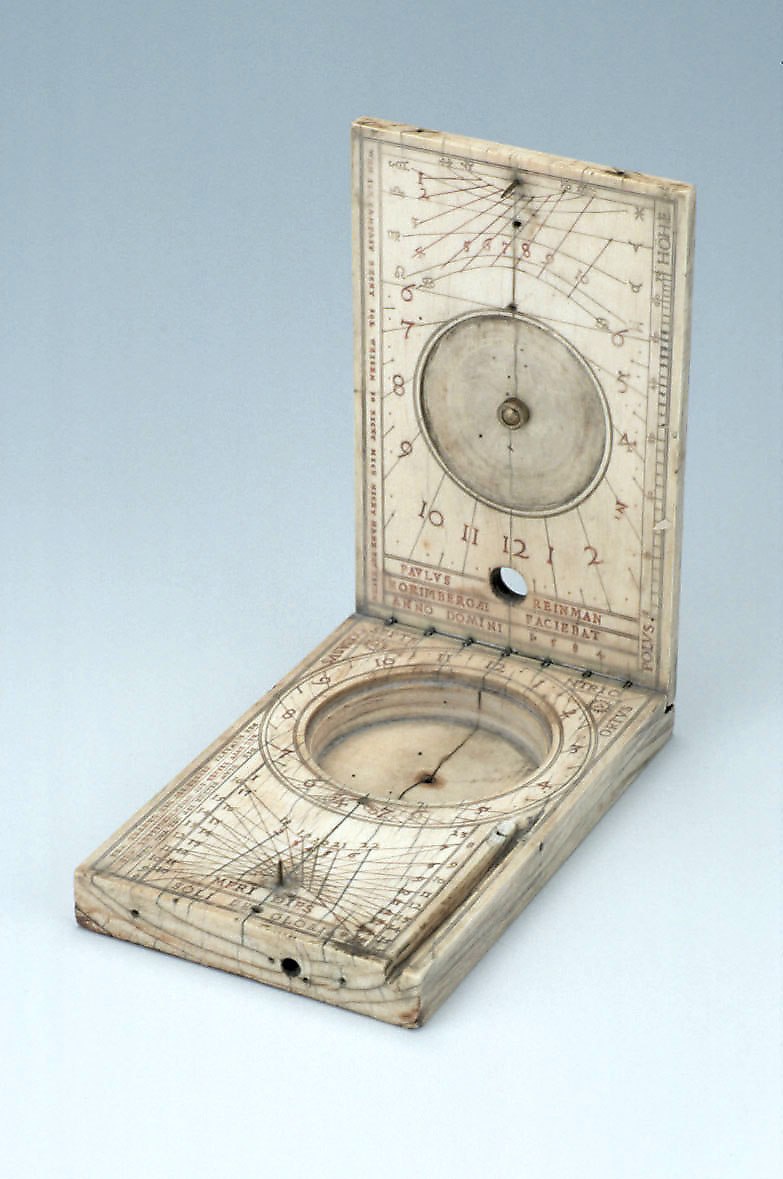
This diptych dial is constructed from ivory and brass and measures 71 x 115 x 18 mm. Attributed to the maker Paul Reinmann and dated 1584, the instrument originates from Nuremberg. The dial comprises two ivory leaves hinged together, featuring multiple time-telling mechanisms including string gnomon dials, pin gnomon dials, and a brass volvelle. The surface is engraved with inscriptions providing instructions for use, latitudes of various cities, and religious mottos, including 'SOLI DEO GLORIA'. The instrument incorporates a compass (now missing) and various compartments designed for components including a brass latitude arm and a wind vane. The dial is signed and dated on the lower inner leaf. The piece shows evidence of missing components, including the triangular gnomon, the compass, the latitude arm, and the wind vane, as well as a possible missing central volvelle on the upper leaf.

Diptych dial by Paul Reinmann, 1584.
Diptych dial by Paul Reinmann, 1584. — Museum of the History of Science, Oxford. Rights pending — permission not yet requested. Original source

Catalogue identity

Source
www.mhs.ox.ac.uk
Category
Tool · Nuremberg diptych dial
Maker / attribution
Paul Reinmann
Reference
Not recorded
Catalogue / lot identifier
48146
Source-reported date
1584
Source-reported place
Germany

Source-reported attribution and specifications are not independent authentication. A listing does not establish present ownership, current display, availability or permission to reproduce.

Object description

Construction and Layout

The diptych dial is composed of two ivory leaves connected by a hinge, with inset brass elements. The exterior of the upper leaf features a rotating brass volvelle decorated with foliage, engraved with month initials and hour lines. The interior of the upper leaf contains a pin gnomon dial with zodiacal symbols and a string gnomon dial.

The lower leaf interior houses a recessed area for a compass, surrounded by a string gnomon dial and a pin gnomon dial displaying Italian and Babylonian hours. Compartments are integrated into the sides for the storage of auxiliary components, including a brass latitude arm and a wind vane. The overall construction incorporates engraved lists of cities and their respective latitudes, alongside various mottos and operational instructions in German and Latin.

Evidence for this section
  • “The outer part of the upper leaf has a brass volvelle decorated with foliage and engraved with the initials of the names of the months and hour lines”
  • “The inner part of the lower leaf has a compass (missing) and a string gnomon dial”
  • “On the far right side is a compartment for the brass arm (missing) for adjusting the latitude.”

Signatures and Inscriptions

The instrument is signed by Paul Reinmann, with the inscription 'PAVLVS REINMAN NORIMBERGAE FACIEBAT ANNO DOMINI 1584' located on the bottom part of the inner upper leaf. The object displays a maker's mark in the form of a crown, which is punched twice on the outer lower leaf.

Numerous inscriptions provide utility and context for the dial. These include instructions for the compass, latitude scales, and the definition of different hour systems used by the instrument. Religious inscriptions such as 'SOLI DEO GLORIA' are present on the lower leaf, alongside the names of cardinal points and decorative solar motifs.

Evidence for this section
  • “On the bottom part of the leaf is the signature and date 'PAVLVS REINMAN NORIMBERGAE FACIEBAT ANNO DOMINI 1584'.”
  • “The outer side of the lower leaf has a table of latitudes and the maker's mark (a crown) punched twice at the bottom.”
  • “On the bottom is the motto 'SOLI DEO GLORIA' ('glory to God only').”

Condition Report

Several components of the dial are absent. The triangular gnomon is missing, as are the compass, the latitude adjusting arm, and the wind vane.

The ivory surface retains visible engraved markings, although certain areas of text remain illegible due to the positioning of existing brass elements. The instrument exhibits signs of wear and age, consistent with the loss of its original movable parts.

Evidence for this section
  • “The triangular gnomon is unfortunately missing.”
  • “. Below it is a string gnomon dial (string missing) with common hours numbered from 6 to 12 to 6 with dots and lines for the half and quarters of hour. The centre is probably missing a volvelle.”
  • “The inner part of the lower leaf has a compass (missing)”

Open research questions

  • What is the content of the obscured text on the upper leaf currently covered by the brass volvelle?
  • What specific types of wood or ivory were used in the construction of the Nuremberg-style diptych dials of this period?

Source evidence

Recorded claims and source quotations for Diptych Dial by Paul Reinmann
FieldSource-reported valueSource quotation
MakerPaul Reinmann“Signed by Paul Reinmann”
Date1584“Dated 1584”
Place of manufactureNuremberg“Nuremberg”
Dimensions71 x 115 x 18 mm“71 x 115 x 18 mm”
MaterialsIvory and brass“Ivory and brass”
Inventory number48146“Inventory number: 48146”
SignaturePAVLVS REINMAN NORIMBERGAE FACIEBAT ANNO DOMINI 1584“PAVLVS REINMAN NORIMBERGAE FACIEBAT ANNO DOMINI 1584”

Visible details

  • Red-colored hour numerals are used on the internal dials.
  • The object features engraved sun effigies and stars as decorative elements.
  • An internal inscription warns against placing the compass near iron.
  • A maker's mark consisting of a crown is punched twice on the outer side of the lower leaf.

Research qualifications

  • The source indicates that the central volvelle on the inner upper leaf is probably missing.
  • The source notes that the writing around the upper outer volvelle is obscured and cannot be read.

Photograph identity and source facts were screened before import; rights clearance remains pending.

Consulted source

Diptych Dial

Reviewed 2026-10-26 · Record 1cb9002bbb

Terms in this record

Glossary explanations for terms named in this object’s record.