
Skip to content
The Encyclopedia of Horology

Tool · Nuremberg diptych dial

Diptych dial by Hieronymus Reinmann

Partially verified

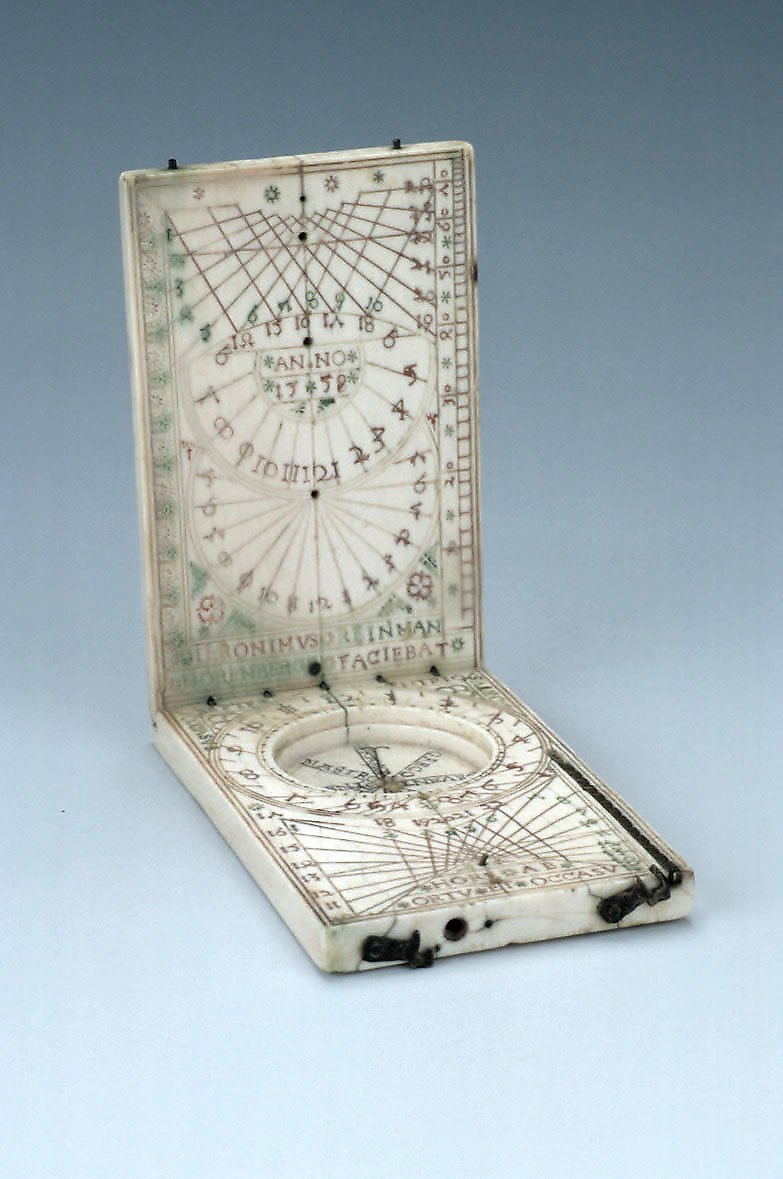
This diptych dial, manufactured in 1559 in Nuremberg, is crafted from ivory and brass and measures 56 x 90 x 13 mm. Signed by Hieronymus Reinmann, the instrument features extensive decorative use of red and green colouring. The upper leaf includes a pin gnomon dial and a table of eighteen towns with latitudes. The interior of the upper leaf displays a vertical pin gnomon dial, a string gnomon dial, and a second vertical string gnomon dial, alongside a signature at the base. The lower leaf houses a compass, a string gnomon dial, and a further pin gnomon dial for Italian and Babylonian hours, accompanied by a brass latitude adjustment arm. Various components, including the pin, needle, ring, and glass, are absent from the current assembly. An ink notation 'N 77' appears on the exterior of the lower leaf, while a storage compartment for the missing pin is located on the bottom edge.

Diptych dial by Hieronymus Reinmann, 1559.
Diptych dial by Hieronymus Reinmann, 1559. — Museum of the History of Science, Oxford. Rights pending — permission not yet requested. Original source

Catalogue identity

Source
www.mhs.ox.ac.uk
Category
Tool · Nuremberg diptych dial
Maker / attribution
Hieronymus Reinmann
Reference
Not recorded
Catalogue / lot identifier
81867
Source-reported date
1559
Source-reported place
Nuremberg

Source-reported attribution and specifications are not independent authentication. A listing does not establish present ownership, current display, availability or permission to reproduce.

Object description

Construction and Design

The diptych dial is constructed from ivory and brass, measuring 56 by 90 by 13 millimetres. The exterior of the upper leaf features a pin gnomon dial for common hours, accompanied by a sun effigy and decorative spandrels, alongside a latitude table for eighteen towns. The inner surfaces are notable for their decorative application of green and red colours.

The inner upper leaf incorporates three distinct dial systems: a vertical pin gnomon dial for Italian and Babylonian hours, a central string gnomon dial, and a vertical string gnomon dial. The lower leaf contains an internal compass, a string gnomon dial for common hours, and a pin gnomon dial with associated inscriptions indicating the calculation of hours from sunrise and sunset. A brass arm is provided for adjusting the latitude.

Evidence for this section
  • “Ivory and brass; 56 x 90 x 13 mm”
  • “The decoration consists of a sun effigy on the outer face of the upper leaf, and on the inner sides the use of colours, especially red and green, is extensive.”
  • “On the right is a brass arm for adjusting the latitude”

Inscriptions and Signature

The object is identified by the signature located at the bottom of the inner upper leaf, which reads 'IERONIMVS REINMAN NORENBERGE FACIEBAT'. The date '1559' is inscribed in the centre of the same leaf, rendered in red with green stars. Additional inscriptions include geographical terms such as 'OCCASVS', 'SEPTE NTRIO', and 'ORTVS' within the spandrel spaces.

On the lower leaf, a Latin inscription notes the function of the dial related to sunrise and sunset hours. The letter sequence 'A A' is punched near the hinge. Furthermore, an inventory or reference marking, 'N 77', is written in black ink on the outer side of the lower leaf, providing a supplementary identification for the instrument.

Evidence for this section
  • “At the bottom of the leaf is the signature 'IERONIMVS REINMAN NORENBERGE FACIEBAT'”
  • “at the centre the inscription 'AN NO 15 59' in red with green stars”
  • “At the bottom of the pin the inscription explains '[star] HORE [star] AB [star] HORTV [star] ET [star] OCCASV'.”

Reported Condition

Specifically, the pin gnomon for the exterior dial, the string gnomons for the interior dials, and the compass needle, ring, and glass are all absent.

Despite the absence of these mechanical components, the ivory housing remains intact, including the compartment on the bottom edge of the lower leaf intended for the storage of the pin. The brass latitude adjustment arm is present, though

Evidence for this section
  • “The outer side of the upper leaf has a pin gnomon dial (pin missing)”
  • “The pin, needle, ring and glass are all missing.”
  • “On the bottom edge of the lower leaf is a compartment for stowing the pin”

Open research questions

  • What is the specific function of the 'A A' punched inscription near the hinge?
  • Do the eighteen towns listed in the latitude table correspond to a specific geographical range often used by Reinmann?

Source evidence

Recorded claims and source quotations for Diptych dial by Hieronymus Reinmann
FieldSource-reported valueSource quotation
MakerHieronymus Reinmann“Signed by Hieronymus Reinmann”
Date1559“Dated 1559”
MaterialsIvory and brass“Ivory and brass”
Dimensions56 x 90 x 13 mm“56 x 90 x 13 mm”
SignatureIERONIMVS REINMAN NORENBERGE FACIEBAT“At the bottom of the leaf is the signature 'IERONIMVS REINMAN NORENBERGE FACIEBAT'.”
LocationNuremberg“Nuremberg”
Inventory number81867“Inventory number 81867”

Visible details

  • Extensive use of red and green pigment for numbering and decorations
  • Significantly complex dial layout on the inner leaf surfaces
  • Absence of primary time-keeping components including the needle and string gnomons
  • Presence of a brass adjustment arm on the lower leaf

Research qualifications

  • The exact purpose of the 'A A' inscription near the hinge is not verified.
  • The original condition of the missing components remains uncertain.

Photograph identity and source facts were screened before import; rights clearance remains pending.

Consulted source

Diptych Dial

Reviewed 2026-10-26 · Record 7aecfa3a34

Terms in this record

Glossary explanations for terms named in this object’s record.