
Skip to content
The Encyclopedia of Horology

Tool · Nuremberg diptych dial

Diptych Dial by Hans Tucher

Partially verified

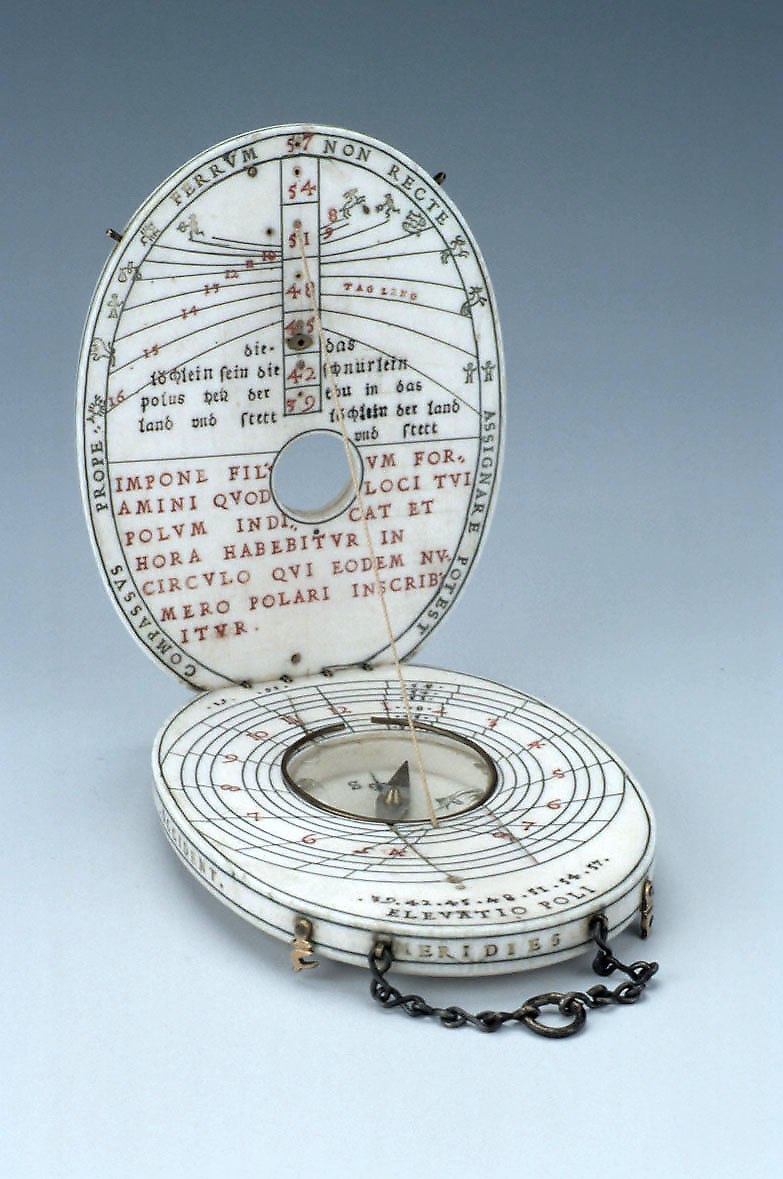
This diptych dial is an ivory, brass, and silver instrument measuring 80 x 111 x 15 mm. Signed by Hans Tucher and dated 1595, it originates from Nuremberg. The oval-shaped instrument features an upper leaf containing a wind rose with 32 directions, a pin gnomon dial for measuring day length, and a string gnomon dial adjustable for seven latitudes. The lower leaf includes a string gnomon dial, a central compass, and a lunar volvelle on its exterior. The instrument is extensively inscribed in Latin and German, including instructions for use, latitude markings, and a moral motto. It retains a silver suspension chain and partially surviving bun feet. The internal compass is damaged, and one bun foot appears missing. The dial is part of the collection of the Museum of the History of Science, Oxford, identified by inventory number 50854.

The interior of the 1595 diptych dial showing the string gnomon, the central compass, and the ivory leaves with inscribed latitude and hour markings.
The interior of the 1595 diptych dial showing the string gnomon, the central compass, and the ivory leaves with inscribed latitude and hour markings. — Museum of the History of Science, Oxford. Rights pending — permission not yet requested. Original source

Catalogue identity

Source
www.mhs.ox.ac.uk
Category
Tool · Nuremberg diptych dial
Maker / attribution
Hans Tucher
Reference
Not recorded
Catalogue / lot identifier
50854
Source-reported date
1595
Source-reported place
Nuremberg

Source-reported attribution and specifications are not independent authentication. A listing does not establish present ownership, current display, availability or permission to reproduce.

Object description

Construction and Design

The diptych dial is constructed in an oval shape, measuring 80 x 111 x 15 mm. It is composed primarily of ivory with brass fittings and an unusual silver suspension chain. The upper and lower leaves are hinged to allow the device to be opened for use.

The outer surface of the lower leaf features a pierced lunar volvelle, decorated with moons and stars, labeled 'NACHT VHR'. The upper leaf's exterior includes a wind rose with 32 directions, complete with a compass viewing hole and a brass index arm. Four bun feet are present on the base, although one appears to be missing.

Evidence for this section
  • “Ivory, brass and silver; 80 x 111 x 15mm”
  • “The outer part of the upper leaf of this oval-shaped dial has a wind rose with 32 directions”
  • “There is one bun foot (another appears to be missing)”
  • “An unusual feature of this dial is the silver suspension chain.”

Timekeeping and Latitude

The inner section of the upper leaf provides a pin gnomon dial for tracking day length, graduated from 8 to 16, and includes zodiac symbols for solar declination. A string gnomon dial is provided for seven specific latitudes: 39, 42, 45, 48, 51, 54, and 57 degrees.

The lower leaf contains a corresponding string gnomon dial for the same latitudes, marked for common hours from 4 to 12 to 8. A central compass, marked with cardinal directions, is integrated into the center of the lower leaf. Latin and German text provides instructions on adjusting the string gnomon for different latitudes and warns against proximity to iron.

Evidence for this section
  • “The string gnomon dial is adjustable for latitudes 39?, 42?, 45?, 48?, 51?, 54?, 57?.”
  • “The inner part of the lower leaf has a string gnomon dial for the latitudes mentioned above”
  • “COMPASSV PROPE FERRVM NON RECTE ASSIGNARE POTEST”

Signatures and Inscriptions

The dial is signed by Hans Tucher and dated 1595. Various inscriptions appear across the surfaces, including the Latin motto 'HIC M ARINVS COMPAS SVS SEMI TAM TERRA MARIQVE OSTENDIT' and the German motto 'DER SP?DTER SOL NICHTS VER ACHTEN DEN ER KANS BESSER MACHTEN'.

The maker's mark, depicted as a serpent, is accompanied by the initials H D. The cardinal directions 'ORIENS', 'OCCIDENS', and 'MERIDIES' are marked on the edge of the dial, while the compass is inscribed with directional initials.

Evidence for this section
  • “Signed by Hans Tucher”
  • “Dated 1595”
  • “At the top is the inscription 'NACH CAMPAST' and the maker's mark (a serpent) and initials (H D)”
  • “the critic should despise nothing unless he can make it better”

Open research questions

  • What is the significance of the 'H D' initials alongside the Hans Tucher signature?
  • Does the compass needle survive inside the broken central housing?

Source evidence

Recorded claims and source quotations for Diptych Dial by Hans Tucher
FieldSource-reported valueSource quotation
MakerHans Tucher“Signed by Hans Tucher”
Date1595“Dated 1595”
Dimensions80 x 111 x 15mm“80 x 111 x 15mm”
MaterialsIvory, brass, silver“Ivory, brass and silver”
OriginNuremberg“Nuremberg”
Inventory Number50854“Inventory number 50854”
InscriptionLatin and German“extensively inscribed in Latin and German with instructions for proper use”

Visible details

  • Silver suspension chain attached to edge
  • Internal compass is broken
  • One bun foot is missing
  • Lunar volvelle on lower leaf exterior

Research qualifications

  • One bun foot appears to be missing
  • Internal compass is noted as broken

Photograph identity and source facts were screened before import; rights clearance remains pending.

Consulted source

Diptych Dial

Reviewed 2026-10-26 · Record 7dc8d96fb0

Terms in this record

Glossary explanations for terms named in this object’s record.