
Skip to content
The Encyclopedia of Horology

Tool · Nuremberg diptych dial

Diptych Dial by Hans Tucher

Partially verified

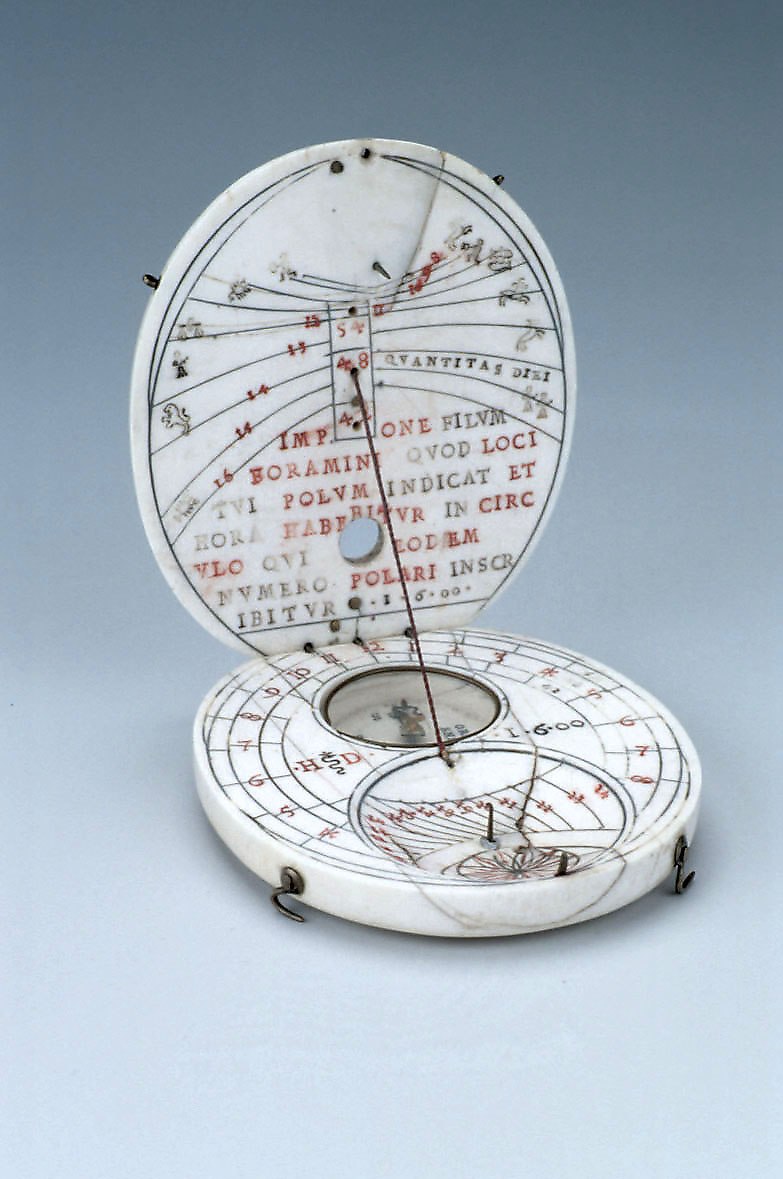
This oval-shaped diptych sundial, crafted from ivory and brass, measures 72 x 90 x 12 mm. The instrument is comprised of two leaves hinged together. The upper leaf contains a pin gnomon dial for calculating day length and solar declination, alongside instructions for latitude adjustments. The lower leaf incorporates a magnetic compass and a string gnomon dial for common hours, as well as a scaphe dial for Italian hours. The exterior of the upper leaf features a wind rose with 32 directions, while the exterior of the lower leaf includes a lunar volvelle and a cautionary inscription regarding magnetic interference from iron. The object serves as a multifaceted timekeeping and astronomical instrument, utilizing multiple gnomon types to provide temporal and latitude-based data for the user.

Diptych sundial, showing the interior of the opened leaves with gnomons, compass, and various hour scales.
Diptych sundial, showing the interior of the opened leaves with gnomons, compass, and various hour scales. — Museum of the History of Science, Oxford. Rights pending — permission not yet requested. Original source

Catalogue identity

Source
www.mhs.ox.ac.uk
Category
Tool · Nuremberg diptych dial
Maker / attribution
Hans Tucher
Reference
Not recorded
Catalogue / lot identifier
50246
Source-reported date
1600
Source-reported place
Nuremberg

Source-reported attribution and specifications are not independent authentication. A listing does not establish present ownership, current display, availability or permission to reproduce.

Object description

Construction and Design

The diptych dial is an oval instrument constructed primarily from ivory, accented with brass components. The design consists of two hinged leaves that house various astronomical and temporal measuring features. The upper leaf includes a wind rose featuring 32 directions on its exterior, alongside a compass viewing hole and brass supports. The interior of the upper leaf serves as a pin gnomon dial for tracking the length of the day, marked with zodiacal symbols and numerical hour scales.

The lower leaf contains an integrated magnetic compass and a string gnomon dial, which is designed to be adjustable for specific latitudes. A central scaphe dial is positioned to measure Italian hours, which are inscribed in red. The overall assembly measures 72 by 90 by 12 mm and includes four bun feet for stability when the dial is opened for use.

Evidence for this section
  • “On this oval shaped dial are engraved inscriptions about the use of the instrument”
  • “The outer part of the upper leaf has a wind rose with 32 directions, brass index arm and compass viewing hole, and two bun feet.”

Astronomical Features and Inscriptions

The dial incorporates multiple methods for determining time and solar positions. The interior of the upper leaf is engraved with an instructional Latin text, "IMPONE FILVM HORAMINI QVOD LOCI TVI POLVM INDICAT ET HORA HABEBITVR IN CIRCVLO QVI EODEM NVMERO POLARI INSCRIBITVR," which guides the user in setting the string gnomon according to their local latitude.

The outer side of the lower leaf includes a lunar volvelle to assist with night-time timekeeping. A warning is engraved around this feature in Latin, cautioning the user that the compass needle may not function correctly if the instrument is kept in proximity to iron. The Italian hour scale on the scaphe dial is rendered in red, providing a clear visual contrast to the black engravings used elsewhere on the ivory surfaces.

Evidence for this section
  • “The string gnomon dial is adjustable for latitudes”
  • “Around the lunar volvelle on the outer side of the lower leaf the user is warned that the compass needle cannot point properly when the instrument is close to iron.”

Maker and Identification

The object is signed by the maker Hans Tucher and is dated to 1600. A distinctive maker's mark in the form of a serpent is punched into the ivory surface, appearing on the outside of the lower leaf and again in the center of the interior of the lower leaf. This mark serves as the primary identifier for the maker within the context of Nuremberg instrument production.

The dial is currently held in the collection of the Museum of the History of Science, Oxford, under inventory number 50246. References to this specific type of instrument are discussed in P. Gouk's publication regarding Nuremberg ivory sundials.

Evidence for this section
  • “The maker's mark of Hans Tucher (a serpent) is punched on the ouside of the lower leaf of the dial”
  • “See P. Gouk, The Ivory Sundials of Nuremberg 1500-1700 (Cambridge, 1988).”

Open research questions

  • Which specific locations correspond to the latitude settings mentioned in the instructions?
  • What is the technical significance of the 16-leaf flower motif found at the base of the scaphe dial?

Source evidence

Recorded claims and source quotations for Diptych Dial by Hans Tucher
FieldSource-reported valueSource quotation
MakerHans Tucher“Signed by Hans Tucher”
Date1600“Dated 1600”
MaterialIvory and brass“Ivory and brass”
Dimensions72 x 90 x 12 mm“72 x 90 x 12 mm”
Place of originNuremberg“Nuremberg”
Inventory number50246“Inventory number 50246”

Visible details

  • Oval ivory casing construction
  • String gnomon for common hour tracking
  • Compass set within the lower leaf
  • Serpent maker's mark present on lower leaf

Research qualifications

  • Specific latitudes for string gnomon dial are obscured by question marks in transcription
  • Exact meaning of the 16-leaf flower motif remains undocumented

Photograph identity and source facts were screened before import; rights clearance remains pending.

Consulted source

Diptych Dial

Reviewed 2026-10-26 · Record 5c9cc98cd4

Terms in this record

Glossary explanations for terms named in this object’s record.