
Skip to content
The Encyclopedia of Horology

Tool · Nuremberg diptych dial

Diptych Dial by Hans Tucher

Partially verified

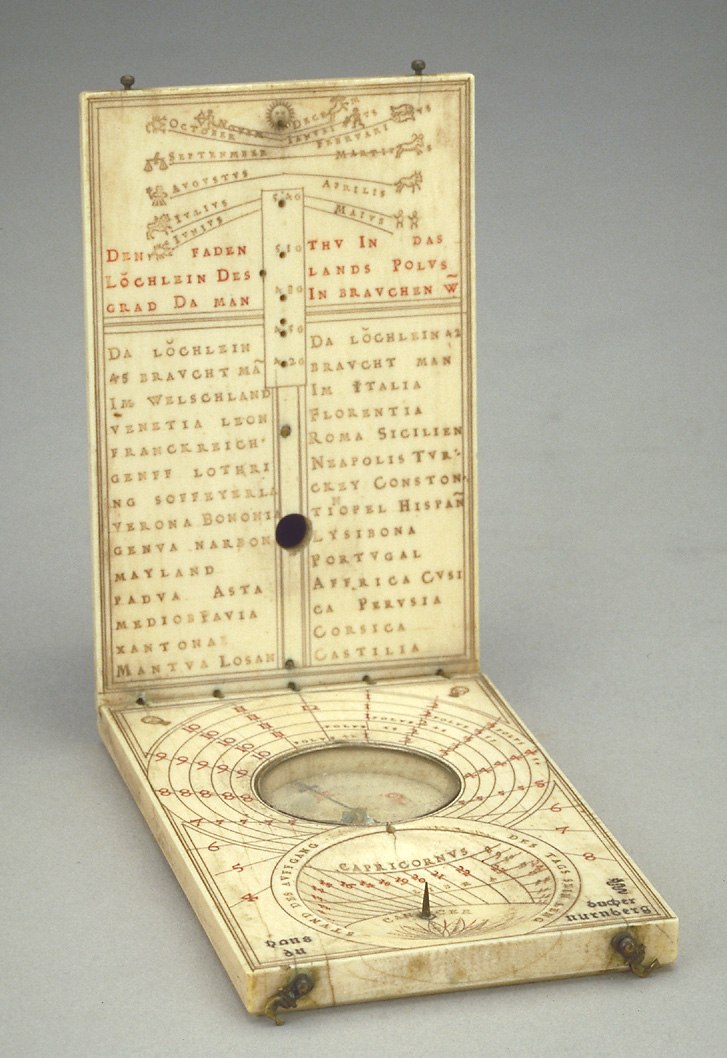
This Nuremberg diptych dial is constructed from ivory and brass, measuring 109 x 70 x 14 mm. Signed by the maker as 'hans ducher zu nurnberg', the instrument features extensive stamped inscriptions in red, black, and brown, alongside decorative geometrical patterns. The device serves as a multifunctional timekeeping instrument, incorporating a string gnomon dial, two pin gnomon dials, a wind rose, and a lunar volvelle. A central magnetic compass is inset into the lower leaf, which displays five concentric circles for string gnomon readings across multiple latitudes. Additional features include a scaphe dial with Italian hours and a day-length scale. The upper leaf provides geographical guidance, correlating specific latitudes (42°, 45°, 48°, 51°, and 54°) to various European and Mediterranean regions. The instrument includes brass clasps for securing and positioning the leaves, though the hinge wire is absent.

Inner surfaces of the ivory diptych dial featuring the string gnomon, scaphe dial, and latitude tables.
Inner surfaces of the ivory diptych dial featuring the string gnomon, scaphe dial, and latitude tables. — British Museum, London. Rights pending — permission not yet requested. Original source

Catalogue identity

Source
www.mhs.ox.ac.uk
Category
Tool · Nuremberg diptych dial
Maker / attribution
Hans Tucher
Reference
MLA 1871,11-15.19
Catalogue / lot identifier
MLA 1871,11-15.19
Source-reported date
1581
Source-reported place
Germany

Source-reported attribution and specifications are not independent authentication. A listing does not establish present ownership, current display, availability or permission to reproduce.

Object description

Construction and Design

The diptych dial consists of two ivory leaves connected by a hinge, though the connecting wire is presently missing. The exterior and interior surfaces are heavily engraved and stamped with text and graphics, with the voids filled in black, red, and brown pigments. The dial incorporates a series of functional components, including a string gnomon dial designed for five distinct latitudes and a scaphe dial for Italian time.

The compass features a dial with marked cardinal points and a noted magnetic deviation of 25 degrees West. The dial's surface is decorated with geometric patterns and a stylized flower within the scaphe area.

Evidence for this section
  • “The wire with which the two leafs were once attached to each other is now missing.”
  • “Two clasps allow the dial to be closed, one clasp on the opposite side holds it open while in use.”
  • “The stamped inscriptions on this ivory dial are filled with red, brown and black colour.”

Timekeeping and Latitude Functions

The instrument is designed for use at multiple latitudes, ranging from 42 to 54 degrees. The inner lower leaf contains a string gnomon dial with concentric scales corresponding to these latitudes, alongside a scaphe dial indicating Italian hours and day lengths. A solar-lunar conversion volvelle is located on the outer surface, allowing for the calculation of lunar and solar time.

Geographical inscriptions on the leaves categorize various regions and cities by their latitude, providing the user with settings for the string gnomon. The pin gnomon dial at the top of the upper leaf displays month names and zodiacal symbols, though it lacks hour markings, limiting its function in direct time measurement.

Evidence for this section
  • “The string gnomon dial has five circles with hour markings 1 to 12 to 8 for the latitudes ('POLVS') 42?, 45?, 48?, 51? and 54?.”

Provenance and Attribution

The object is held by the British Museum under the inventory number MLA 1871,11-15.19. It was presented to the museum by A.W. Franks in 1871. The maker is identified as Hans Tucher, based on the signature and the mark of an upright serpent with a crown.

The documentation notes that it remains impossible to distinguish whether this work originated from Hans Tucher II or Hans Tucher III, as both were active during this period and shared the same maker's mark. The spelling 'Ducher' appearing on the instrument is noted as being consistent with other documented dials by this maker.

Evidence for this section
  • “It is impossible to establish whether this instrument was made by either Hans Tucher II or Hans Tucher III”
  • “Left and right of the scaphe is the signature of the maker 'hans ducher zu nurnberg' and his mark, a vertical serpent with a crown.”

Open research questions

  • Did Hans Tucher II and III consistently use the exact same serpent mark, or are there subtle differences identified in other specimens?
  • What is the technical basis for the 25 degree West magnetic deviation cited in the description?

Source evidence

Recorded claims and source quotations for Diptych Dial by Hans Tucher
FieldSource-reported valueSource quotation
MakerHans Tucher“Signed by Hans Tucher”
Date1581“Dated 1581”
Place of manufactureNuremberg“Nuremberg”
Dimensions109 x 70 x 14 mm“109 x 70 x 14 mm”
MaterialsIvory and brass“Ivory and brass”
Latitude range42 to 54 degrees“latitudes ('G') 42?, 45?, 48?, 51? and 54?”
CompassMagnetic deviation of 25 degrees W“magnetic deviation of 25? W”

Visible details

  • Maker's mark of a vertical serpent with a crown
  • Hand-inscribed geographic latitude tables on inner leaves
  • Compass needle and glass indicated as later replacements
  • Inlay of brass pin for the scaphe dial

Research qualifications

  • Maker identity uncertain between Hans Tucher II and Hans Tucher III
  • Original hinge wire is missing from the assembly

Photograph identity and source facts were screened before import; rights clearance remains pending.

Consulted source

Diptych Dial

Reviewed 2026-10-26 · Record 5265a5fe35

Terms in this record

Glossary explanations for terms named in this object’s record.