Construction and Exterior Features
The diptych dial is a rectangular instrument composed of ivory and brass, featuring two hinged leaves. The outer face of the upper leaf displays a wind rose with 32 directions, marked in German, surrounded by Latin-inscribed circles and a brass index arm. Decoration in the spandrels consists of fruit and foliage, and the edge is inscribed with text referencing the value of time.
The exterior of the lower leaf includes a pierced lunar volvelle, an aspectarium, and a table of epacts. A planetary table, labeled 'PLANETEN TAFEL', indicates the ruling planet for each day of the week, flanked by allegorical figures and decorations of angels and foliage. The instrument stands on four bun feet and retains the maker's mark, a six-pointed star, punched near the hinge.
Evidence for this section
- “The outer side of the upper leaf has a wind rose with 32 directions”
- “The outer part of the lower leaf has a pierced lunar volvelle and aspectarium”
- “The maker's mark is punched twice in the circle for hours.”
Interior Dials and Mathematical Functions
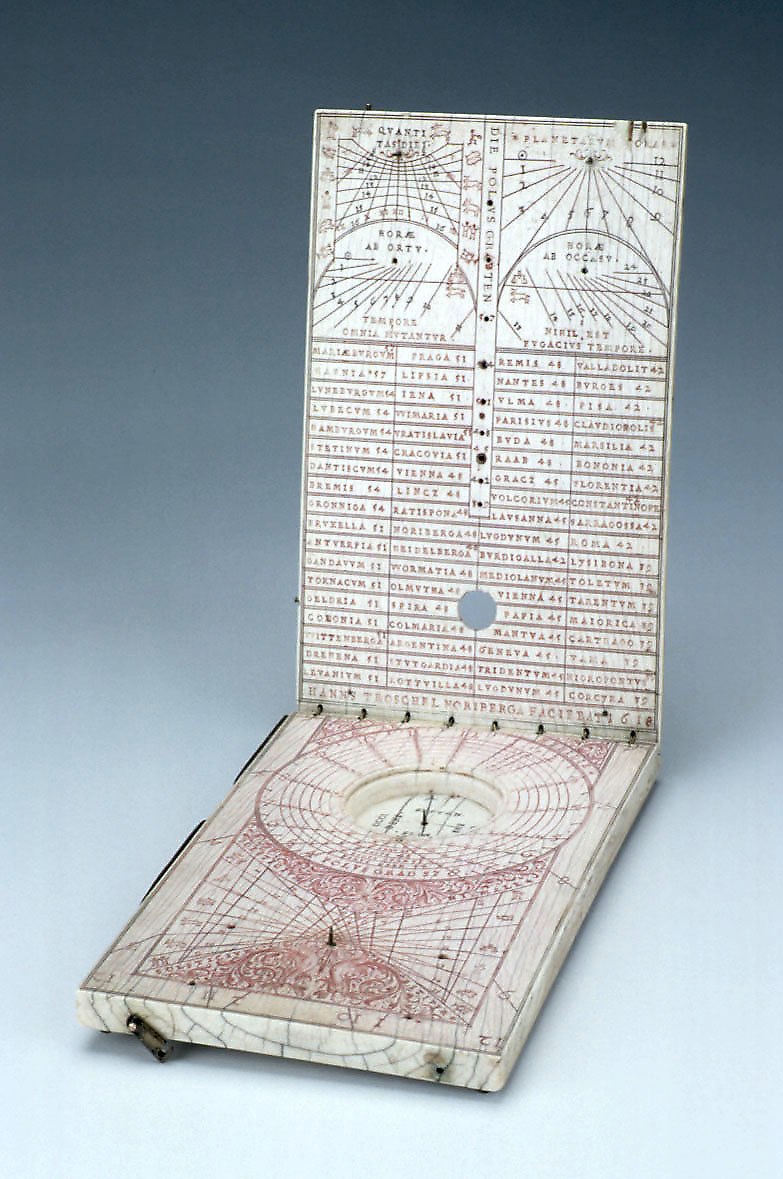
The inner portion of the upper leaf contains multiple pin gnomon dials indicating 'QVANTITAS DIEI', common hours in red, 'HORAE AB ORTV', 'PLANETARVM HORAS', and 'HORAE AB OCCASV'. Between these dials are holes for latitude adjustment ranging from 39 to 57 degrees. A table on the lower section lists 72 cities alongside their respective latitudes.
The lower leaf contains a compass, which is currently missing its glass and ring. A string gnomon dial surrounds the compass area, providing timekeeping for various latitudes. Below this, a polar dial indicates both Italian and Babylonian hours, with solar declination marked by zodiacal symbols. The borders feature a dial intended for use in conjunction with the upper leaf as a gnomon.
Evidence for this section
- “The inner part of the upper leaf has two pin gnomon dials”
- “Between the dials are the holes for adjusting the latitude to 57, 54, 51, 48, 45, 42 and 39 degrees”
- “Below the decoration is a pin gnomon polar dial, indicating Italian hours from 9 to 24 and Babylonian hours from 1 to 15.”
Condition and Attribution
The instrument is attributed to Hans Troschel, with the date 1618 clearly inscribed. The maker's mark is observed as a six-pointed star, punched in multiple locations. The physical integrity of the object has been affected by time; specifically, the polar pin gnomon is missing, as is the compass glass, the compass ring, and the wind vane.
The object retains its functional markings and inscriptions, including various Latin mottos regarding the nature of time. Two compartments are located on the left edge of the leaves, intended for the storage of the pin and the missing wind vane.
Evidence for this section
- “Signed by Hans Troschel”
- “the maker's mark (a six-pointed star) is punched twice next to the hinge”
- “There is also a brass index arm and a compass viewing hole.”