Construction and Design
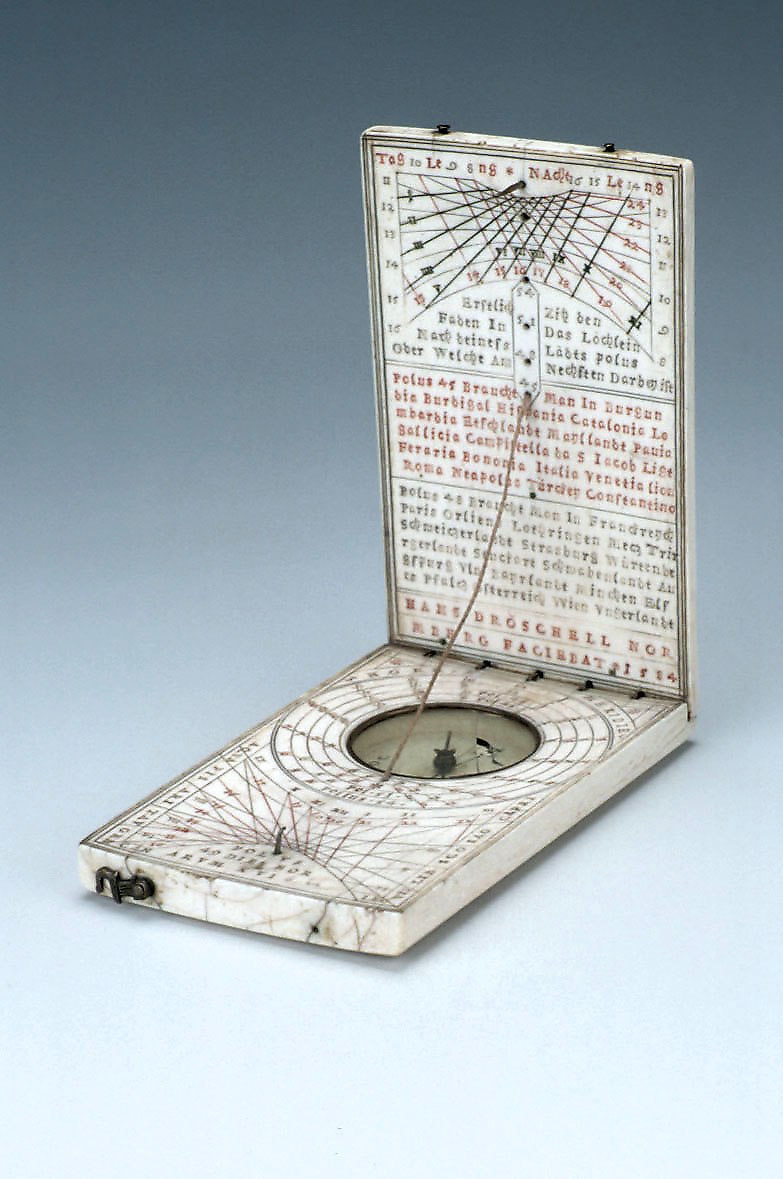
The diptych dial is a portable instrument fashioned from ivory and brass, measuring 62 mm by 16 mm by 11 mm. The instrument consists of two hinged leaves that fold together. The interior surface of the upper leaf is populated with a pin gnomon dial, lists of geographical locations grouped by latitude, and various time scales including Italian hours in red ink and Babylonian hours in green ink. It also displays day and night length indicators.
The lower leaf contains a circular compass inset with cardinal points marked as 'SE', 'OR', 'ME', and 'OC'. Additionally, the lower leaf incorporates a string gnomon dial with four distinct rings corresponding to latitudes 45, 48, 51, and 54 degrees. The exterior of the lower leaf features the maker's punch mark, repeated three times, and the Nuremberg quality mark 'n'.
The outer face of the upper leaf features a lunar volvelle with scales for time correction in hours and minutes. The borders of this section are marked with the cardinal points, and it includes a list of cities corresponding to latitudes 51 and 54 degrees.
Evidence for this section
- “Ivory and brass; 62 x 16 x 11 mm”
- “The inner part of the upper leaf has a pin gnomon dial”
- “On the inner side of the lower leaf is a compass (glass cracked)”
- “On the outer side of the lower leaf is punched the mark of Hans Troschel and the quality mark 'n' for Nuremberg”
Timekeeping Features
The instrument functions primarily through string and pin gnomon dials. The string gnomon is adjustable to four specific latitudes, allowing the user to select the setting closest to their geographic location. Instructions for this adjustment are provided directly on the dial in gothic script, translated as 'firstly put the string into the slotlet according to the pole of your country or which is the nearest to it'.
The dial tracks time using several different systems. The pin gnomon dial on the upper leaf displays Italian hours marked 13 to 24, and Babylonian hours marked I to XI. The lower leaf includes a string gnomon dial tracking common hours from 4 to 12 to 8, and a further pin gnomon dial showing Italian hours from 10 to 23 and common hours from VI to XII to VI. The sun's declination is denoted by zodiac names.
Evidence for this section
- “It has a string gnomon dial adjustable for four different latitudes”
- “The inner part of the upper leaf has a pin gnomon dial with Italian hours (marked from 13 to 24 in red), Babylonian hours (marked I to XI in green)”
- “The declination of the sun is not indicated by zodiac symbols but by the corresponding names.”
Signatures and Provenance
The dial is signed by Hans Troschel, with the specific inscription 'HANS DR?SCHELL NORMBERG FACIEBAT [star] 1584' located on the bottom of the upper leaf. The object is catalogued by the Museum of the History of Science, Oxford, under inventory number 82451.
The maker's attribution is supported by both the signature and the quality mark 'n' for Nuremberg found on the exterior of the lower leaf, confirming its geographic origin within the context of 16th-century ivory sundial production. The instrument is documented in the reference work by P. Gouk regarding Nuremberg ivory dials.
Evidence for this section
- “Signed by Hans Troschel”
- “At the bottom of the leaf is the signature and date 'HANS DR?SCHELL NORMBERG FACIEBAT [star] 1584'”
- “On the outer side of the lower leaf is punched the mark of Hans Troschel and the quality mark 'n' for Nuremberg”
- “See P. Gouk, The Ivory Sundials of Nuremberg 1500-1700 (Cambridge, 1988).”