
Skip to content
The Encyclopedia of Horology

Tool · Nuremberg diptych dial

Diptych Dial

Partially verified

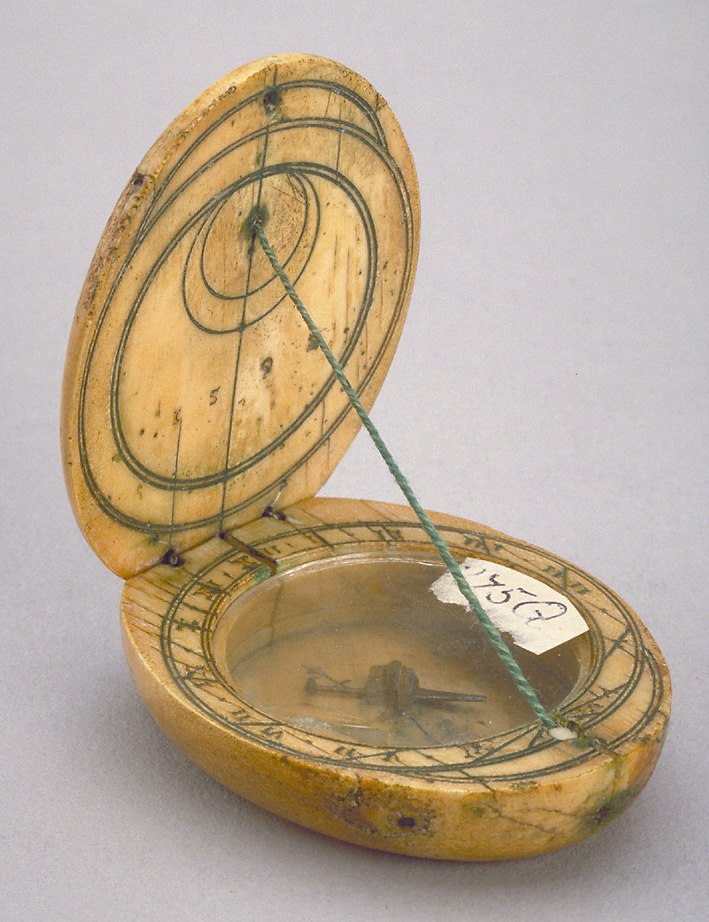
This oval-shaped diptych dial is constructed from bone and measures 50 x 62 x 18 mm. The instrument is unsigned, although the construction resembles the style of late 16th-century makers from Nuremberg. It consists of two leaves joined by a hinge with a small catch to hold the device open. The outer surfaces are plain. On the inner face of the upper leaf, decoration consists of tangent circles and an engraved date that is read as 1592, though the final digit is uncertain. The lower leaf contains a compass, which is currently missing its needle, and a horizontal string gnomon dial. The hour lines on the lower leaf are graduated from V to XII to VII, including markings for half-hours. The object is currently part of the collection at the British Museum, having been acquired via the Ilbert Collection through a gift from Gilbert Edgar in 1958.

Diptych dial made of bone showing the open leaves, the string gnomon, and the compass bowl.
Diptych dial made of bone showing the open leaves, the string gnomon, and the compass bowl. — © British Museum, London. Rights pending — permission not yet requested. Original source

Catalogue identity

Source
www.mhs.ox.ac.uk
Category
Tool · Nuremberg diptych dial
Maker / attribution
Not established
Reference
Not recorded
Catalogue / lot identifier
MLA 1958, 10-6.2415
Source-reported date
Late 16th century ?
Source-reported place
Nuremberg

Source-reported attribution and specifications are not independent authentication. A listing does not establish present ownership, current display, availability or permission to reproduce.

Object description

Construction and Dial Layout

The dial is formed from bone in an oval configuration consisting of an upper and lower leaf connected by a hinge. To facilitate use, a small catch is integrated near the hinge to secure the instrument in an open position. The exterior faces of the leaves are plain and featureless. The interior of the upper leaf features engraved geometric decoration consisting of tangent circles, alongside an inscribed date.

The lower leaf houses a compass, which currently lacks its needle, with the interior bowl inscribed with the letters 'S' and 'M'. Surrounding the compass is a horizontal dial designed for a string gnomon. The scale is graduated for common hours ranging from V to XII to VII, with small markings indicating half-hour intervals.

Evidence for this section
  • “The outer sides of both leaves of this oval shape dial are blank.”
  • “The inner side of the lower leaf has a compass inscribed 'S' and 'M' (needle detached) and the hour lines for a horizontal string gnomon dial around it.”

Chronology and Attribution

The object remains unsigned, making a definitive identification of the maker impossible.

An engraved date appears on the interior of the upper leaf, which is identified as 1592. However, the final digit is not clearly legible, leading to uncertainty regarding the exact year of manufacture.

Evidence for this section
  • “Unsigned”
  • “Late 16th century ?; Nuremberg”
  • “The date engraved on the inside of the upper leaf refers to the last decade of the 16th century, but the last figure cannot be read.”

Provenance and History

The instrument is held by the British Museum in London. It was previously part of the Ilbert Collection and was donated to the museum in 1958 by Gilbert Edgar. The piece is formally catalogued with the registration number MLA 1958, 10-6.2415.

The dial is further documented in academic literature relating to the museum's collections. It appears in F. A. B. Ward's 1981 publication regarding the museum's department of Medieval and Later Antiquities, where it is listed as object number 14 on page 22.

Evidence for this section
  • “The instrument was formerly in the Ilbert Collection and was presented by Gilbert Edgar in 1958.”
  • “It is described in F. A. B. Ward, A Catalogue of European Scientific Instruments in the Department of Medieval and Later Antiquities of the British Museum (London, 1981), p. 22, no.14.”

Open research questions

  • What is the significance of the 'S' and 'M' inscriptions within the compass bowl?
  • Is the crude nature of the bone engraving consistent with other surviving instruments in the British Museum collection from the same period?

Source evidence

Recorded claims and source quotations for Diptych Dial
FieldSource-reported valueSource quotation
Dimensions50 x 62 x 18 mm“50 x 62 x 18 mm”
Inscribed Date1592(?)“1592[?]”
MakerUnsigned“Unsigned”
ProvenanceIlbert Collection“The instrument was formerly in the Ilbert Collection”
Acquisition Date1958“presented by Gilbert Edgar in 1958”
Geographic AssociationNuremberg“Nuremberg”
ConditionThe lower leaf is badly cracked“The lower leaf is badly cracked across.”

Visible details

  • Oval shape with two leaves joined by a hinge
  • Compass inset in lower leaf with 'S' and 'M' markings
  • String gnomon connecting the upper and lower leaves
  • Cracks visible across the surface of the lower leaf

Research qualifications

  • The exact date of manufacture remains uncertain due to the illegible final digit of the inscribed year
  • The attribution to Nuremberg is based on style only, as the instrument is unsigned

Photograph identity and source facts were screened before import; rights clearance remains pending.

Consulted source

Diptych Dial

Reviewed 2026-10-26 · Record 97ce8a33a3

Terms in this record

Glossary explanations for terms named in this object’s record.