
Skip to content
The Encyclopedia of Horology

Tool · Nuremberg diptych dial

Diptych Dial

Partially verified

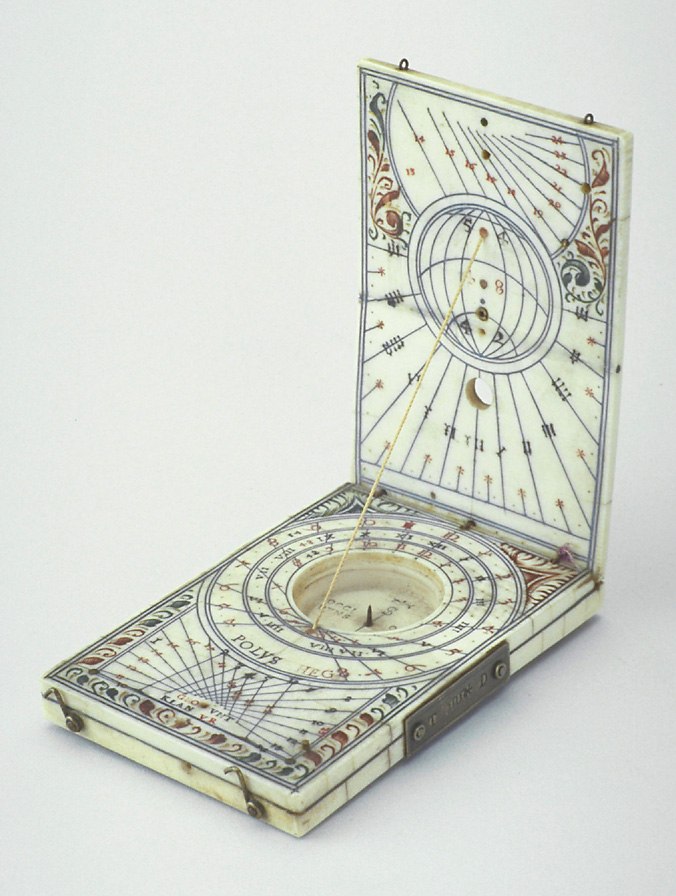
This diptych dial is attributed to Thomas Tucher of Nuremberg, dating to circa 1600. Constructed primarily of ivory with brass accents, it measures 60 x 88 x 13 mm. The instrument features a hinged construction with multiple timekeeping functions, including string gnomon dials, pin gnomon dials for Italian and Babylonian hours, and a lunar volvelle on the exterior. The decoration includes arabesques, leaves, and a central sun face. The object integrates a compass, although several components are currently missing, including the compass glass, needle, ring, and the wind vane. The maker's mark is found on a brass plate on the lower leaf edge rather than being punched into the ivory. The dial incorporates specific astronomical tables and inscriptions, some of which are noted by the museum to be historically inconsistent, such as the epact table and the hour system labels.

Diptych sundial, showing the interior leaves with string gnomon, hour markings, and compass cavity.
Diptych sundial, showing the interior leaves with string gnomon, hour markings, and compass cavity. — Museum of the History of Science, Oxford. Rights pending — permission not yet requested. Original source

Catalogue identity

Source
www.mhs.ox.ac.uk
Category
Tool · Nuremberg diptych dial
Maker / attribution
Thomas Tucher
Reference
Not recorded
Catalogue / lot identifier
46918
Source-reported date
circa 1600
Source-reported place
Nuremberg

Source-reported attribution and specifications are not independent authentication. A listing does not establish present ownership, current display, availability or permission to reproduce.

Object description

Construction and Design

The diptych dial consists of two ivory leaves hinged together, measuring 60 x 88 x 13 mm. The outer side of the upper leaf features a wind rose with 32 directions, a compass viewing hole, and a sun face motif at the center. The spandrels are decorated with coloured arabesques and leaves. The lower leaf is supported by three bun feet.

The inner sections utilize both string and pin gnomon mechanisms. The upper inner leaf houses a pin gnomon dial and a string gnomon dial with latitude adjustments. The lower inner leaf contains a compass cavity and further gnomon-based hour markings. Brass is employed for structural elements, including the hinge, the maker's signature plate, and index arms.

Evidence for this section
  • “Ivory and brass; 60 x 88 x 13 mm”
  • “The outer side of the upper leaf has a wind rose with 32 directions”
  • “There are also three bun feet.”

Signatures and Inscriptions

The maker's mark for Thomas Tucher is located on a brass plate fixed to the right edge of the lower leaf. This is noted as a departure from the traditional practice of punching the mark directly into the ivory surface. Additional inscriptions include cardinal points around the compass and labels for different hour systems.

Specific astronomical inscriptions appear on the exterior and interior faces. A lunar volvelle on the outer lower leaf contains a table of epacts. The museum report identifies inconsistencies in this table, noting that the Julian and Gregorian terms are reversed. Similarly, a label referencing 'large' and 'small' hours is described as incorrect because both systems present would be categorised as large.

Evidence for this section
  • “mark of Thomas Tucher with his initials is not punched on a leaf as usual, but is engraved on a brass plate on the right edge of the lower leaf”
  • “table of epacts is 'incorrect', i.e. starts with 17 / 7 and the terms 'Julian' and 'Gregorian' are reversed”
  • “inscription refers to 'small' and 'large' hours but it appears to be incorrect”

Reported Condition

The object retains its primary structure, although several functional components are missing. The internal compass, which would have contained a needle, ring, and glass cover, is currently empty. Additionally, the pin gnomon for the Italian hours and the wind vane normally housed in a compartment on the left edge are not present.

The maker's mark of a crowned serpent, located within the compass area, is described as very faded. The overall decorative scheme, including the coloured leaves and arabesques, remains visible on the leaf surfaces.

Evidence for this section
  • “compass with the cardinal points marked (glass, needle and ring missing)”
  • “the maker's mark, a crowned serpent (very faded)”
  • “On the left edge of the lower leaf is a compartment for the wind vane (missing)”

Open research questions

  • What is the specific intended function of the 'incorrect' epact table in the context of Nuremberg ivory dial production?
  • How do the missing compass components affect the overall balance and utility of the dial compared to complete examples?

Source evidence

Recorded claims and source quotations for Diptych Dial
FieldSource-reported valueSource quotation
MakerThomas Tucher“Attributed to Thomas Tucher”
Datecirca 1600“circa 1600”
Place of manufactureNuremberg“Nuremberg”
Dimensions60 x 88 x 13 mm“60 x 88 x 13 mm”
MaterialsIvory and brass“Ivory and brass”
Inventory number46918“Inventory number 46918”

Visible details

  • The dial is missing its compass needle, glass, and ring.
  • The maker's mark is engraved on a brass plate on the edge of the lower leaf.
  • The exterior includes a wind rose with 32 directions and a sun face.
  • The piece features three bun feet on the underside of the lower leaf.

Research qualifications

  • The museum notes the internal table of epacts is incorrect regarding the Julian and Gregorian terms.
  • The inscription 'GRO VNT KLAN VR' regarding hour systems is described by the museum as appearing incorrect.

Photograph identity and source facts were screened before import; rights clearance remains pending.

Consulted source

Diptych Dial

Reviewed 2026-10-26 · Record 7f8ec0f117

Terms in this record

Glossary explanations for terms named in this object’s record.