
Skip to content
The Encyclopedia of Horology

Tool · Nuremberg diptych dial

Diptych Dial

Partially verified

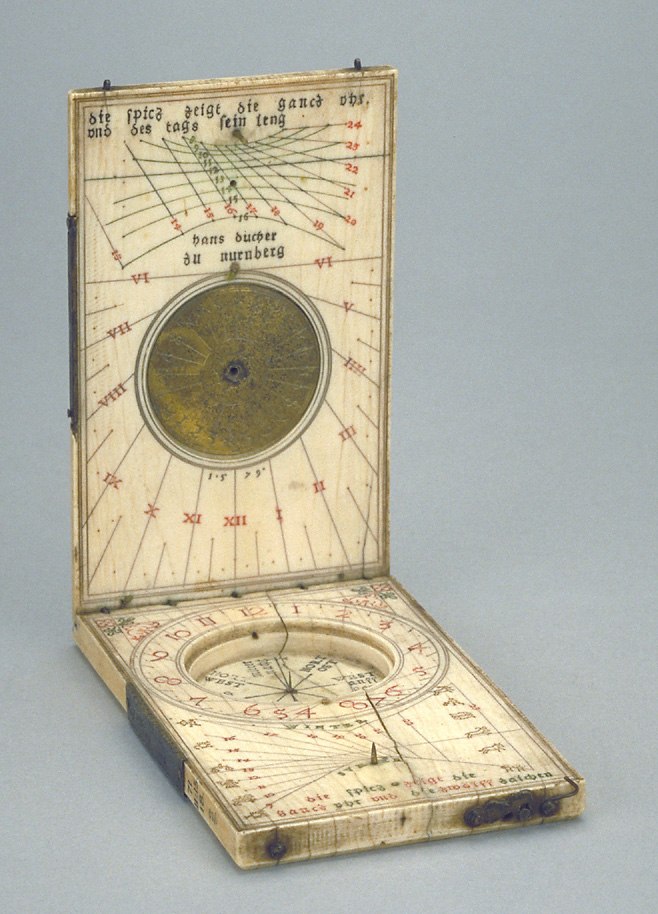
This 1579 diptych dial is constructed from ivory and brass, measuring 110 x 65 x 13 mm. Signed by Hans Tucher in Nuremberg, it features various integrated timekeeping systems, including an equatorial sun- and moondial on the outer leaf, and a combination of vertical and horizontal string and pin gnomon dials on the interior. The surfaces are embellished with inscriptions detailing geographical latitudes and functional instructions in German. The construction incorporates a brass latitude adjustment mechanism on the exterior and a central compass well. The object is decorated with stamped inscriptions filled with red, green, brown, and black pigments, and features the maker's mark—a vertical crowned serpent—stamped twice. The dial is currently missing several components, including the brass clasps, the pin gnomons, the string gnomons, and the compass needle and glass.

Detailed view of the interior ivory leaves and the central brass compass well of the Tucher diptych dial.
Detailed view of the interior ivory leaves and the central brass compass well of the Tucher diptych dial. — British Museum, London. Rights pending — permission not yet requested. Original source

Catalogue identity

Source
www.mhs.ox.ac.uk
Category
Tool · Nuremberg diptych dial
Maker / attribution
Hans Tucher
Reference
Not recorded
Catalogue / lot identifier
MLA 1871,11-15.18
Source-reported date
1579
Source-reported place
Nuremberg

Source-reported attribution and specifications are not independent authentication. A listing does not establish present ownership, current display, availability or permission to reproduce.

Object description

Construction and Design

The dial is formed from two ivory leaves joined together, with integrated brass elements such as the latitude adjustment arm and a central circular disc. The exterior upper leaf houses an equatorial sun- and moondial, which can be adjusted for latitude using a movable brass arm that locks into a corrugated scale ranging from 30 to 60 degrees.

The inner surfaces are densely packed with multiple sundial types, including vertical string and pin gnomon dials. These are annotated with German inscriptions, such as the note accompanying the pin gnomon dial that indicates the function of the shadow point in displaying hours and day length. The ivory surfaces are finished with coloured wax fillings in red, green, brown, and black for the engraved lettering and lines.

Evidence for this section
  • “It can be set to the right latitude using a movable brass arm on the outer edge of this leaf which can be hooked with a small index to a corrugated latitude scale on the outside edge of the lower leaf.”
  • “The stamped inscriptions on this ivory dial are filled with red, green, brown and black colours.”

Signatures and Markings

The instrument bears the signature 'hans ducher zu nurenberg' located on the upper interior leaf. Additional identification is provided by the maker's mark, which consists of a vertical crowned serpent stamped twice on the outer surface of the lower leaf.

The geographic information inscribed on the dial serves as a reference for various locations across Europe, grouped by their corresponding latitude requirements. These lists include cities such as Lisbon, Venice, and Nuremberg, providing a reference for users to calibrate the dial accurately based on their current location.

Evidence for this section
  • “Below this dial is the signature of the maker 'hans ducher zu nurenberg'.”
  • “In the remaining empty space the maker's mark, a vertical crowned serpent, is stamped twice.”

Reported Condition

The instrument is missing several original parts, including two brass closure clasps and two retaining clasps for the open position. Both the string gnomons for the interior dials and the pin gnomons are no longer present.

The compass well, located on the inner lower leaf, is missing its original glass cover and the magnetic needle. The remaining compass markings show a magnetic deviation of approximately 6 degrees East, and the primary directional markers are noted as being confused regarding East and West orientation.

Evidence for this section
  • “Two brass clasps, now missing, allowed the dial to be closed”
  • “The compass glass and needle are missing.”
  • “The string gnomon is missing.”

Open research questions

  • What is the definitive attribution to Hans Tucher II versus Hans Tucher III?
  • What was the original intended function of the now-missing brass clasp mechanism?

Source evidence

Recorded claims and source quotations for Diptych Dial
FieldSource-reported valueSource quotation
MakerHans Tucher“Signed by Hans Tucher”
Date1579“Dated 1579”
Place of originNuremberg“Nuremberg”
Dimensions110 x 65 x 13 mm“110 x 65 x 13 mm”
MaterialsIvory and brass“Ivory and brass”
Maker's markVertical crowned serpent“the maker's mark, a vertical crowned serpent, is stamped twice”
Inventory numberMLA 1871,11-15.18“Registration no. MLA 1871,11-15.18”

Visible details

  • Maker's mark of a vertical crowned serpent stamped on the exterior lower leaf
  • Dial surfaces feature German text inscriptions detailing city latitudes
  • Compass well marked with eight points
  • Brass latitude adjustment arm on the side of the upper leaf

Research qualifications

  • It is not possible to verify if the dial was made by Hans Tucher II or Hans Tucher III
  • Missing components include pin gnomons, string gnomons, two brass clasps, and the compass glass and needle

Photograph identity and source facts were screened before import; rights clearance remains pending.

Consulted source

Diptych Dial

Reviewed 2026-10-26 · Record 6821e40a2d

Terms in this record

Glossary explanations for terms named in this object’s record.