
Skip to content
The Encyclopedia of Horology

Tool · Nuremberg diptych dial

Diptych Dial

Partially verified

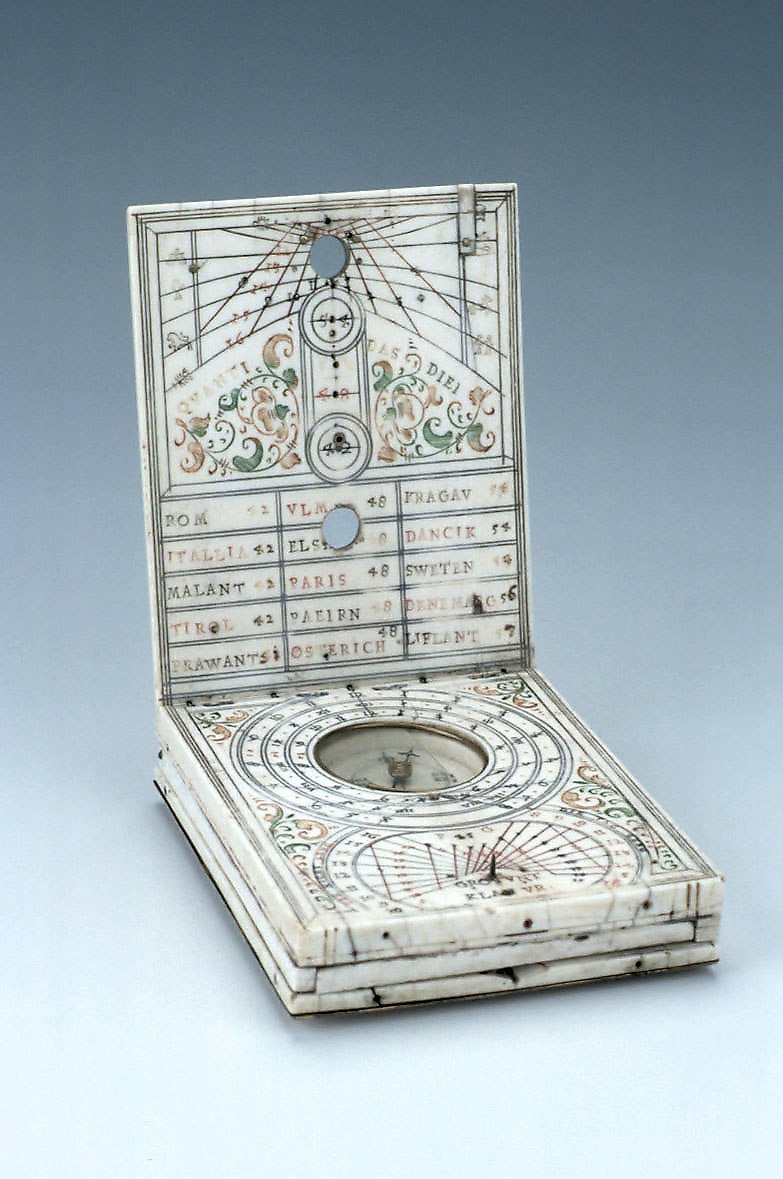
This diptych dial is attributed to Thomas Tucher, dating to circa 1620, Nuremberg. The instrument is constructed from three layers of ivory, with two folding leaves, creating a double diptych configuration with brass components. It incorporates a wide array of timekeeping and astronomical features, including a universal equinoctial dial, a polar dial, a lunar volvelle with an aspectarium, and a conversion table for Italian and Babylonian hours. Decoration consists of polychrome foliate and floral motifs. The instrument also features an integrated compass with magnetic deviation and a list of fifteen cities with their respective latitudes. Dimensions are 110 x 87 x 20 mm. The object includes specific brass plate covers, one of which conceals earlier ivory engravings. The dial currently exhibits signs of wear, including missing components such as bun feet, a wind vane, and a missing pin for the polar dial, while the compass glass is cracked.

General view of the open diptych dial showing the inner leaves, the compass, and the conversion table.
General view of the open diptych dial showing the inner leaves, the compass, and the conversion table. — Museum of the History of Science, Oxford. Rights pending — permission not yet requested. Original source

Catalogue identity

Source
www.mhs.ox.ac.uk
Category
Tool · Nuremberg diptych dial
Maker / attribution
Thomas Tucher
Reference
Not recorded
Catalogue / lot identifier
73044
Source-reported date
circa 1620
Source-reported place
Nuremberg

Source-reported attribution and specifications are not independent authentication. A listing does not establish present ownership, current display, availability or permission to reproduce.

Object description

Construction and Composition

The object is constructed of three layers of ivory, featuring two folding leaves that expand the functional space of the instrument. The core structure is augmented by brass components, including plates, volvelles, and a compass assembly. Dimensions are recorded as 110 mm by 87 mm by 20 mm.

On one leaf, a brass plate covers the exterior, featuring a pierced lunar volvelle and aspectarium. Evidence of underlying ivory engravings suggests the brass plate was applied to cover previous work. Decoration across the ivory surfaces is executed in polychrome, featuring birds, flowers, and foliage in the spandrel spaces and remaining open areas.

Evidence for this section
  • “This dial is made of three layers of ivory, two of them folding, thus constituting a double diptych dial”

Timekeeping and Astronomical Features

The dial integrates multiple horological functions. One side functions as a standard diptych dial, while another hosts a universal equinoctial dial adjustable for latitudes between 0 and 90 degrees. Further features include a polar dial on an inner leaf, which provides sunlight duration information and solar declination via zodiac symbols.

A conversion table on one leaf allows for the translation of Italian and Babylonian hours. Below the compass, which displays cardinal points and magnetic deviation, another polar dial calibrated for latitude 45 degrees provides additional temporal data, including Italian and Babylonian hour scales and day/night length indicators.

Evidence for this section
  • “the other has a brass folding universal equinoctial dial which can be adjusted for latitudes from 0 to 90?”
  • “Below it is a list of 15 cities and latitudes. This inner side of the central leaf has a compass (glass cracked) with the magnetic deviation and the cardinal points indicated”
  • “Below the compass is a polar dial for latitude 45 ('P G 45') indicating Italian hours, numbered from 10 to 23 in red, Babylonian hours numbered from 1 to 15 in black and indicated 'GROS VNT KLAN VHR'”

Condition and Marks

The object bears the maker's mark in the form of a snake, punched twice within the compass housing. The instrument shows several signs of previous use and partial loss. Notably, two of the four bun feet on the brass plate side are missing.

Additional damage is observed in the compass, where the protective glass is cracked. Furthermore, a wind vane on the leaf featuring the wind rose is absent, and the polar dial on the corresponding leaf is missing its central pin, limiting its current functionality as a diagnostic instrument.

Evidence for this section
  • “The maker's mark (a snake) is also punched twice in the compass.”
  • “four bun feet (two missing)”
  • “compass (glass cracked)”
  • “wind vane missing”
  • “polar dial (pin missing)”

Open research questions

  • What is the nature of the engravings hidden beneath the brass plate on the folding leaf?
  • Can the specific list of 15 cities be used to refine the provenance or the intended market for this dial beyond the Nuremberg attribution?

Source evidence

Recorded claims and source quotations for Diptych Dial
FieldSource-reported valueSource quotation
MakerThomas Tucher“Attributed to a Thomas Tucher”
Datecirca 1620“circa 1620; Nuremberg”
MaterialIvory and brass“Ivory and brass; 110 x 87 x 20 mm”
Inventory Number73044“Inventory number: 73044”
ConfigurationDouble diptych dial“This dial is made of three layers of ivory, two of them folding, thus constituting a double diptych dial .”
Maker's MarkSnake“The maker's mark (a snake) is also punched twice in the compass.”

Visible details

  • Polychrome floral and foliate decoration
  • Compass with magnetic deviation and snake maker's mark
  • Visible latitude scale on the universal equinoctial dial component

Research qualifications

  • Missing wind vane and polar dial pin
  • Cracked compass glass
  • Two missing bun feet

Photograph identity and source facts were screened before import; rights clearance remains pending.

Consulted source

Diptych Dial

Reviewed 2026-10-26 · Record 4ad572e54a

Terms in this record

Glossary explanations for terms named in this object’s record.