
Skip to content
The Encyclopedia of Horology

Clock · Skeleton clock

Cooper Hewitt Skeleton Clock on Wooden Base

Partially verified

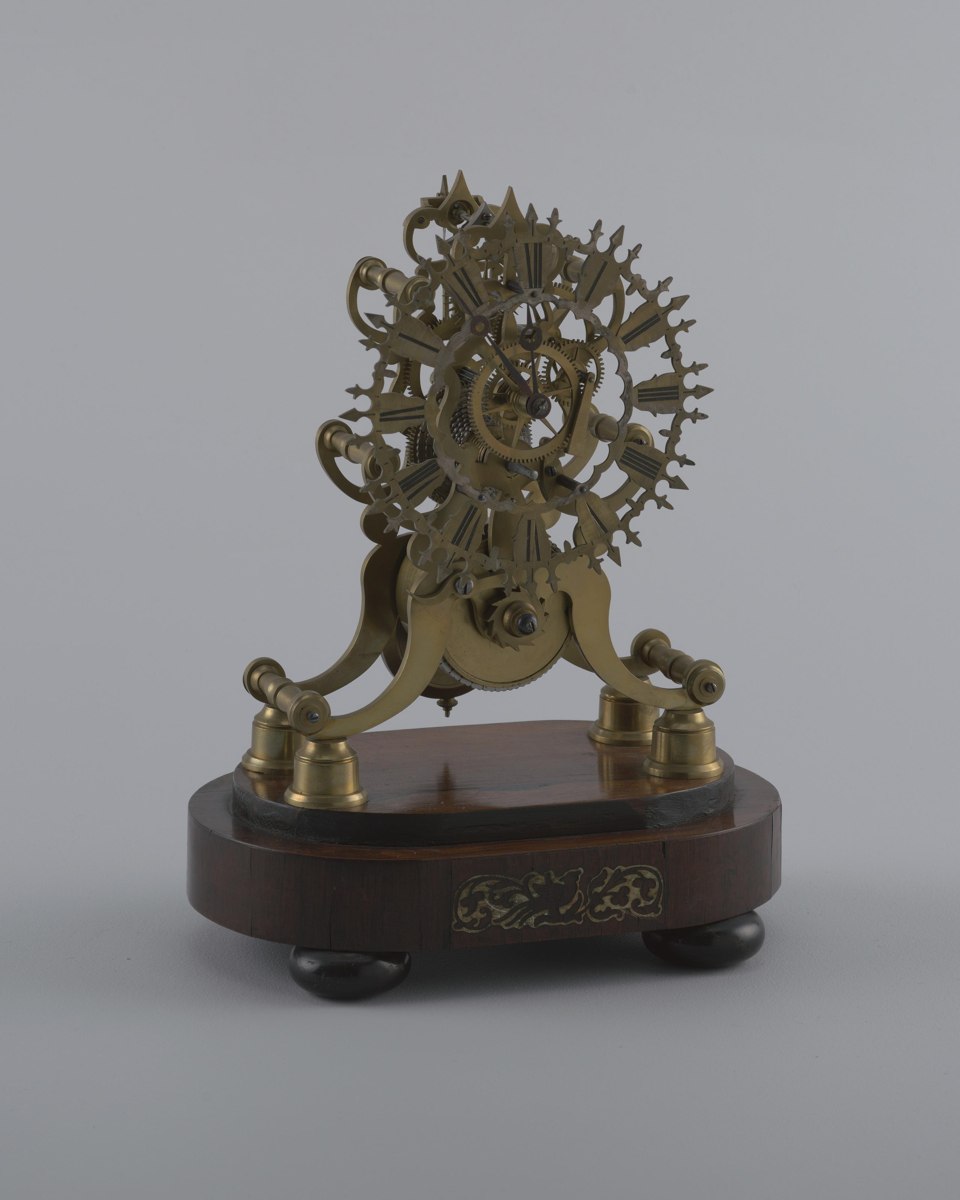
This skeleton clock, dated to circa 1890 and catalogued by Cooper Hewitt as made in Scotland, is mounted on an oval brown wooden base supported by four dark bun feet. The front of the base features an inlay panel of wood and presumed ivory portraying a bird amidst foliage. The clock's openwork brass framework supports a circular pierced brass chapter ring with Roman numerals I through XII, revealing an exposed movement with a fusee and chain drive.

Three-quarter front view of the brass skeleton clock mounted on its wooden base
Three-quarter front view of the brass skeleton clock mounted on its wooden base — Cooper Hewitt, Smithsonian Design Museum. Rights pending — permission not yet requested. Original source

Catalogue identity

Source
www.si.edu
Category
Clock · Skeleton clock
Maker / attribution
Not established
Reference
1967-66-30-a/d
Catalogue / lot identifier
Source URL identifies the listing
Source-reported date
ca. 1890
Country
Scotland

Source-reported attribution and specifications are not independent authentication. A listing does not establish present ownership, current display, availability or permission to reproduce.

Object description

Object Description and Construction

The object is a skeleton clock mounted on an oval wooden base supported by four bun feet. The base features a decorative panel inlaid with wood and a material identified by the museum as 'ivory (?)', displaying a motif of a bird and foliage.

The clock includes a circular brass chapter ring marked with Roman numerals I through XII. The internal brass movement is exposed, featuring a fusee and chain drive.

Evidence for this section
  • “Skeleton clock (a) on oval brown wooden base (d) with four bun feet and ivory (?) and wood decorative panel showing bird amidst foliage.”
  • “Circular brass chapter ring with hours I - XII; exposed brass movement with fusee and chain”

Provenance and Documentation

The clock is catalogued as having been made in Scotland and is dated to approximately 1890. It is held under the accession number 1967-66-30-a/d.

The status of the object is recorded as 'Research in Progress' by the Cooper Hewitt, Smithsonian Design Museum.

Evidence for this section
  • “Clock made in Scotland”
  • “Date ca. 1890”
  • “Accession Number 1967-66-30-a/d”
  • “Catalogue Status Research in Progress”

Associated Components

The museum record identifies two additional components: a fitted glass vitrine (b) and a circular key (c).

These components are listed in the catalogue description, though their current status or physical inclusion with the primary clock unit (a) is not specified in the descriptive text.

Evidence for this section
  • “fitted glass vitrine (b); circular key (c)”

Open research questions

  • What is the specific material identity of the material labeled as 'ivory (?)' in the base inlay?
  • Does the current museum collection status 'Research in Progress' pertain to the attribution of the clockmaker or the authentication of the materials?

Source evidence

Recorded claims and source quotations for Cooper Hewitt Skeleton Clock on Wooden Base
FieldSource-reported valueSource quotation
Dateca. 1890“Date ca. 1890”
OriginScotland“Clock made in Scotland”
Accession Number1967-66-30-a/d“Accession Number 1967-66-30-a/d”
MaterialsBrass, wood, ivory(?)“Medium Brass, wood, ivory(?)”
Dimensions31 x 24 x 16 cm (12 3/16 x 9 7/16 x 6 5/16 in.)“Dimensions H x W x D (Dust Mitigation 2012): 31 x 24 x 16 cm (12 3/16 x 9 7/16 x 6 5/16 in.)”
Movement MechanismFusee and chain“exposed brass movement with fusee and chain”
Dimensions31 x 24 x 16 cm (12 3/16 x 9 7/16 x 6 5/16 in.)“Dimensions H x W x D (Dust Mitigation 2012): 31 x 24 x 16 cm (12 3/16 x 9 7/16 x 6 5/16 in.)”
MaterialsBrass, wood, ivory(?)“Medium Brass, wood, ivory(?)”

Visible details

  • Pierced brass chapter ring with pointed perimeter finials and Roman numerals
  • Open brass frame resting on four brass pillar supports on an oval wooden plinth
  • Oval wooden base with dark bun feet and a decorative inlaid panel on the front face

Research qualifications

  • The glass vitrine (b) and circular winding key (c) mentioned in the catalogue text are not shown in the image.
  • The presence of ivory in the inlaid decorative panel is questioned by the museum cataloguers ('ivory (?)').

Photograph identity and source facts were screened before import; rights clearance remains pending.

Consulted source

Clock | Smithsonian Institution

Reviewed 2026-10-25 · Record 92c8514b0f

Terms in this record

Glossary explanations for terms named in this object’s record.