
Skip to content
The Encyclopedia of Horology

Clock · Wall clock

Cloisonné and Bronze Wall Clock

Partially verified

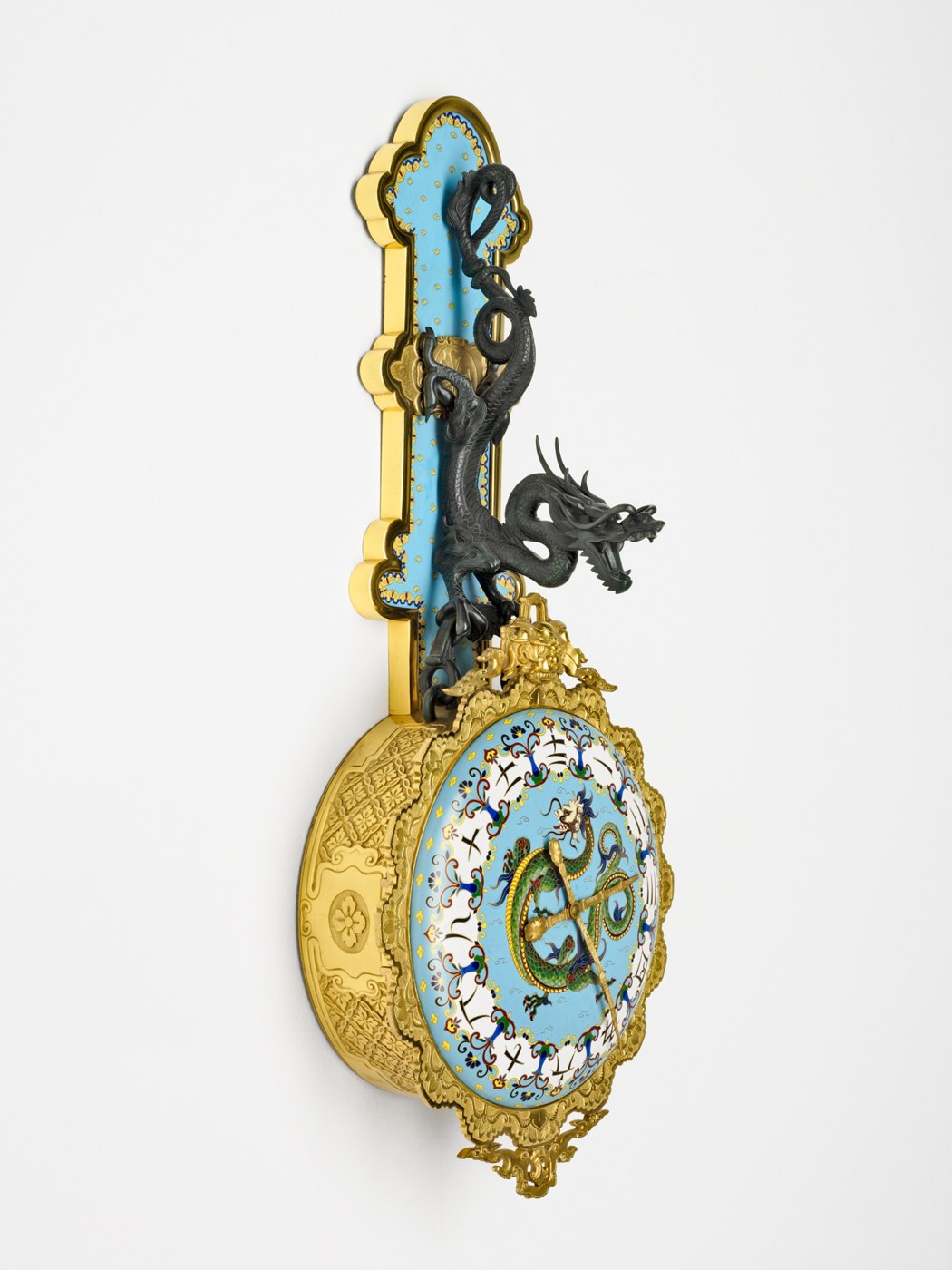
This wall clock is an elaborate decorative object constructed from bronze, gilded bronze, and cloisonné enamel. The clock has a total height of 94 cm and features an elongated, vertical gilded frame supporting a pale blue enamel panel. A dark bronze dragon, sculpted in a dynamic posture, is mounted upon the upper bracket. The circular housing below contains the clock movement and is surrounded by ornate gilded bronze fittings. The enamel dial is prominently decorated with dragon motifs against a light blue background and features Chinese characters to indicate the time. This specific clock was commissioned for the Japanese Parlor within the New York mansion of William H.

Side profile view of the wall clock, showing the elongated frame, the sculpted bronze dragon, and the circular cloisonné enamel dial.
Side profile view of the wall clock, showing the elongated frame, the sculpted bronze dragon, and the circular cloisonné enamel dial. — Art Institute of Chicago. Rights pending — permission not yet requested. Original source

Catalogue identity

Source
orbiscollectibles.com
Category
Clock · Wall clock
Maker / attribution
L’Escalier de Cristal (attributed)
Reference
Not recorded
Catalogue / lot identifier
2008.491
Source-reported date
c. 1880
Source-reported place
France

Source-reported attribution and specifications are not independent authentication. A listing does not establish present ownership, current display, availability or permission to reproduce.

Object description

Construction and Design

The clock is constructed from a combination of bronze, gilded bronze, and cloisonné enamel. Its overall design follows an elongated vertical format measuring 94 cm in height. The upper section consists of a gilded frame featuring an upright bracket with a pale blue enamel field, which serves as a mounting point for a sculpted dark bronze dragon.

The lower section houses the circular clock movement within a frame decorated with ornate gilded bronze mounts. The dial itself is executed in cloisonné enamel on a light blue background, decorated with further dragon and ornamental motifs. The time is marked by Chinese characters rather than traditional numerals, a design choice contributing to the clock's distinct aesthetic.

Evidence for this section
  • “constructed from bronze, gilded bronze, and cloisonné enamel”
  • “features an elongated gilded frame topped by an upright bracket with a pale blue enamel field, upon which rests a sculpted dark bronze dragon”
  • “clock face is decorated with cloisonné enamel, displaying Chinese numbers”

Attribution and Origin

The clock is attributed to the French firm L’Escalier de Cristal, which operated in Paris between 1802 and 1923. The attribution remains qualified, described by the source as probably originating from this workshop. The piece was manufactured circa 1880, a time when such decorative works were frequently exported to the United States for prominent residential collections.

The production of the clock in France coincides with the late nineteenth-century interest in foreign artistic styles. It was specifically acquired for the mansion of William H. Vanderbilt located at 640 Fifth Avenue in New York, where it served as a primary decorative piece in the home's Japanese Parlor.

Evidence for this section
  • “probably by the Paris-based firm L’Escalier de Cristal”
  • “made in France”
  • “acquired in about 1880 for American railroad magnate William H. Vanderbilt”

Historical Context

The clock functioned as a central element of the Japanese Parlor, an interior space designed by the firm Herter Brothers. This room was intended to provide a visual contrast to the European historical interior styles found throughout the rest of the Vanderbilt residence. While Herter Brothers produced the majority of the furnishings for the house, specific artworks were sourced from foreign manufacturers to achieve the intended aesthetic effect.

William H. Vanderbilt resided at the Fifth Avenue mansion for three years following the acquisition of the clock, until his death in 1885. The object is currently held within the collection of the Art Institute of Chicago, indexed under the object number 2008.491.

Evidence for this section
  • “served as a central adornment in the Japanese Parlor”
  • “designed by Herter Brothers that deliberately contrasted with the European historical styles throughout the rest of the mansion”
  • “Vanderbilt resided in the home for three years before his death in 1885”

Open research questions

  • Are there any maker's marks or signatures located on the movement or the reverse side of the casing?
  • Does the clock movement feature any technical specifications or identifiable stamps indicating a specific clockmaker utilized by L’Escalier de Cristal?

Source evidence

Recorded claims and source quotations for Cloisonné and Bronze Wall Clock
FieldSource-reported valueSource quotation
MaterialBronze, gilded bronze, and cloisonné enamel“constructed from bronze, gilded bronze, and cloisonné enamel”
Datec. 1880“Dating to around 1880”
MakerProbably L’Escalier de Cristal“probably by the Paris-based firm L’Escalier de Cristal”
Dimensions94 × 40.6 × 22.9 cm“measures 94 × 40.6 × 22.9 cm (37 × 16 × 9 in.)”
ProvenanceWilliam H. Vanderbilt“acquired in about 1880 for American railroad magnate William H. Vanderbilt”
LocationJapanese Parlor, 640 Fifth Avenue“served as a central adornment in the Japanese Parlor”
Museum Number2008.491“Museum object number 2008.491”

Visible details

  • Vertical gilded bronze frame with pale blue enamel
  • Sculpted dark bronze dragon figure on upper bracket
  • Dial featuring Chinese numeric characters
  • Gilded bronze mounts surrounding the circular housing

Research qualifications

  • Attribution to L’Escalier de Cristal is not confirmed as certain
  • Specific mechanical details of the internal movement are not documented

Photograph identity and source facts were screened before import; rights clearance remains pending.

Consulted source

Wall Clock

Reviewed 2026-11-02 · Record aa7a2d89d7

Terms in this record

Glossary explanations for terms named in this object’s record.