
Skip to content
The Encyclopedia of Horology

Clock · Bracket clock

Clock with Boulle marquetry case

Partially verified

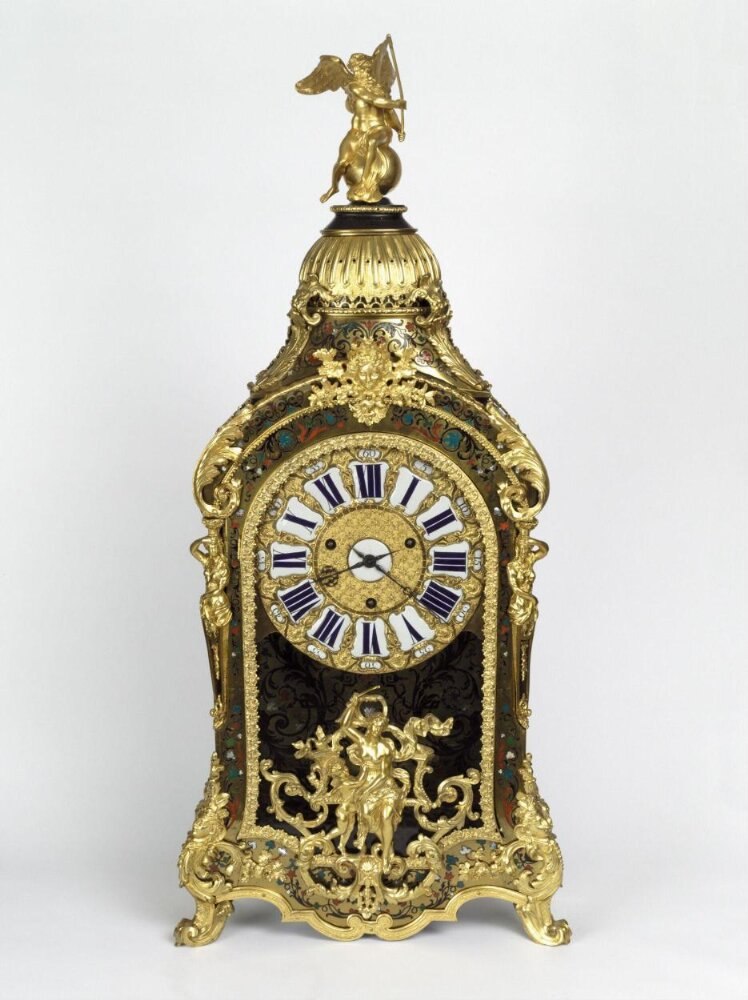
This spring-driven clock features an oak case decorated in boulle marquetry, composed of brass inlaid with tortoiseshell, mother-of-pearl, and pigmented horn. The case is adorned with gilt brass mounts depicting the themes of Time and Love, including a figural group of Venus and Cupid below the dial and a crowning finial of a winged figure of Time on a globe. The brass dial plate contains individual white enamel plaques for the blue Roman numeral hours and black Arabic numeral minutes, complemented by pierced blue steel hands. The movement, signed by Salles of Caen, is a verge escapement mechanism. It features a removable pediment and stands on four scrolling brass feet. The internal surface of the rear door displays a panel depicting Bacchus.

Clock featuring boulle marquetry, gilt brass mounts, and a dial with individual enamel numeral plaques.
Clock featuring boulle marquetry, gilt brass mounts, and a dial with individual enamel numeral plaques. — Victoria and Albert Museum, London. Rights pending — permission not yet requested. Original source

Catalogue identity

Source
collections.vam.ac.uk
Category
Clock · Bracket clock
Maker / attribution
Salles
Reference
M.265:1 to 3-1923
Catalogue / lot identifier
M.265:1 to 3-1923
Source-reported date
1710 - 1750
Source-reported place
France

Source-reported attribution and specifications are not independent authentication. A listing does not establish present ownership, current display, availability or permission to reproduce.

Object description

Case Construction and Decoration

The clock case is constructed of oak and veneered in elaborate boulle marquetry. This decorative technique employs inlaid sheet brass alongside tortoiseshell, mother-of-pearl, and coloured horn, creating intricate floral and foliate patterns. The exterior is further embellished with gilt brass mounts that invoke allegorical themes. Below the dial, a sculptural group features Venus with Cupid, while the edges are accented by draped female figures.

The cresting of the clock is formed by a removable pediment featuring a pierced, ribbed brass dome, which is topped by a finial depicting a winged figure of Time seated upon a globe. Lower corner elements include four additional female masks, and the entire assembly is elevated on four scrolling brass feet. The inner surface of the rear door contains a marquetry panel depicting Bacchus astride a barrel, further decorated with grape vines and masks.

Evidence for this section
  • “The case is ornamented with gilt brass mounts representing the themes of Time and Love.”
  • “Behind this rises a removable pediment, in part formed by a pierced, ribbed dome of brass surmounted by a finial mount in the form of a winged figure of Time seated on a globe.”
  • “The inside surface of the door at the back of the case is decorated with a panel of inlaid brass in the same materials as the clock case, depicting Bacchus astride a barrel”

Movement and Dial

The clock movement is spring-driven and incorporates a verge escapement. It is signed by Salles, a clockmaker active in Caen. The dial consists of a brass plate fitted with individual white-ground enamel plaques. The hours are represented by blue Roman numerals, while the minutes are displayed in smaller black Arabic numeral plaques positioned around the outer edge. The time is indicated by pierced blue steel hands.

Evidence suggests that while the movement was signed in Caen, the case was produced in Paris. The movement's design remains consistent with eighteenth-century production methods. The pendulum and the silk suspension mechanism are absent from the current assembly. Scratched signatures on the internal springs indicate dates in the 1740s, though it is noted that these marks may refer specifically to the production of the springs themselves rather than the completion of the clock.

Evidence for this section
  • “The movement has a verge escapement.”
  • “The brass dial plate is set with enamelled plaques with a white ground, showing the hours in blue Roman numerals with the minutes in black Arabic numerals”
  • “The clock case was almost certainly made in Paris.”
  • “Signature scratched faintly on two springs. This indicates the date on which the springs were made”

Attribution and History

The movement is attributed to Salles of Caen. Historical records for the area identify two potential makers, Jacques and Michel Salles, who were working during the 1750s. The case, however, displays characteristics of earlier Parisian production, with the boulle marquetry style being consistent with work from approximately 1710. The object underwent a restoration during the 19th century.

The provenance includes the acquisition of the clock from a resident of Caen by Sir William Leeson for the price of 300 francs. The piece later entered the museum collection through a bequest by Mrs. R.S. Warburton.

Evidence for this section
  • “Two clockmakers named Salles were recorded as working in Caen in the 1750s”
  • “The clock case was almost certainly made in Paris.”
  • “The clock was bought from a resident in Caen by Sir William Leeson for 300 francs”

Open research questions

  • Does the inscription on the springs definitively correlate to the movement's assembly date or merely a service event?
  • Can the specific Parisian workshop responsible for the case be identified through the maker's marks on the gilt brass mounts?

Source evidence

Recorded claims and source quotations for Clock with Boulle marquetry case
FieldSource-reported valueSource quotation
MakerSalles a Caen“signed `Salles a Caen'”
Case OriginParis“The clock case was almost certainly made in Paris.”
Movement OriginCaen“The clock movement is marked by Salles of Caen, north-west France”
TechniqueBoulle marquetry“A spring-driven clock, in a case of oak, veneered with sheet brass inlaid with brightly-coloured flowers and foliage in tortoiseshell, mother-of-pearl and coloured horn.”
EscapementVerge“The movement has a verge escapement.”
InscriptionBimol [or Binol, or Burol, or Jurot] aout 1743 [or 1745]“Signature scratched faintly on two springs.”

Visible details

  • Case includes gilt brass mounts of Venus and Cupid.
  • Dial features separate white enamel numeral plaques.
  • Winged figure of Time acts as the top finial.
  • Rear door interior features Bacchus marquetry panel.

Research qualifications

  • The pendulum and silk suspension are missing.
  • The exact identity of the Salles clockmaker is uncertain, as records mention both Jacques and Michel Salles in Caen.
  • The scratched signature on the springs may indicate the date of manufacture for the springs rather than the entire movement.

Photograph identity and source facts were screened before import; rights clearance remains pending.

Consulted source

Clock, Salles, Paris, 1710 - 1750

Reviewed 2026-11-02 · Record edf126344c

Terms in this record

Glossary explanations for terms named in this object’s record.