
Skip to content
The Encyclopedia of Horology

Clock · Clock

Clock with base

Partially verified

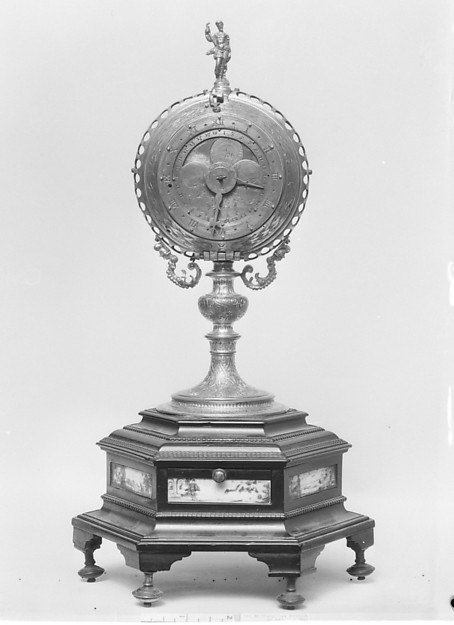
This monstrance-style clock, held in the collection of The Metropolitan Museum of Art under accession number 29.52.10a, b, is dated to the early 17th century. The object comprises two distinct components: the clock itself and a supporting base. Constructed of gilt brass, the monstrance clock features a circular head mounted upon a stem, raised above a substantial hexagonal base. The dial displays intricate internal detail, with the entire assembly exhibiting a decorative aesthetic consistent with the period of production. The dimensions are documented by the museum as 8 7/8 by 4 1/8 inches for the monstrance portion, while the base measures 4 by 6 inches. This record is based on open-access data provided by the museum, which classifies the item under its European Sculpture and Decorative Arts department. Further independent research is required to verify specific manufacture details, as the current attribution remains broad.

A monstrance-style clock on a hexagonal base, dated to the early 17th century.
A monstrance-style clock on a hexagonal base, dated to the early 17th century. — The Metropolitan Museum of Art, New York. Rights pending — permission not yet requested. Original source

Catalogue identity

Source
orbiscollectibles.com
Category
Clock · Clock
Maker / attribution
Not established
Reference
Not recorded
Catalogue / lot identifier
29.52.10a, b
Source-reported date
early 17th century
Source-reported place
Not established

Source-reported attribution and specifications are not independent authentication. A listing does not establish present ownership, current display, availability or permission to reproduce.

Object description

Construction and Design

The object is classified by the museum as a clock with a base, divided into two specific components identified as 10a (monstrance) and 10b (base). The primary timekeeping element is a monstrance-style head, which is circular and supported by an ornate, elevated stem. The visual aesthetic of the piece is defined by the use of gilt brass, which appears across the visible surfaces of the clock head and the supporting column.

The base, which supports the entire structure, is distinct in shape and decoration compared to the clock head. It exhibits a hexagonal profile, adding stability and visual weight to the composition. The construction incorporates panels that feature imagery, contrasting with the metallic surface of the upper clock assembly. The overall design occupies a total height of approximately 12 7/8 inches when the components are combined.

Evidence for this section
  • “Brass gilt”
  • “Overall (monstrance.10a): 8 7/8 × 4 1/8 in. (22.5 × 10.5 cm); Overall (base.10b): 4 × 6 in. (10.2 × 15.2 cm)”

Documentation and Attribution

This clock is formally catalogued within the European Sculpture and Decorative Arts department of The Metropolitan Museum of Art. The documentation provides a date for the object as being from the early 17th century. This chronological placement remains the primary historical marker provided by the institution for the artifact.

The administrative details of the clock, including its museum accession number and its internal object ID, facilitate its identification within the museum's digital archives. While the museum maintains the record, there are no specific catalogue numbers or identified makers attributed to the piece in the provided documentation, leaving the exact provenance or specific workshop origin as an area requiring further investigation.

Evidence for this section
  • “The museum dates it early 17th century.”
  • “catalogued by the museum's European Sculpture and Decorative Arts department”
  • “Met object 29.52.10a, b (ID 196399)”

Status and Research

The record is derived from the museum's open-access online collection. The source notes that while the information is transcribed, the broader context of the object, such as how it relates to other documented horological types from the same period, has not been independently verified.

Current research priorities for the object include confirming its maker and refining the dating through comparison with other period-specific horological references. The documentation emphasizes that the information provided is based solely on the museum's public record and awaits further expert validation to determine the wider significance of the specimen.

Evidence for this section
  • “These details are transcribed from the museum's open-access record; how far this object represents a wider collectible type has not yet been independently verified.”
  • “Research required: confirm the wider type, maker and date against a specialist reference.”

Open research questions

  • What is the specific horological mechanism housed within the gilt brass monstrance case?
  • Can the painted scenes on the hexagonal base be attributed to a specific region or artistic influence of the early 17th century?

Source evidence

Recorded claims and source quotations for Clock with base
FieldSource-reported valueSource quotation
MuseumThe Metropolitan Museum of Art, New York“Clock in The Metropolitan Museum of Art, New York”
Accession number29.52.10a, b“29.52.10a, b”
Dateearly 17th century“early 17th century”
MaterialBrass gilt“Brass gilt”
Dimensions monstrance8 7/8 × 4 1/8 in. (22.5 × 10.5 cm)“8 7/8 × 4 1/8 in. (22.5 × 10.5 cm)”
Dimensions base4 × 6 in. (10.2 × 15.2 cm)“4 × 6 in. (10.2 × 15.2 cm)”
Object ID196399“196399”

Visible details

  • The clock head is circular with a decorative, pierced border.
  • A small human figure finial is positioned at the top of the clock.
  • The hexagonal base features panels with painted or inlaid scenes.

Research qualifications

  • The broader type, maker, and specific place of origin are not confirmed by the source.
  • The functional internal movement mechanisms are not detailed in the provided documentation.

Photograph identity and source facts were screened before import; rights clearance remains pending.

Consulted source

Clock with base, early 17th century

Reviewed 2026-11-02 · Record d40e9eeca0

Terms in this record

Glossary explanations for terms named in this object’s record.

Other clock records