
Skip to content
The Encyclopedia of Horology

Clock · Clock

Simon Willard Clock

Partially verified

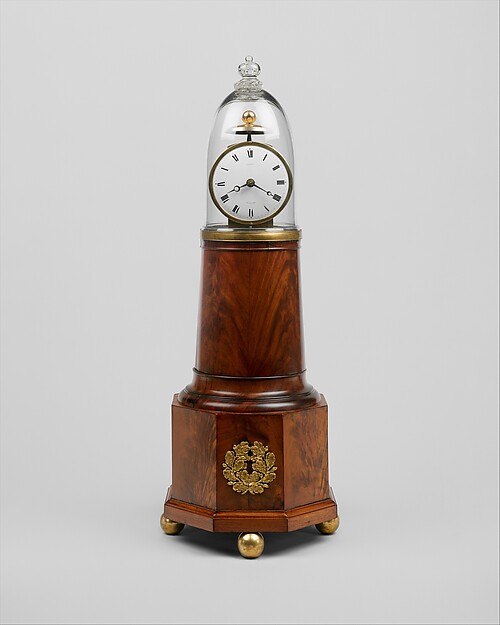
This clock was made by the American clockmaker Simon Willard (1753–1848). Dating to 1825–30, the timepiece was produced in Roxbury, Massachusetts. The object is constructed from mahogany, mahogany veneer, white pine, brass, and glass. It stands 29 1/2 inches (74.9 cm) in height and measures 10 1/4 inches (26 cm) in both width and depth. The clock features a circular dial with Roman numerals, enclosed within a protective glass dome. The base is an octagonal shape, decorated with a brass mount featuring leaf ornamentation, and supported by spherical feet. The Metropolitan Museum of Art holds this timepiece as part of its collection.

Full view of the clock, showing the glass dome, dial, and octagonal base.
Full view of the clock, showing the glass dome, dial, and octagonal base. — The Metropolitan Museum of Art — Gift of Mary B. Walton, in memory of her husband, John S. Walton, 1991. Rights pending — permission not yet requested. Original source

Catalogue identity

Source
orbiscollectibles.com
Category
Clock · Clock
Maker / attribution
Simon Willard
Reference
Not recorded
Catalogue / lot identifier
1991.185
Source-reported date
1825–30
Source-reported place
United States

Source-reported attribution and specifications are not independent authentication. A listing does not establish present ownership, current display, availability or permission to reproduce.

Object description

Construction and Design

The clock is composed of various materials, including mahogany and mahogany veneer over a white pine core. It features a brass-mounted circular dial which is protected by a glass dome. The base of the clock is octagonal in geometry and displays a central decorative brass appliqué showing leaf motifs. The entire structure is raised upon spherical feet.

The clock measures 29 1/2 inches in height, with a base footprint of 10 1/4 by 10 1/4 inches. These dimensions identify the object as a compact, potentially decorative or table-top timekeeping instrument designed for the American market during the early nineteenth century.

Evidence for this section
  • “Mahogany, mahogany veneer, white pine, brass, glass.”
  • “Recorded dimensions: 29 1/2 x 10 1/4 x 10 1/4 in. (74.9 x 26 x 26 cm).”

Maker and Context

Simon Willard (1753–1848) was an American clockmaker who operated his workshop in Roxbury, near Boston, Massachusetts. After initial work in Grafton, Willard established an independent factory to produce timepieces that were among the first economically accessible clocks in the United States.

Throughout his career, Willard introduced numerous improvements to timekeeping. While he is most noted for the development of the eight-day patent timepiece, his shop also produced a range of domestic and institutional clocks. This specific clock, catalogued as 1991.185 at the Metropolitan Museum of Art, represents the output of his established factory period between 1825 and 1830.

Evidence for this section
  • “Simon Willard (1753–1848) was an American clockmaker who operated in Massachusetts.”
  • “His Roxbury workshop produced domestic and institutional clocks for the American market.”
  • “The Metropolitan Museum of Art holds this object as 1991.185”

Provenance and Documentation

The object is held in the collection of The Metropolitan Museum of Art under the accession number 1991.185. It was received by the museum as a gift from Mary B. Walton, in memory of her husband, John S. Walton, in 1991.

As a museum-held object, it is documented with specific materials and dimensions. The details provided represent the record of this specific specimen, though the broader categorization of the object type remains an area for further investigation against specialized horological references.

Evidence for this section
  • “The Metropolitan Museum of Art holds this object as 1991.185”
  • “Gift of Mary B. Walton, in memory of her husband, John S. Walton, 1991”

Open research questions

  • What is the specific movement mechanism contained within the clock?
  • Does this design correspond to a named model series within Willard's broader production output?

Source evidence

Recorded claims and source quotations for Simon Willard Clock
FieldSource-reported valueSource quotation
MakerSimon Willard“Clock made by Simon Willard (1753–1848)”
Date1825–30“dated 1825–30”
MaterialsMahogany, mahogany veneer, white pine, brass, glass“Mahogany, mahogany veneer, white pine, brass, glass.”
Dimensions29 1/2 x 10 1/4 x 10 1/4 in. (74.9 x 26 x 26 cm)“Recorded dimensions: 29 1/2 x 10 1/4 x 10 1/4 in. (74.9 x 26 x 26 cm).”
Holding InstitutionThe Metropolitan Museum of Art“The Metropolitan Museum of Art holds this object as 1991.185”
GeographyRoxbury, Massachusetts, United States“Made in Roxbury, Massachusetts, United States”

Visible details

  • Circular dial with Roman numeral indices
  • Protective glass dome housing the dial
  • Octagonal wooden base with central foliate brass mount
  • Spherical brass feet

Research qualifications

  • The specific horological mechanism is not detailed in the source
  • The exact functional designation of this specific clock model remains subject to further research

Photograph identity and source facts were screened before import; rights clearance remains pending.

Consulted source

Clock, Simon Willard, 1825–30

Reviewed 2026-11-02 · Record d6d01bfc5b

Terms in this record

Glossary explanations for terms named in this object’s record.

Other clock records