
Skip to content
The Encyclopedia of Horology

Wristwatch · Baguette wristwatch

Cartier Baguette à mouvement Duoplan Bracelet Watch

Partially verified

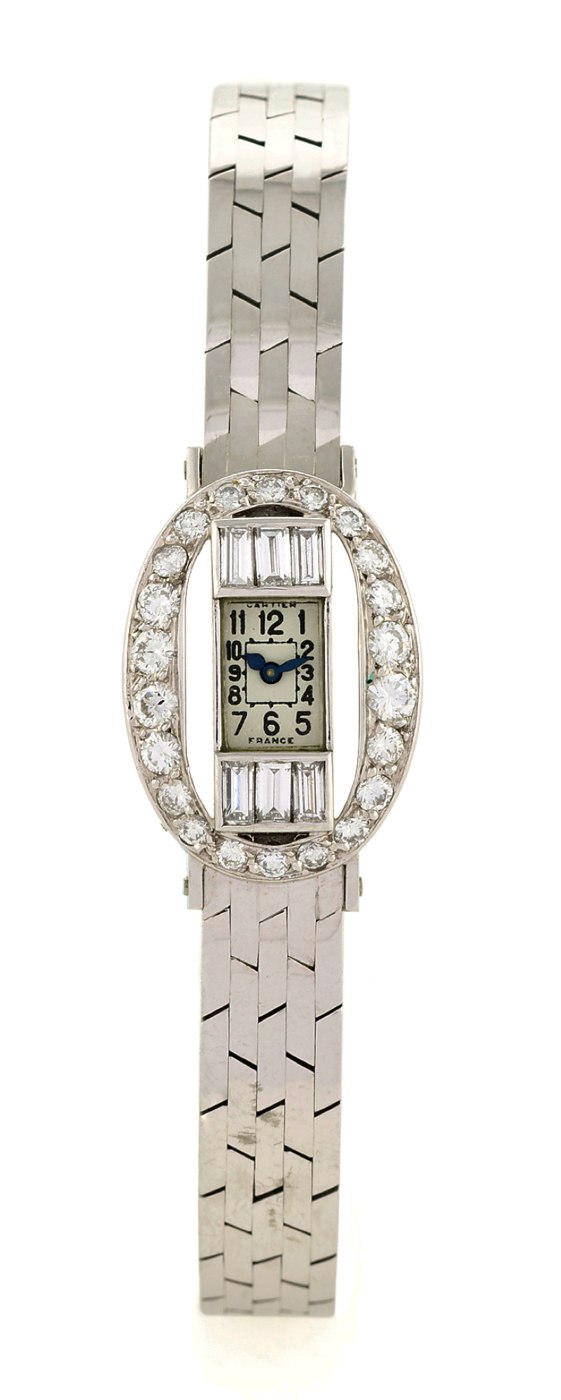
This Cartier wristwatch, catalogued as a Baguette à mouvement Duoplan, dates to circa 1940. The piece features a platinum oval case measuring 19.5 x 14 mm with a thickness of 5 mm. The case is decorated with six baguette diamonds at the upper and lower edges and twenty-two round diamonds along the oval border. It is fitted with an integral 18K white gold tile-link bracelet and a concealed deployant clasp numbered 3789. The dial is white with painted black Arabic numerals and blued steel lozenge hands. The watch is powered by a rhodium-plated Calibre 101 movement, featuring 15 jewels, a lateral lever escapement, and a cut bimetallic compensation balance.

Front view of the Cartier platinum and diamond wristwatch, showing the diamond-set bezel, dial, and tile-link bracelet.
Front view of the Cartier platinum and diamond wristwatch, showing the diamond-set bezel, dial, and tile-link bracelet. — Antiquorum. Rights pending — permission not yet requested. Original source

Catalogue identity

Source
catalog.antiquorum.swiss
Category
Wristwatch · Baguette wristwatch
Maker / attribution
Cartier
Reference
920287/49104
Catalogue / lot identifier
67
Source-reported date
circa 1940
Source-reported place
France
Source-reported serial
920287/49104

Source-reported attribution and specifications are not independent authentication. A listing does not establish present ownership, current display, availability or permission to reproduce.

Object description

Case and Dial Construction

The timepiece features a two-body platinum case designed in an oval shape. The aesthetic is defined by its diamond setting, which includes six baguette-cut diamonds positioned at the top and bottom of the case, supplemented by twenty-two graduated round diamonds surrounding the bezel. The back of the case is secured with two screws and incorporates a back-winding mechanism to maintain the profile of the piece.

The dial is finished in white with black painted Arabic numerals and blued steel lozenge-shaped hands. The overall dimensions are 19.5 by 14 mm with a thickness of 5 mm. The total length of the watch and integral 18K white gold tile-link bracelet is approximately 150 mm.

Evidence for this section
  • “Two-body, polished and brushed, the upper and lower edges set with six baguette diamonds, oval border further set with 22 graduated round diamonds, back with 2 screws, back winder.”
  • “White with painted black Arabic numerals. Blued steel lozenge hands.”

Movement and Technical Specifications

The watch is driven by a Calibre 101 baguette-style movement. This caliber is rhodium-plated and decorated with fausses cotes. It utilizes 15 jewels and features a lateral lever escapement along with a cut bimetallic compensation balance adjusted to two positions. The oscillation is managed by a blued steel Breguet balance spring and an index regulator.

This movement type was originally conceptualized by Henri Rodanet to provide an efficient wheel train for ultra-small watches.

Evidence for this section
  • “Cal. 101, baguette, rhodium-plated, fausses cotes decoration, 15 jewels, lateral lever escapement, cut bimetallic compensation balance adjusted to two positions”
  • “The Duoplan movement itself was the idea of Paris watchmaker Henri Rodanet”

Signatures and Provenance

The watch exhibits signature markings consistent with Cartier's manufacturing records. Both the dial and the case are signed with the Cartier name and internal serial identifiers. The movement is also signed by Cartier.

Technical provenance is evidenced by the punch mark 'EJ' found on both the case and the concealed deployant clasp. This mark identifies the work of Edmond Jaeger, confirming the historical collaboration between Jaeger-LeCoultre and Cartier for the production of these specific movements and casings.

Evidence for this section
  • “Dial and case signed Cartier and with Cartier numbers, movement signed Cartier”
  • “case and deployant clasp punched EJ for Edmond Jaeger.”

Open research questions

  • What is the specific historical significance of the Cartier serial number 920287/49104 in relation to the Duoplan production records?
  • Does the 'EJ' punch mark relate to a specific period of cooperation between Edmond Jaeger and Cartier regarding the Calibre 101?

Source evidence

Recorded claims and source quotations for Cartier Baguette à mouvement Duoplan Bracelet Watch
FieldSource-reported valueSource quotation
MakerCartier“Cartier, "Baguette à mouvement Duoplan", No. 920287/49104.”
Datecirca 1940“Made circa 1940.”
Case dimensions19.5 x 14 mm“DIM. 19.5 x 14 mm.”
MovementCalibre 101“Cal. 101, baguette, rhodium-plated, fausses cotes decoration”
Jewel count15“15 jewels”
Bracelet clasp number3789“concealed Cartier deployant clasp, No. 3789.”
Punch marksEJ“case and deployant clasp punched EJ for Edmond Jaeger.”

Visible details

  • Oval case with diamond-set border
  • Integral tile-link white gold bracelet
  • Back-winding case construction with two visible screws
  • Dial marked with Cartier signature and France

Research qualifications

  • Overhaul status is noted as required by the auction house
  • Specific metallurgical composition of the platinum and gold components is reliant on the auction report

Photograph identity and source facts were screened before import; rights clearance remains pending.

Terms in this record

Glossary explanations for terms named in this object’s record.